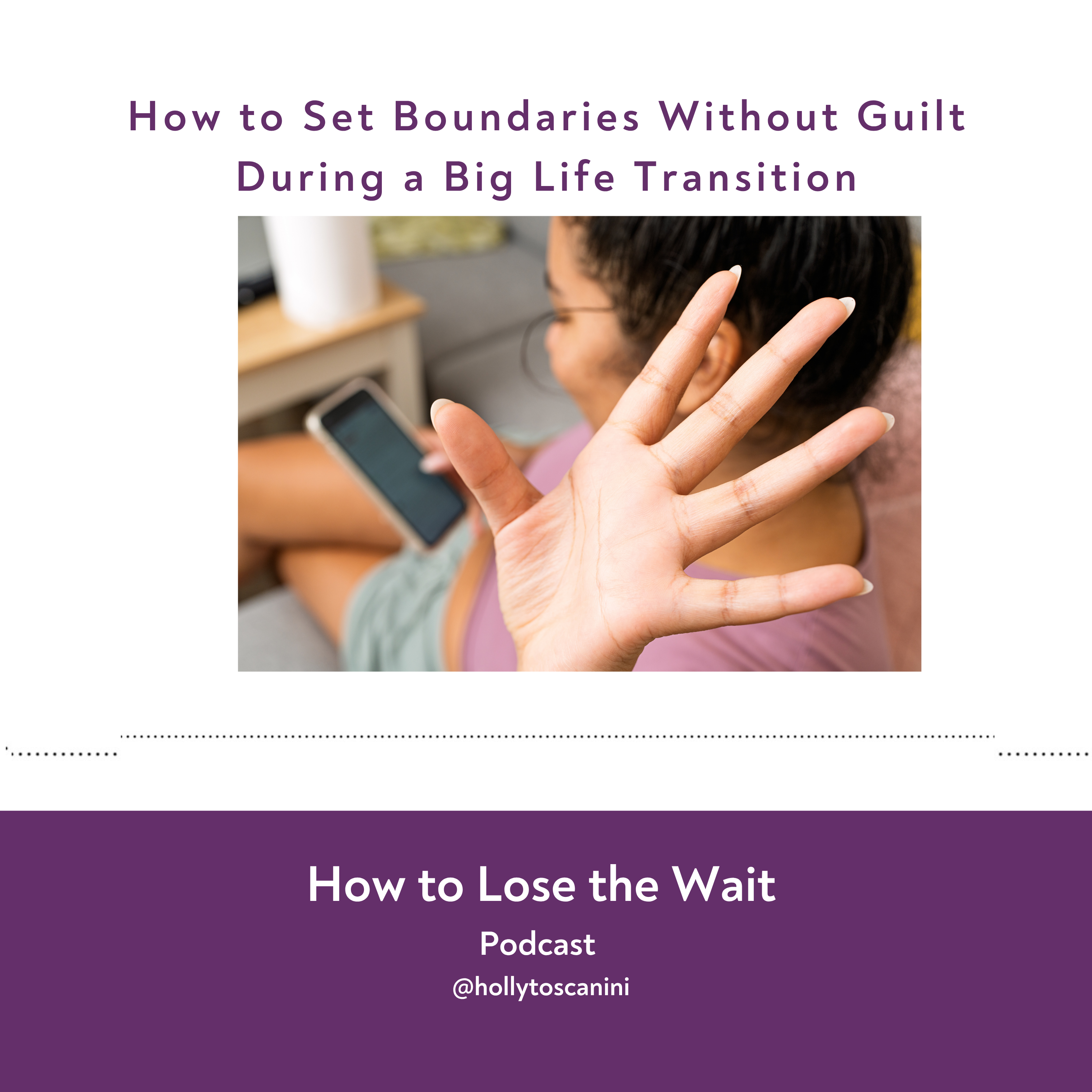
139. How to Set Boundaries Without Guilt During a Big Life Transition
About this episode
Big life transitions like an empty nest, menopause, or a career change can open up room in your life, and the old habit of saying yes often fills it right back up. In this episode of How to Lose the 'WAIT,' life coach Holly Toscanini explains how to set boundaries without guilt during a big life transition.
Holly walks through where the pull to people-please comes from, including Good Girl Syndrome and the fawn response, why it tends to get louder when your role changes, and what it quietly costs you. Then she shares three small practices to start this week: noticing your script, setting one low-stakes boundary, and letting guilt become useful information.
In this episode:
- Why people-pleasing often gets stronger after the kids leave, during menopause, or in a career change
- What Good Girl Syndrome is and where it comes from
- A 2010 study on why women apologize more than men
- How the fawn response makes a reasonable boundary feel physically scary
- Three simple phrases for saying no without over-explaining
- How small boundaries build self-trust over time
Resources mentioned:
The "What's Next?" Self-Coaching Session (free): https://withme.so/hollytoscanini/lead_542
When You Can't Stop Second-Guessing Yourself, a 5-day private podcast https://withme.so/hollytoscanini/dm_7519
Research referenced: Schumann, K., & Ross, M. (2010). Why women apologize more than men: Gender differences in thresholds for perceiving offensive behavior. Psychological Science. The fawn response is a term from therapist Pete Walker.
Licensed Podcast music https://uppbeat.io/t/mood-maze/trendsetter License code: VGZ66UBEGXBP8YK8
Holly Toscanini: For about 20 years, your Tuesday evenings belonged to everybody else. Maybe that meant soccer practice, homework, dinner for four, and somebody's science project that was due tomorrow and somehow became your science project. Or maybe it meant the office, the late meetings, the client who only called after six, and the inbox you cleared the kitchen counter while your dinner went cold. You built a career and it took every evening you had to give. Then something shifts. Maybe the youngest. Child moves out, or you leave the job, retire early, or finally step back from the role that just ran your calendar. One Tuesday, you realize the whole evening is yours, and you feel something you haven't felt in a long time. Space. Three weeks later, Tuesday's full again. You said yes to the fundraising committee. You said yes to driving your neighbor to her appointments, and you said yes to your sister who needed help with something that was only going to take an hour, tops, and it took four. Your life changed. But your "yes" stayed exactly the same. Hello, and welcome back to How to Lose the Weight, the podcast where we talk about what it really takes to stop postponing your life and start trusting yourself. I'm your host, Holly Toscanini. Today we're talking about how to set boundaries without guilt during a big life transition. Now that could be an empty nest, menopause, a career change, or the end of a relationship. Anything that shifts the shape of how you. Run your days. We'll look at where the pull to say yes comes from, why it tends to get louder when life changes, and what it costs you. And then I'm gonna walk you through three small but effective practices you can start this week. And at the end, I'll tell you about a free resource for figuring out what comes next for you. Now, there's a name for the pattern in that Tuesday story. A lot of people call it Good Girl Syndrome. You're not gonna find it in a diagnostic manual, it's a name. For cultural conditioning, a a set of rules that many of us absorbed really early in our childhood. Your worth depends on how agreeable, helpful, and easy to be around you are. Keep everybody comfortable. Don't make a fuss. Smile. It shows up in ordinary ways. You apologize when somebody else bumps into you. You say, I'm fine when you're not, which to me always stood for freaking irritated, not explaining. You hear yourself agreeing to something while a voice in your head is saying very clearly, no. Now, most of us don't notice we're doing it. It's been running so long that it just feels like who we are. Now, I'm going to use the word patriarchy here, and I want to be clear about what I mean. I'm describing a system, a very old one, that rewards women for being quiet, accommodating, and staying small. The men in your life are welcome to keep listening. Think about how early all that starts. A little girl who says what she wants gets called bossy. A teenager who sets a boundary is somehow dramatic. A woman who knows her worth is intimidating. And a mother who takes time for herself is selfish. So we learn. We get very fluent in other people's needs and a little rusty on our own. Now there's a study I love on this. 2010 researchers Karina Schumann and Michael Ross published a paper in Psychological Science looking at why women apologize more than men. And what they found was really interesting. When men and women felt they'd done something wrong, they apologized at about the same rate. The difference was that women saw more of their behavior as needing an apology in the first place. And that matches with what I see in the women I work with. When you've been trained to keep everybody comfortable, a lot of ordinary things start to feel like a failure on your part. Disagreeing, asking for something, saying no. Now I want to say this with compassion. This pattern made sense. For many of us, it was a smart way to stay safe, stay liked, and stay employed. It kept the peace in families where peace was pretty hard to come by. You learned it for good reasons. And now you're allowed to let it go. So why does this get louder during a transition? Well, for most of your adult life, a role has organized your yeses. Mom, manager, wife, daughter, employee, the dependable one. The role where your time and energy went and the good girl rules fit pretty neatly inside it. When the role changes, The rules keep going. They just look for somewhere new to take root. With an empty nest, the time that opens up gets quietly claimed by other people, often before you've had a chance to ask yourself what you want to do with it. With menopause, your body is asking for something different. More rest, maybe, more patience with yourself. And the old rule says to push through and not complain because nobody wants to be the woman who makes her hot flashes everybody's problem. And with a career change, whether you left, got pushed out, or you're thinking about something entirely new, you finally have room to ask what you want. And that's usually when a familiar voice shows up to ask, "who do you think you are?" Transitions are uncomfortable, but they can also shake things loose. When your routines change, the script you've been following gets easier to see because the old structure isn't holding it up anymore. And that makes these moments some of the best times to question it and start writing something that fits who you are now. Let's talk about what it costs to keep saying yes on autopilot. The first cost is losing track of what you want. I hear this from women all the time. I've spent so long taking care of everyone else that I don't know what I want anymore. Whenever yes goes out, your own preferences get Quieter, and after enough years, they can be hard to hear at all. The second cost shows up in your relationships. People pleasing makes them lopsided. You become the one who absorbs the extra work, smooths over the tension, and remembers everybody's birthday. And people learn to expect it. So when you finally set a boundary, some of them are going to push back. And that usually means that the terms of the relationship changed and they noticed. The people who care about you will adjust. Some won't. And that's useful information too. The third cost is guilt. You know you're stretched thin. You know you need to say no. And the second you start to, that inner critic arrives. You're being difficult. You're gonna let them down. Who do you think you are? Guilt is strong enough that many women decide it's easier to say yes and be done with it. So they do again and again. And that's how the waiting happens. You postpone what you want until everyone else is taken care of. And my friend, that day has a way of never quite arriving. So before we get into the practices, I want to spend a minute on your body, because it's usually the first to know. Think about the last time you agreed to something you didn't want to do. There's a good chance you felt it. A tight stomach, a clenched jaw, a heaviness after you hung up the phone. Intuition often speaks through sensation before you found the words. Now, there's a therapist named Pete Walker, and he has a name for one piece of this. He calls it the fawn response. Most of us have heard of fight, flight, and freeze. Fawning is a stress response where we try to stay safe by pleasing and appeasing. It can kick in before you've consciously decided anything. And that's why setting a boundary can feel physically scary, even when the boundary is completely reasonable. At some point, your body learned that keeping people happy kept you safe, and it's been doing its job ever since. You can teach it something new. That happens slowly. Through small experiences of saying no and noticing that you're okay. So let's get practical. Grab your journal if it's nearby. Practice number one: notice your script. Before you change a pattern, it helps to see it clearly. So I want you to take five quiet minutes in the morning, sit with your coffee, your tea, and take a few slow deep breaths and ask yourself two questions. Whose approval am I afraid of losing? Where am I saying yes when I want to say no? Write down whatever comes up without editing or judging it. You may notice the same few names appearing, and you may hear a phrase you absorbed as a kid, something like don't be rude, or family comes first. That's your script. Seeing it is the first step. Practice two: one small boundary. Start somewhere low stakes. The bake sale request. The meeting that could have been an email. The friend who always calls during dinner. Build the muscle there before you take on the conversation with your mother in law. When a request comes in, pause before you answer and check in with your body. Notice whether you feel tight or settled. Then try one of these. I need some time to think about that. That doesn't work for me. thanks for thinking of me. I need to pass this time. You'll probably feel the urge to explain or justify or apologize. You don't owe anyone a long explanation. A short, kind no is complete. Practice three: let guilt be information. After you say no, the guilt will probably show up. That feeling is your nervous system reacting to something unfamiliar. It's uncomfortable. And it's also a sign you did something new. Notice it, name it. You might even say to yourself, I feel guilty, and I made the right call for me. Both of those can be true at the same time. Now, a few episodes ago, I talked about evidence over emotion, the idea that self-trust gets built through a track record. Boundaries are one of the quickest ways to build that record. Every small no you keep shows that you can count on yourself. And you don't have to do this perfectly. Your voice can shake, you can overexplain first few times. Practice is enough. Now, if you're in the middle of a transition and trying to figure out what comes next, I made something for you. It's called the What's Next self-coaching session. It's free. You can do it on your own time. And it'll help you get clearer about your next step. The link is in the show notes. And if second guessing is what keeps pulling you back into yes, my five day private podcast, When You Can't Stop Second Guessing Yourself, was made for that. It's five short episodes, one a day, to help you make one important decision and feel confident moving forward. That link's in the show notes, too. Let's go back to that Tuesday evening for just a moment. This week, pick One request. Pause before you answer, notice what your body tells you, and let that shape your answer. A transition can feel like losing the shape of your life the way you used to have it. It can also be a chance to decide what goes into the next new chapter. Because your next chapter gets to have new rules, and you're the one who gets to write them. Thank you for being here, friends. Take good care of yourself this week. And I'll see you next time. Bye for now.
 Apple Podcasts
 Spotify
 Castbox
 Castro
 Goodpods
 Moon FM
 Overcast
 Pocket Casts
 Podbean
 Podcast Addict
 Podcast Republic