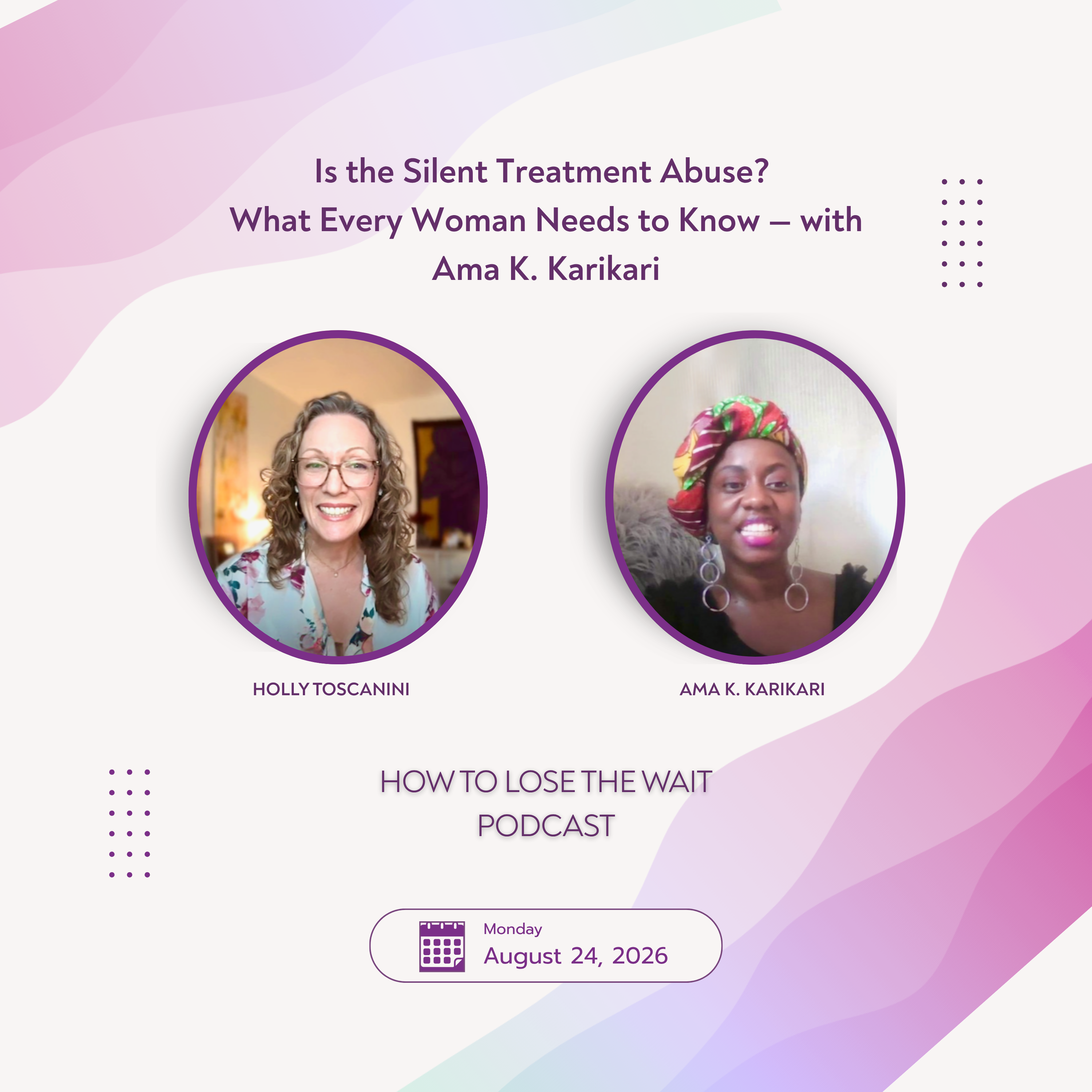
130. Is the Silent Treatment Abuse? What Every Woman Needs to Know — with Ama K. Karikari
About this episode
Ama K. Karikari spent 15 years in a marriage defined by chronic silent treatment before recognizing it as abuse. Here’s what she learned.
Sometimes the hardest relationships to leave are the ones that don’t look obviously harmful from the outside. There may not be a single incident you can point to or a piece of evidence that makes everyone around you immediately understand what you’re feeling. Instead, there’s withdrawal, punishment, confusion, and a growing sense that you can’t trust your own interpretation of what’s happening anymore.
My guest today, Ama K. Karikari, spent fifteen years experiencing chronic silent treatment in marriage before recognizing it as a form of emotional harm. Today she helps other women and mothers find language for experiences they may have struggled to explain even to themselves.
In this conversation, you'll learn:
- What the silent treatment actually is — and the critical distinctions between it, a cooling off period, and involuntary stonewalling
- Why the silent treatment triggers the same neurological pain centers as physical violence
- Why it’s so hard for others — friends, family, even clinicians — to recognize it as abuse when there’s no visible evidence
- How chronic silent treatment erodes self-trust over time and causes women to doubt their own perception
- The four potential outcomes of staying in a narcissistic relationship, according to research
- The one safest first step for a woman who still feels confused or afraid to trust her own experience
Ama’s free resources
Find both in the links below.
Website: https://www.amakkarikari.com/
Instagram: https://www.instagram.com/amakkarikari/
LinkedIn: https://www.linkedin.com/in/amakarikariyawson/
eBook — Silenced to Soaring: Heal from Chronic Silent Treatments, Toxic Relationships and Abuse: https://www.amakkarikari.com/
Soaring Sisters Community — guided lessons, practical exercises, community webinars, and optional weekly peer support circles: https://www.skool.com/silenced-to-soaringmoms/about
the silent treatment, chronic silent treatment, emotional abuse in marriage, narcissistic abuse recovery, silent treatment in relationships, emotional harm women, how to recognize emotional abuse, self-trust after abuse, toxic relationship recovery, mothers in abusive relationships, Ama K. Karikari, Silenced to Soaring, gaslighting and silence, narcissistic tendencies, rebuilding self-trust after toxic relationship
https://uppbeat.io/t/mood-maze/trendsetter
License code: VGZ66UBEGXBP8YK8
Holly Toscanini: You know, sometimes the hardest relationships to leave are the ones that don't look obviously harmful from the outside. There may not be a single incident that you can point to or a piece of evidence that's gonna make everybody around you immediately understand what you're feeling. Instead, there's withdrawal, punishment, confusion, and a growing sense that you can't trust your own interpretation of what's happening anymore. My guest today, Ama K. Karikari, spent years experiencing chronic silent treatment intermarriage before recognizing it as a form Of emotional harm. Today, she helps other mothers find language for experiences they may have struggled to explain even to themselves. Alma is an author, speaker, attorney, and transformational guide whose work helps mothers understand emotional harm, recover from toxic relationships, and rebuild trust in themselves. She is the author of Silenced to Soaring, an empowerment workbook for mothers who are separated, divorced, or recovering from emotional abuse, including. Chronic silent treatment. Now her background spans law, finance, educational, organizational consulting, and cultural awareness. And she holds degrees from Harvard, the University of Pennsylvania Law School, and Wharton. Plus, she has appeared on programs including The Today Show, Al Jazeera's the Stream, and Fox Business. Alma, welcome to How to Lose the Weight.
Ama K. Karikari, Esq.: Woo so happy to be here. Thank you for having me, Holly.
Holly Toscanini: I'm glad you're here. I really loved your story and was so excited when you agreed to be a guest. U I just want to dive right in and ask, when you use the term silent treatment, what exactly are you describing?
Ama K. Karikari, Esq.: I'm very grateful for you asking that because this is an issue which has caused great confusion for many, including myself. So in my book, Silence is Soaring, Heal from Chronic Silent Treatments, Toxic Relationships and Abuse, I define the silent treatment this way. One, it is the sudden withdrawal of communication and emotional connection paired with hostile, angry energy, usually for a period of 24 hours or more. And without repair. Now, I think this is very crucial because when you are reading the literature, very often it can be confusing, and the silent treatment can be confused with two other issues, one being a cooling off period. Some people say, it wasn't the silent treatment, the person wasn't cool, was just cooling off. I would like to say there are huge distinctions. One, a cooling off period typically is done with warning. my goodness, Holly. I I really can't talk about this right now. I'm afraid I'm gonna say something that is not valid or not right. I need 24 hours to cool off, then we'll regroup. That's a cooling off period. There was an actual statement of intent. Hey, the person needs time to process it. It was with warning, a certain time period was given, and there is repair afterwards, and there's communication about what happened afterwards. That is not what I'm talking about. The silent treatment. Does not have that intent intentionality, it does not have that bound, those boundaries, and it does not have that repair. There's another thing which is often confused for the silent treatment, which is also painful, but is not abusive. And I refer to that in my book as involuntary stonewalling. So that's when a person is flooded. The person has a maladaptive response. Let's say you say the words, why on earth would you do that? And the person has a history, maybe a Father or mother said it, and why on earth would you do that in the past was the was was paired with physical violence. And so when you say, Why on earth would you do that? the person gets this involuntary, maladaptive response where the person freezes, runs away, hops in their car and has to go somewhere or what have you. That is also very bad. I'm not saying that that does not cause challenges in relationships, but it was involuntary. And usually when the person becomes more regulated, the person will come back and have a conversation. So it does not meet my definition of the silent treatment. The person who involuntary stonewalls is able to have a conversation of repair afterward. Now that person may need counseling, EMDR, prayer, Reiki, whatever is is in that person's holistic.
Holly Toscanini: Right.
Ama K. Karikari, Esq.: Remedy for resolving the maladaptive response, but it's not abuse because it's not intentional. We know the silent treatment is intentional because the person comes back and refuses to deal with it. It is a manipulation tactic.
Holly Toscanini: Great answer. So is this a form of narcissism?
Ama K. Karikari, Esq.: So I would say this: people who typically engage in the silent treatment have narcissistic traits. I am not saying that every single person who uses the silent treatment would meet the clinical definition of having narcissistic personality disorder. I am not a clinician. We have not evaluated anyone, so I cannot say that. However, I would say that the person has narcissistic tendencies. Because for someone to feel so entitled, so as to refuse communication, refuse to give any sort of warning, engage in this for a long period of time, and then to feel so entitled that they don't even have a conversation of repair and very often defend, denies, attacks, and reverses the victim and offender by saying. my goodness, how could you be so unforgiving? Why are you still talking about that? Or I'll give an example. Someone that I met recently said that she had someone who did this to her, did not speak to her for three weeks, then out of nowhere, asked her out on a date, and then during the date, says, When she's like, Hey, why didn't we speak for three weeks? He goes, Why would you ruin our nice dinner? We're having a nice dinner now. Why would you ruin it by bringing that up? That shows. Narcissistic tendencies or narcissistic traits. I'm not gonna say everyone who did does it has narcissistic personality disorder because we don't have enough information, but it does reveal narcissistic tendencies or traits.
Holly Toscanini: Got it. So it definitely sounds like it's a form of control. Okay.
Ama K. Karikari, Esq.: It's a form of control, absolutely.
Holly Toscanini: So what does chronic silent treatment begin to do to somebody's confidence and ability to trust their own judgment? I mean, if I'm on the receiving end of this, what's happening inside my head?
Ama K. Karikari, Esq.: Thank you. That's a great question. Psychologists, neurologists have determined that the silent treatment triggers the same pain centers as physical violence. Why
Holly Toscanini: Well.
Ama K. Karikari, Esq.: would this be? Why would it trigger the same centers as actual physical violence? These are some reasons. We as human beings are herd animals. We are herd creatures. From the very beginning when we are born, we are defenseless. Think of an infant. An infant is defenseless. An infant depends on his, her, or their caregivers to provide warmth, comfort, food, sustenance, protection. The list goes on and on. So you can actually see this in a lab where when an infant is smiling at his, her, or their mom and trying to get some interaction, and the mom or the dad has a stern, cold look, it causes the infant. To panic. Try the infant tries to get the attention. When it's not working, they'll start crying, they'll start getting flustered because that lack of emotional connection and that lack of responsiveness could mean death for the infant. The same thing happens on the adult level. There have been studies of ancient hunter-gatherer-gatherer communities where they did not have prison systems. But what they would do when someone offended is that they would all stop talking to that person. And guess what that target would do eventually on Alive themselves? Because without
Holly Toscanini: Oof.
Ama K. Karikari, Esq.: the care, the protection, and the emotional connection of the community, the person might as well be dead. And so it has huge repercussions in terms of actually causing physical like pain, activating those pain centers, and then having the person lose confidence and self-trust. Very often they start walking on eggshells. They're trying their best to avoid it. That's why it's control. Because now that the person is so afraid of it, they're changing their behavior in order to accommodate the perpetrator. And in that process, they're losing themselves.
Holly Toscanini: Got it. So it sounds like this is a an instinct, right? I mean like a natural instinct. So
Ama K. Karikari, Esq.: Mm-hmm.
Holly Toscanini: if this is true, why is this form of harm so easy for other people, including our friends or family or counselors, to to understand when it's happening? When we're trying to explain it, why is it so hard for them to understand what we're experiencing?
Ama K. Karikari, Esq.: I know. I I I really appreciate that because all that I've laid out makes it very clear that this is a form of abuse and it's very dangerous. So I can understand you saying, hmm, makes total sense to me. Why is it that it seems off the radar? I think part
Holly Toscanini: Yeah.
Ama K. Karikari, Esq.: of it is the fact that unfortunately the textbooks are not including this information. So even clinicians are missing this. So the domestic violence wheel of control. Which is being used all over the country and the world, lists physical violence, financial abuse, gaslighting, verbal abuse. It lists all of these different forms of abuse. It does not list the silent treatment. So I think that that's one reason. Basically, there's a horizon of knowledge. Every single minute of the day, people are putting out thought leadership. That is why I wrote my book, Silent to Soaring, in order to contribute to this. Body of knowledge. And so textbooks have to be updated. It has not yet happened. I even went to a retreat that Dr. Romani hosted at the Omega Institute, and she said that up to this current day, narcissism is not being taught in many clinical programs for psychology, etc. So, point blank, there's always a horizon of knowledge. You can imagine 60, 70 years ago. There were people on TV smoking cigarettes and saying cigarettes did not lead to cancer. Now the horizon of knowledge has changed. We all
Holly Toscanini: Right.
Ama K. Karikari, Esq.: know cigarette use causes cancer. But this was not a bygone conclusion a hundred years ago or whatever. You know, you'll check the date for me, right? It was not a bygone
Holly Toscanini: Right.
Ama K. Karikari, Esq.: conclusion. So I would say number one, the horizon of knowledge has not caught up. And I'm working diligently with so many other people in order to have it catch up. But I would say, second. We live in a 3D world where people are very often interested in evidence. And this is a form of abuse, unlike the other forms of abuse, which cannot be at this point, to my knowledge, quantified. So what do I mean by that? When someone beats up another person, there's evidence, right? We see there may
Holly Toscanini: Right, right.
Ama K. Karikari, Esq.: be a video evidence, there may be bruises. So this is something
Holly Toscanini: Mm-hmm.
Ama K. Karikari, Esq.: that everyone can feel, touch, and understand. And even think about it, even with the evidence, people still often victim blame. Think about Rihanna, and Rihanna got beat up by Chris Brown, and we all saw those images. Yet people were still making up excuses for him. Think about Cassie with Puff Daddy. Literally, we all see this video of her tiptoeing out of a hotel room, trying to get away. He comes back, drags her, beats her up. Yet you still have people saying, Well, why didn't she leave him? excuse me, didn't you literally just see her trying to leave? We have video evidence
Holly Toscanini: Exactly.
Ama K. Karikari, Esq.: of it. Yet still, so I think that's also a part of it. There's no video evidence, there's no audio evidence the way with verbal abuse you can take the person calling you names. And so without that 3D evidence, people very often want to in some cases blame the victim, but I would say also misinterpret the victim. Or tell the victim that the victim is misinterpreting things by saying, well, maybe he was just cooling off. Well, maybe he's depressed. Maybe this, maybe that. And they try to rationalize the behavior when really it's not rationalizable. It is an issue of
Holly Toscanini: Right.
Ama K. Karikari, Esq.: control, manipulation, and domination.
Holly Toscanini: So in lieu of bruising and nasty text messages or some dramatic inst instance that was gonna prove that this has happened, how does a woman learn to take her own distress seriously?
Ama K. Karikari, Esq.: Holly. Very challenging. And I am going to say that from experience because for 15 years I was in this loop in which it kept on happening. And I was trying everything. I write in my book. I didn't try hard. I tried everything. I tried, I read Marriage Book after marriage book. Men are from Mars, Women Are From Venus. Love Respect. Getting the love you want. The love languages. Like The oldest New York Times best selling books for marriages. I
Holly Toscanini: Ha ha
Ama K. Karikari, Esq.: was reading them. Okay. We went to counseling together. I did individual counseling. I did EMDR. I did Reiki. I joined a wife coaching program. I mean, I did everything. And I think my assumption was that one, there was hope to get the marriage to a place of human decency. And two, a part of that reason for hope is I thought it was unintentional. I'll be a hundred percent honest in that it was like a spiritual download for me to recognize, my goodness, this is not unintentional. It is intentional,
Holly Toscanini: Right.
Ama K. Karikari, Esq.: it is campaign, it is a concerted effort to destroy my spirit. And that was a download. And I I and I say this with all respect to others who are going through it. I played a part in this happening. I did not trust myself, partly because we are raised and conditioned to not trust ourselves. We live in a very 3D
Holly Toscanini: Mm-hmm.
Ama K. Karikari, Esq.: orientated world where it's like, no, people try to question other people. They want proof, they want evidence, etc. etc. I learned from this experience that we all have to lean into our God given intuition. That is what's real. It was the 15th anniversary. The first silent treatment had been on the honeymoon. And it and I was getting the silent treatment the 15th anniversary. And it was almost like I woke up from a trance where I said, my goodness, for 15 years I've been walking in a circle. I've been begging, I've been pleading, I've been reading books, I've been doing code, I've been doing all of this to get to human decency. The reason why it's not changing is because the person doesn't want it to change. All of a sudden it became crystal clear. Whereas before
Holly Toscanini: Wow.
Ama K. Karikari, Esq.: then, I had assumed good intentions, I'd assumed there was misunderstanding, I'd assumed there was hope, but it was really it crystallized
Holly Toscanini: Mm-hmm.
Ama K. Karikari, Esq.: that day of the 15th anniversary. This is on purpose because there's no way that you could beg and plead with someone to stop doing doing this where you could engage in all of these different activities to try and get them to stop. And they didn't stop. They didn't stop because they didn't want to stop. It became very obvious to me.
Holly Toscanini: Right. Now had you considered leaving before that particular moment?
Ama K. Karikari, Esq.: Absolutely. I tried twice and each time a medical emergency was manufactured.
Holly Toscanini: Wow, by by your ex husband. Wow.
Ama K. Karikari, Esq.: Five yeah, exactly. So ambulance showed up t both times.
Holly Toscanini: Amazing. I so did you think you needed more proof before you were entitled to make the decision to leave?
Ama K. Karikari, Esq.: Well, this is it. With the ambulances showing up, I one, it changes the dynamic. And my domestic violence counselor
Holly Toscanini: Absolutely.
Ama K. Karikari, Esq.: knew that was a manipulation tactic. I didn't know that. I thought that these
Holly Toscanini: my god.
Ama K. Karikari, Esq.: were genuine medical emergencies because this person
Holly Toscanini: Mm-hmm.
Ama K. Karikari, Esq.: was so upset by the prospect of me leaving. I did not recognize it as a manipulation tactic. So it worked. The person acts like they're so upset. That they're on the brink of this medical emergency. The ambulances show up. Obviously, the attention moves from why I was upset to how to get this person back on track out of the hospital, what have you, etc. And I just felt like I had no choice. I didn't want to be responsible for a genuinely I didn't want to feel responsible for a genuine medical emergency. That would lead to life termination. And so I felt responsible. But
Holly Toscanini: Got it.
Ama K. Karikari, Esq.: when I had this download, and then I had this experience in which I realized that if I stayed in this dynamic, I myself would genuinely pass away. I realized I must leave to stay alive. And if an emergency medical emergency happens, I trust the highest power. To just help me and my children figure it out. That was the
Holly Toscanini: Mm-hmm.
Ama K. Karikari, Esq.: turning point because I realized I was in such danger. So often, especially we as women, we want to believe that we're strong, that we can handle it, that we're capable, that we're resourceful, and we are resourceful. We are strong, we are capable, but some burdens are not ours to maintain. And we cannot
Holly Toscanini: Right.
Ama K. Karikari, Esq.: be responsible for another adult's life or health.
Holly Toscanini: So once you once you knew this, you had this epiphany and you understood what was finally happening, what helped you move from knowing all of that to actually taking action? And my follow up to that is gonna be did this clarity come all at once or did you continue to question yourself after you left?
Ama K. Karikari, Esq.: Okay, very good question. So the clarity came all at once because the The the experience and the download was unmistakably strong. So during that that time of the 15th anniversary anniversary, my ex-husband was just a passing look. We were passing by each other in the hall. But this look that he gave me was filled with so much hostility that I ran to my bedroom, locked the door, and prayed and cried for hours.
Holly Toscanini: my gosh.
Ama K. Karikari, Esq.: There was no coming back from that. I was begging God. To deliver me from the situation. So I knew at that point it was over. I prayed and prayed like my life depended on tears, singing gospel music, asking for deliverance.
Holly Toscanini: Mm-hmm.
Ama K. Karikari, Esq.: This was a negative supernatural experience. And
Holly Toscanini: Wow.
Ama K. Karikari, Esq.: afterwards, I knew I had to get out. I just needed higher power intervention for the steps. Now
Holly Toscanini: Mm-hmm.
Ama K. Karikari, Esq.: Were they little moments, right? Well, first of all, when I told people they were not supportive. Because again, they're in the 3D. And so they're saying, like my brother, don't you know married people don't speak sometimes? Come on now, married people don't speak sometimes. Why are you gonna make my nephews from a broken home when this is normal? And I'm saying to him, it's not that I'm not speaking to him. He's not speaking to me. I'm like, this is not
Holly Toscanini: Mm-hmm.
Ama K. Karikari, Esq.: what you're talking about. And I'm not immature like that. I don't ignore people for fun. Like this is just not how I get down, right? And so he's there talking about this other dynamic, which was his closest experience. So I give this example
Holly Toscanini: Mm-hmm.
Ama K. Karikari, Esq.: that people are always using their closest reference point. And so I'm talking about a lion, but if they don't know that a lion exists, and I say it has four legs, it has whiskers, they're picturing a cat.
Holly Toscanini: Ha ha ha.
Ama K. Karikari, Esq.: I'm telling them I'm with a lion, but their brain is telling them cat because they don't know what a lion is. And I'm like, no, it's really scary. But then I lion. But they're
Holly Toscanini: It's a lion. It's a lion.
Ama K. Karikari, Esq.: picturing cat, cat, cat, cat. So they're like, just buy Purina. Just pet it more. Like they're over here giving all the solutions that work for a cat, that don't work for a
Holly Toscanini: Right.
Ama K. Karikari, Esq.: lion, right? And so my brother pushed back. My mentor said I wasn't extending enough race. And I said, absolutely not. I've extended too much grace, right? And she's like, nope, no, don't do it. I'm like, but this was the process and this is the journey. I had to get myself to such a place of internal conviction that I could face all of that doubt and keep on telling people, I'm leaving. I'm leaving. I'm leaving. My father says, Ama, he's it's not so bad. Women in Ghana put up with this. We're not in Ghana, I'm in America. And it's not happening, right? Like both of my parents are from Ghana. This was not an arranged marriage. Because very often when people hear my story, they're like, Was it arranged? Because they can't imagine that someone's nice during the courtship for me to agree to marry, and then switches
Holly Toscanini: Mm.
Ama K. Karikari, Esq.: so suddenly and becomes very wicked. So they're like, Was it arranged? I'm like, it was not arranged. I was in America,
Holly Toscanini: Mm-hmm.
Ama K. Karikari, Esq.: living my life in Philadelphia and was introduced to this person. It was not arranged. So I'm getting all of these like, no, my I mean this I decided to leave. Two years after my mom passed away, and
Holly Toscanini: Mm.
Ama K. Karikari, Esq.: my sister's like, Umma, but our family's experienced so much change, and then my ex was doing some renovation. So at one point, she we go to the house. I wasn't living there, but we go to the house and she sees the beautiful bathroom, and he was a very fancy guy. So literally, the toilet
Holly Toscanini: Ha ha
Ama K. Karikari, Esq.: opened upon rising and had heating to heated toilet seats.
Holly Toscanini: Wow. If that doesn't make you stay nothing will.
Ama K. Karikari, Esq.: This is what she said. And I'm like, he could make a hundred bathrooms like this. I'm not
Holly Toscanini: Yeah.
Ama K. Karikari, Esq.: staying. And that is part of the journey. And that is my prayer for all women who are undergoing this, that they learn to trust themselves. Because part of me being able to put this puzzle together was seeing the description of a scapegoat on psychology today or psychology.com. And the definition
Holly Toscanini: Mm-hmm.
Ama K. Karikari, Esq.: of a scapegoat. Hit home so much. I said, my goodness, this is what's going on. It said that the scapegoat
Holly Toscanini: Yeah.
Ama K. Karikari, Esq.: is very independent, very resourceful, very empathetic, very forgiving. But then there was another line in there, and the line was seeks external validation and has an external locus of control. This
Holly Toscanini: Mm-hmm.
Ama K. Karikari, Esq.: experience was so horrific, it shifted my external locus of control to say no. Internally, I feel in my spirit. So strongly as I'm on the floor praying for my life that I must leave. And then I don't seek external validation. They say the bathroom's so nice. They say people put up with this in foreign countries. They say married people don't. And I'm just like, none of that matter matters. I'm gone. This is it. I'm saving my life. And I my children need a mother, and therefore I move
Holly Toscanini: Yeah.
Ama K. Karikari, Esq.: it.
Holly Toscanini: Yeah. So you're a very well educated woman. You've got three Ivy League degrees, a legal career, years of professional experience. At some point did part of you think, I should be able to figure this all out.
Ama K. Karikari, Esq.: That's the that's the trick. Holly, that's the trick. So many women are saying this. Because we are so scapegoat material, independent, resourceful,
Holly Toscanini: Mm-hmm.
Ama K. Karikari, Esq.: educated, we thought we could figure out. I spent 15 years trying to figure it out. But this is the problem. I was in the marriage section of the library and not the domestic violence section. The day I read one of the foremost books on domestic violence called Why Does He Do That by Lundy Bancroft, I didn't even finish the book. I was listening to the first two chapters and nearly fainted because all of a sudden it made sense. All these other books, they're not fitting, but I'm in the marriage section. It's a New York Times bestseller. The council recommended it. So I'm over there just trying to apply it.
Holly Toscanini: Mm-hmm.
Ama K. Karikari, Esq.: Did not fit. Then I read, why does he do that? And all of a sudden everything is explained in black and white. So
Holly Toscanini: Wow.
Ama K. Karikari, Esq.: you are capable, but there are rules. So Marie Verleo says this, which I think is very applicable. She says everything in life is figure outable unless
Holly Toscanini: Yes.
Ama K. Karikari, Esq.: there's a contradictory law. And this
Holly Toscanini: Mm.
Ama K. Karikari, Esq.: is the law, people. It takes two happy people to have a happy marriage. It takes two healed people to have a healed marriage. It takes two faithful
Holly Toscanini: Mm.
Ama K. Karikari, Esq.: people to have a faithful marriage. It takes two commitment, like you just keep on going on and on with all of the problems that are
Holly Toscanini: Yeah, absolutely.
Ama K. Karikari, Esq.: needed for a marriage. Two people were not there. It's just that I was deceived. There was a whole other life going on that I was not aware of. And this is the thing about God or the universe. I will say God. Many of you might say universe. You do it does not get revealed until you're strong enough to receive it from in my experience. And so it wasn't until
Holly Toscanini: absolutely.
Ama K. Karikari, Esq.: it wasn't until after I left the marriage that all this other stuff that had I known in plain English beforehand, I would have
Holly Toscanini: Mm-hmm.
Ama K. Karikari, Esq.: left. 10 years ago with no hesitation, but the double light
Holly Toscanini: Right.
Ama K. Karikari, Esq.: did not get revealed until after I had already signed the retaining document for legal counsel
Holly Toscanini: Mm-hmm.
Ama K. Karikari, Esq.: and I was out the house.
Holly Toscanini: Wow. That resonates on so many different levels. I think so many of us think that we brought this on ourselves or that it's somehow our fault. And you've written about the difference between victim blaming and what you call victim accountability. What does that distinction mean to you?
Ama K. Karikari, Esq.: my goodness. It means the trauma is not our fault, but the healing is our responsibility. I'll repeat that. The trauma is
Holly Toscanini: Please.
Ama K. Karikari, Esq.: not our fault, but the healing is our responsibility. Now I've, you know, in reading and writing the book and just my own personal journey over these years, I will quote Mark Wolin. It didn't start with you. There's intergenerational trauma that is responsible
Holly Toscanini: Mm-hmm.
Ama K. Karikari, Esq.: for some of this. It does not, it did not start with you. But as Colleen Hoover's book said, it ends with us, meaning we have to end it. We have to take responsibility. So, in taking responsibility, how was I responsible for this? So, number
Holly Toscanini: Mm-hmm.
Ama K. Karikari, Esq.: one, I didn't even realize the childhood trauma that had to be healed. I thought, hey, that happened back then, moving on. Not realizing
Holly Toscanini: Mm.
Ama K. Karikari, Esq.: that unless we heal it, we carry it wherever we go. And so I fell into the Psychological phenomena of becoming my mother and marrying my father in multiple ways.
Holly Toscanini: Mm.
Ama K. Karikari, Esq.: I manifested a man who I've lived in the United States all of my life. I had not even dated a man from Ghana, except
Holly Toscanini: Yeah.
Ama K. Karikari, Esq.: my husband, my ex-husband, XXX, X. Right?
Holly Toscanini: Ha ha ha.
Ama K. Karikari, Esq.: Yet somehow I wind up with someone from the same country. Not only someone
Holly Toscanini: Mm-hmm.
Ama K. Karikari, Esq.: from the same country, Holly, because this is just how crazy it is, someone who went to the same boarding school.
Holly Toscanini: my gosh. As your father. my God. wow.
Ama K. Karikari, Esq.: Same high school. So yes. Yes. So the same country, the same boarding school. Additionally, both of them came here for higher education. My father came here to go to NYU and get a PhD. This man came here to go to get an engineering degree from Yale. I mean, this similarities were startling, both with similar wounds. I manifested someone similar to my father. triggered me in similar ways. So we have that aspect, the intergenerational trauma aspect. We also have the fact that I was being conditioned, right? So we think about just living in the world as women. Constant conditioning happening, right? You have the whole
Holly Toscanini: Yeah.
Ama K. Karikari, Esq.: night in shining armor, the Cinderella through all of the folk tales. Additionally, I'm a black woman and I was growing up in a time where black single mothers were demonized. I am a child of the 80s
Holly Toscanini: Mm-hmm.
Ama K. Karikari, Esq.: The war on drugs, there's a welfare queen in Chicago, the
Holly Toscanini: Yeah.
Ama K. Karikari, Esq.: Moynihan Report. Like all of
Holly Toscanini: Yeah.
Ama K. Karikari, Esq.: this stuff was informing. This was the atmosphere that my ear of my early childhood experienced. So
Holly Toscanini: Mm-hmm.
Ama K. Karikari, Esq.: it was this fear that, they're not enough good black men. So a man is introduced. I get introduced by someone in B school with me, B school. He's from the same country. He's also of a Christian background, same quote unquote religion. I went to Harvard.
Holly Toscanini: Mm.
Ama K. Karikari, Esq.: He went to this is looking like a match made in heaven. All the boxes are click. Check, check,
Holly Toscanini: Yes, yes.
Ama K. Karikari, Esq.: check, check, check, check, check. I thought he was deeply spiritual because at the time we didn't know Deepot Chopra had not been in the Epstein files. So the Epstein files had not been revealed. Both of us are reading Deepot Chopra. Both of us are talking about rain
Holly Toscanini: yeah.
Ama K. Karikari, Esq.: dire. We're there meditating together. I thought. This is it, people. This is it. This is like divinely orchestrated. And to a certain extent, it is because I needed to awaken. And so, so
Holly Toscanini: Yeah.
Ama K. Karikari, Esq.: what are the layers here? We have the layers of intergenerational childhood trauma and that wound pleading to be healed. We have the issue of cultural conditioning as a woman. We have the intersectionality of being a black woman at that time. Additionally,
Holly Toscanini: Mm-hmm.
Ama K. Karikari, Esq.: all of these things. Additionally, we have all of these. Moral, I would say sayings, stay for the kids, etc. All of this helped to create it. And so even though I knew it was horrible, this marriage was bad from day one, from the honeymoon. All of that cultural conditioning kept me in. Paired with, I would say, and this goes with the childhood drama, my identity. My identity was good girl. Good girl,
Holly Toscanini: Mm-hmm.
Ama K. Karikari, Esq.: hardworking girl. Nice girl, girl who does everything right. I mean, I remember, you know, when I there there were there was an epidemic of out-of-wedlock children. That's a bad
Holly Toscanini: Mm-hmm.
Ama K. Karikari, Esq.: term. Let's say children born outside of marriage. I remember
Holly Toscanini: Right.
Ama K. Karikari, Esq.: after I had the wedding, then got pregnant, like one of my sisters' friends, like, we gotta get Alma going to school to talk to the kids. She did everything in the right order.
Holly Toscanini: Exactly.
Ama K. Karikari, Esq.: So I was trying to do everything right. I was trying to do everything right. That was my identity. And
Holly Toscanini: Yeah.
Ama K. Karikari, Esq.: so even though this was killing me, I was trying my best to make it work because I thought I was doing the right thing.
Holly Toscanini: Yeah, well we're all conditioned to be people pleasers, and so much of that revolves around perfectionism. If I'm perfect, they can't deny me. So it's no wonder that that is kind of ingrained in in all women at some point. Yeah.
Ama K. Karikari, Esq.: Hundred percent.
Holly Toscanini: Now I know that you write specifically for mothers. So what do you think mothers need that general relationship advice maybe fails to give them?
Ama K. Karikari, Esq.: my goodness. So this question has come up because non mothers are reading the book and loving it and non mothers please read it. Please read it. Please read it. Why
Holly Toscanini: Yeah, it's a great book. I have no children. I thought it was great. So I highly recommend. Yeah, absolutely.
Ama K. Karikari, Esq.: Thank you. But the reason why I made it for mothers is because of what we just discussed. The mandate to stay for the kids, which is incorrect information. So all in my brain during those 15 years, the idea was you have two boys, boys need their father in the house, stay for the kids. Many people think. That the determinant or the major determinant of a child's success, especially a boy's success, is whether the father is in the home. Not true. The main determinant is a mother's emotional well-being. I did not know that. So that's one reason why I really wanted to focus on mothers because we need to know that. Additionally, many mothers, again, and there was just this case in this case of this man who killed his wife and his six kids, and they found
Holly Toscanini: yeah.
Ama K. Karikari, Esq.: her prior. Post in which she talked about how she loves her kids more than she hates the husband, and she's staying in again. Literally, this idea is killing women and killing children.
Holly Toscanini: Mm-hmm.
Ama K. Karikari, Esq.: So, just like this is the example I give. I went to the eye doctor, and the eye doctor had this document of a healthy diet for the eyes, and it said, green tea and leafy greens and walnuts. And you know, sardines and fatty fish. And guess what? The same
Holly Toscanini: Yeah.
Ama K. Karikari, Esq.: excess, the same diet for the eyes is the same diet for the heart, and it's the same diet for the heart, it's the same diet for the teeth. And it's similarly,
Holly Toscanini: Right.
Ama K. Karikari, Esq.: the same emotional environment that allows you as the wife to thrive is the same environment that allows the children to thrive. But this is not being broadcast from the rooftops, it's not.
Holly Toscanini: Mm. Mm mm.
Ama K. Karikari, Esq.: So I wanted to write specifically for women. Additionally, the horror that happened, once I realized that I had thought I was doing right by them and I was doing wrong,
Holly Toscanini: Mm-hmm.
Ama K. Karikari, Esq.: that is a particular type of horror, knowing that the cycle, it's not just that the cycle repeats, it gets worse unless someone in the bloodline takes responsibility and repents, renounces, and changes course. And so that's
Holly Toscanini: absolutely.
Ama K. Karikari, Esq.: that is a different kind of feeling, Holly. It's like, my I thought I was doing everything right and I was doing
Holly Toscanini: Mm-hmm.
Ama K. Karikari, Esq.: everything wrong. And I wanted to deal with that aspect of when you're in the middle. Now
Holly Toscanini: Mm-hmm.
Ama K. Karikari, Esq.: in my generation, I can see okay, what happened to my parents, to a certain extent, what happened to my grandparents. I didn't know them that well, but I'm getting some tidbits of information. Then I'm seeing the next
Holly Toscanini: Mm-hmm.
Ama K. Karikari, Esq.: generation. So when you're there, like the Bible says that these intergenerational curses. last for four generations. People may have other sources about a number of generations, but when you're there at this crucial point, how do you manage this when you are trying to steer the next generation in a different direction?
Holly Toscanini: Yeah, and not only that, I think the bigger question to ask ourselves is maybe this was because it is my duty, my soul's purpose in this lifetime to be the person who breaks the chain. And that's a heavy responsibility. But I tell you what, there is there is really no greater gift you can give to humanity than being the person to step up and say it ends here.
Ama K. Karikari, Esq.: Completely, completely agreed. I mean, this is a part of the soul's journey. As I said, had I not experienced this, I would have continued to be a people pleaser. I would not have understood my own boundaries. I would not have strengthened my intuition and my connection to the divine. I I'm working, I'm praying so that I can be like other narcissistic abuse, not survivors, but thrivers. That's the goal.
Holly Toscanini: So what would you say to a mother who recognizes herself in your story but's maybe not financially, emotionally, or even physically ready to leave?
Ama K. Karikari, Esq.: Get ready. Honestly, honestly, get ready. Get ready.
Holly Toscanini: Hey, I like it. Tell me more. How does she get ready?
Ama K. Karikari, Esq.: So one, understand what's at stake here. Understand what's at stake. There's a book called You Can Thrive After Narcissistic Abuse, something along those lines, but Melanie Tanya Evans, in which she says that her psychologist said staying in a narcissistic relationship has only four potential outcomes. Outcome number one, the nar the person with narcissistic tendency. kills the target. Number two, the person, the target, winds up killing him or herself. Number three, the target gets a terminal disease from all of the stress. And number four, the target experiences psychosis. Four potential
Holly Toscanini: Wow.
Ama K. Karikari, Esq.: outcomes. Every week we are seeing stories of victims targets being unalived. Literally there's a story This week, there are stories every single week. Very often the kids are are die are dying too, like are being killed. Let me not say the kids are dying. The kids and the wife are being killed. Understand
Holly Toscanini: Mm-hmm.
Ama K. Karikari, Esq.: what is at stake. Every day, women are dying prematurely of terminal illnesses. Dr. Gabor Mate has rung the alarm. He says women are disproportionately getting autoimmune diseases from not listening to themselves, from not honoring themselves, from being in these types of relationships. So let's recognize what's at stake. This is a life or death situation. So now let's prepare. Okay. It is hot in New York. I'm over here sweating. So, you know, pardon me. Love you all. I have the fan going, but it's not enough, and the air is not not. Maybe that's part of it too. Maybe it's
Holly Toscanini: That's all right, you're passionate about what you're talking about. That's what happens. It's all good.
Ama K. Karikari, Esq.: part of it too. All right, beautiful. So, how do you prepare? Whew. The narcissistic agenda aims to make you believe that this person is your source. And This is very clear to me. After I left the marital home, I was watching the news and the Ukraine war was revving up. And this person said that a strategy of war is making the target's life so uncomfortable that the target bends to the aggressor's will. This is a war strategy. The goal is to get you in such a depressed Repressed, lonely, isolated, economically disadvantaged. You just get keep just keep let the list keep on going of negatives to get to
Holly Toscanini: Mm.
Ama K. Karikari, Esq.: such a bad place that you look at the aggressor as your source and feel as if you have to worship that source and bend to that person's will. That person is not God. That person is a false idol. So I'm imploring you. To take a deep breath, pray, get into your body, and get in tune with your own divine source. The real source, not this counterfeit person, the
Holly Toscanini: Right.
Ama K. Karikari, Esq.: real source, and to start asking, asking, and thanking in the same same breath, command and demand and pray and thank in the same voice, in the same space. For the resources, the intelligence, the strategy, the angels to take it one step at a time. So, in my case, how did that pan out? I realize I want a divorce. I start going to divorce attorneys. Of course, I start praying. Even before I left the marital house, I started get going to like looking up domestic violence therapy because
Holly Toscanini: Mm-hmm.
Ama K. Karikari, Esq.: Dr. Romani had said that all targets of narcissistic abuse. Should avail themselves of domestic violence resources, which wouldn't have occurred to me on my own because I thought
Holly Toscanini: yeah.
Ama K. Karikari, Esq.: of DB as physical violence. So I start
Holly Toscanini: Right.
Ama K. Karikari, Esq.: on this journey. I go to lawyers. They tell me I can't leave with the kids because that's kidnapping. I can't leave without his permission. He's asking me every day, every other day, because he could feel the shift. It was almost like he could feel the shift. He literally comes
Holly Toscanini: yeah.
Ama K. Karikari, Esq.: into the room. I don't have my wedding ring on, but before he even sees my hand, he goes, Uh-oh, uh-oh, you've had enough. He's not even seeing my hand. He's like far away at the door and goes, uh-oh, uh-oh, you've had enough. I'm silent, Holly. I'm just like, la la la la la. Type me, typey, typey, typey. He goes, uh-oh, you've had enough. You're not wearing your ring. and I said, Let's talk. He starts talking to me. I say, Let's go talk in a room. He's like, Okay, I'm sorry. You know, he's trying, and I and I'm just,
Holly Toscanini: Mm-hmm.
Ama K. Karikari, Esq.: I just, so he's like, What are you gonna do? I just keep on saying, I don't know. I'm still figuring out. I'm still figuring out. I'm still figuring it out. I go to these lawyers. They say I can't leave, as I mentioned to you. I go to church. The pastor says, Stop worrying. God is going to arrange this in God's secret place. I tell my dad, hey, I want to move around the corner to you. My dad doesn't really answer. But one day I go visit my dad and I've been praying. I've said, God, solve this situation in your secret place. God, I need to get out of this house. It's toxic. I know I'm leaving this marriage. I'm not ready to file. I don't want a numerical emergency, but Lord, I'm trusting you to solve this in your secret place. I go to my dad's house. My ex calls my father and says, Ama is upset about the renovations. The renovations are causing her not to be happy. It's a silent treatment. And it's it's not the renovations, but he says this, right? It's really the silent treatment. And if it's the renovations, it's the fact that I told him not to do the renovations. I said, please don't do it. I can't take the noise. I can't take the dust. Please stop.
Holly Toscanini: Mm-hmm.
Ama K. Karikari, Esq.: And this person just didn't care. Does what they want
Holly Toscanini: Right.
Ama K. Karikari, Esq.: to do. I'm of no consequence in his decision making. So he
Holly Toscanini: Mm-hmm.
Ama K. Karikari, Esq.: says, can Ama and the kids come stay with you for two months? During these two months, I'm gonna let the contractors come in for 12 hours a day and the house will be done. My father says yes. Polly,
Holly Toscanini: Interesting. Wow.
Ama K. Karikari, Esq.: that was my out.
Holly Toscanini: Yep.
Ama K. Karikari, Esq.: I left with him telling me to leave. That is
Holly Toscanini: Mm-hmm.
Ama K. Karikari, Esq.: how beautiful, supernaturally, it can work out in your favor. I have plenty of examples of this. Get deep into yourself and recognize the true source, not that counterfeit false idol.
Holly Toscanini: Right.
Ama K. Karikari, Esq.: That's how you that's how you take step by step to leave, Polly.
Holly Toscanini: And I think it's beautiful that you were able to see those things because so often little miracles, minor miracles, mini miracles, whatever you want to call them, occur in our day-to-day life, but we are just not able to see them. And I think another mini miracle is that you saw that for what it truly was. You're out. That was your opportunity to leave without the drama and potentially more violence, right? So yeah, that was beautiful. So
Ama K. Karikari, Esq.: Yes, yes, yes.
Holly Toscanini: what has surprised you the most about the response you've gotten to silenced to soaring and your conversations about the silent treatment in
Ama K. Karikari, Esq.: Ooh,
Holly Toscanini: general.
Ama K. Karikari, Esq.: what has surprised me the most is how applicable the book is to other situations because I was really thinking about this in terms of romantic relationships. And I mean, I vaguely knew it could be related to others, but people have now come to me to talk about silent treatment in offices, silent treatments at the job. Someone told me about the silent treatment that her mother gave her when she was a small child. She said her eighth eighth birthday party. Her mom was not talking to her. And she talks about the emptiness she experienced and through yoga and meditation, she was able to break the cycle. But I that has been part of the blessing. People who are coming to me telling me that it is impacting other areas of their lives outside of these romantic relationships. That's a blessing because it means that right now we are elevating the standard for all relationships through this conversation.
Holly Toscanini: Right. That's beautiful. Have has anybody challenged the idea that the silent treatment can be abuse?
Ama K. Karikari, Esq.: Who I'm grateful that you asked that so far, I can't say that people are directly challenging it, but I can say that people are making light of it even as I describe the seriousness. And I chalk that up to what I was describing in terms of the lion versus the cat. Even though I'm telling them, hey, there's no warning. It is emotional withdrawal, it's emotional connection, it's paired with hostile. And I'm saying all of this, but without them actually feeling the hostile energy. It's almost like I'm describing the lion, but they think I'm
Holly Toscanini: Mm-hmm.
Ama K. Karikari, Esq.: describing a cat. So they
Holly Toscanini: Wow.
Ama K. Karikari, Esq.: haven't like said, that's not abuse in in so many words, but it's like, yeah, I do that. Ha ha ha. You know, just making light of it. And I'm like, this is life and death. You're not getting what I'm saying. The cat
Holly Toscanini: Yeah.
Ama K. Karikari, Esq.: versus the lion. You get me?
Holly Toscanini: Yeah, yeah. so I'm gonna ask, have men responded to the work differently than women? If you've had men responding to the work that you're doing?
Ama K. Karikari, Esq.: So I was very grateful. This was even before I came, this was when I before I came out with the book, or right as I came out with the book, I had an essay in essence called How the Angry Black Woman Stereotype Kept Me in an Abusive Marriage for 15 years. And I shared it on Facebook. So that's when I talked about the war on drugs and all of the sort of racial dynamics. And a friend of mine who I had not spoken to in easily 30 years, we went to A junior high school, like prep high school prep program together. He writes me and is like, I need to talk to you. I need to talk you. He's a man who's experiencing it with his wife. And he just
Holly Toscanini: wow.
Ama K. Karikari, Esq.: said it was so powerful because for so long he didn't have words for it. And reading the essence article, it just he said, This is what I was experiencing. He filed for divorce from his wife. He said that the therapist wasn't really like again, the therapist was acting as if. He's in the wrong and j gender stereotyping
Holly Toscanini: Yeah.
Ama K. Karikari, Esq.: him and not understanding this the the silent treatment is abuse. That was that's one response from a man basically saying he experienced it. Another response, I did like a 10-like talk on it, and this man came to me and said it triggered him because he did it and now he realizes why his wife divorced him.
Holly Toscanini: interesting.
Ama K. Karikari, Esq.: And his wife had divorced him years and years and years earlier, and he said he just did not have. The emotional awareness and he would do that. He would get upset and he would go silent and just did not have the emotional awareness. So now he realized he said it was triggering from him because he knows that on some level he was the person doing it and he lost his marriage as an adult. He as a result. Then someone else came to me who is also of Ghanaian heritage, and he was very interesting too because he was, he was just. He kind of showed me the outside perspective. He said that one day he saw me and my ex-husband walking. We were about to go to some New York Times event. And he said that he remembers being mesmerized and saying, This is it, right? These are two Ghanaian Americans. One went to Harvard, one went to Yale. This is like the life, which is true. And such ex to such an extent, there's so many couples that we're seeing in the news. Look at Dr.
Holly Toscanini: yeah.
Ama K. Karikari, Esq.: Serena Fairfax and the Lieutenant Governor Fairfax, where these people are looking like they are perfect. This new couple in
Holly Toscanini: Mm-hmm.
Ama K. Karikari, Esq.: which this man unalied his wife and his six kids, like they're looking perfect on the outside. You're seeing the pictures of them holding hands on the beach and blah blah. So I realized I was a part of that. People, some people were seeing us as that. And he said he just he just read the article. He said he admitted, he said he he's he understands, he understands the other perspective. He said that he he did it, he did it to women, and now he realizes how horrible it is. He said that why are they doing it? He basically said that men are being taught not to show any emotion. And they're
Holly Toscanini: Mm-hmm.
Ama K. Karikari, Esq.: being taught to have this stoic nature at all times. And so when they're disturbed by something, the only Expression that they feel they have available to them is the stern silence if they're not going to beat up a woman or verbally scream at a woman. So I said, okay, tell me more. I said, if this is the case, then why is it that when they stop, they expect everything to resume and go back to normal and not have any repair? And he said they would be embarrassed to admit that whatever happened the weeks or months beforehand affected them. And so they were.
Holly Toscanini: Mm.
Ama K. Karikari, Esq.: or to just act like nothing happened. That was like a two hour conversation with this man. And
Holly Toscanini: Wow.
Ama K. Karikari, Esq.: he just said he lost his last relationship and he said he felt like sending the art the essay to his last relationship because now he realizes why he was sabotaging that relationship.
Holly Toscanini: Wow. Well let's hope he did.
Ama K. Karikari, Esq.: I told him, I said, go there's no it's never too late for repair.
Holly Toscanini: Absolutely. So why was it important for you for silenced to soaring to be something women could work through rather than a book about what happened to you? 'Cause it's sort of a workbook.
Ama K. Karikari, Esq.: Absolutely, absolutely, because I wanted the attention to be off of me and onto the healing process. I do not
Holly Toscanini: That makes sense.
Ama K. Karikari, Esq.: believe in passive healing. I don't believe you're just gonna
Holly Toscanini: Mm-hmm.
Ama K. Karikari, Esq.: read because you're just gonna read my story, which don't get me wrong, it's a compelling story, and you're gonna be like, my goodness, this happened to her, and you can make up excuses. well, she's black, well, she has African parents, well, you know, she must have been a tree people pleaser and had childhood problems. You can come up with all these excuses as to why it does not apply to you, but it absolutely applies to you because you're a human being walking on this earth, and all of us are engaging in a human journey, and a he we should be engaging in a healing journey. And so I wanted
Holly Toscanini: Mm-hmm.
Ama K. Karikari, Esq.: it to be active. I love workbooks. I've done calling in the one before, just because a life coach said I should do it. I've done other journals. I wanted engagement. Additionally, God bless my ex. May he be blessed all the days of his life. I wanted again to make sure that my voice was not a victim complaining voice, but was really moving people towards healing because that's the stand I'm taking. I'm not taking a stand for I'm Alma, this is what I went through, everyone should know. No, I'm taking a stand for mother's healing. That is what I'm about
Holly Toscanini: Right.
Ama K. Karikari, Esq.: in the world. Mother's healing. Because when mothers heal, families heal. And when families heal, nations heal. And when nations heal, the world heals.
Holly Toscanini: Absolutely. And it kinda goes back to the purpose of being the one to break the chain in that cycle for your family. It it trickles through generations, but as you just mentioned, it trickles through worlds as well. Yeah.
Ama K. Karikari, Esq.: There's a New York Times article, and and this occurred to me on my own, right? I just loves to see valid validation, even though I'm, you know, no longer hooked on validation. But there's a New York Times article about the parallels between domestic violence and authoritarian authoritarian regimes. And it's spot on. And this is what I felt like. I felt like I was living in some dictator nation when I say, please stop the renovations. I the dust is the dust had gotten me an asthma diagnosis. I'm like, please. Stop, please stop. And this person just, I want what I want, what I do, I do what I want. And the person just doesn't take into consideration me. The kid, the kids are getting annoyed with it. I mean,
Holly Toscanini: Mm-hmm.
Ama K. Karikari, Esq.: it was a nightmare, Holly. It started in the attic. Then it went to the basement. So the attic is is a is a construction zone. The basement is a construction zone, then the bathroom in the mate mage primary bedroom, and then outside it was it was I was going crazy, and I'm telling this person. I can't do this. Stop. And they just do what they want. That it
Holly Toscanini: Wow.
Ama K. Karikari, Esq.: felt like being in an authoritarian country where there's a dictator that is only appeasing his selfish desires with no consideration for the people. I mean, it just it just felt atrocious. And now that I've studied it, it's a similar pattern. Hitler had an abusive father. The playbook
Holly Toscanini: Yeah.
Ama K. Karikari, Esq.: is the home. The playbook is the home. That's why. People are shocked. They're like, Ama, you have all these degrees. And yet right now your focus is on support groups for women. Why? And I'm like, because this is the source. This is the source. We get women healing and coming into their intuition and their creative power. And we've healed the world. Let's gotta
Holly Toscanini: Absolutely.
Ama K. Karikari, Esq.: do it. We gotta do it.
Holly Toscanini: So a woman gets your book. what stage do you think she might still be in? Still in the relationship, getting ready to leave, trying to rebuild afterward? Where do you see most women sort of entering into this lane?
Ama K. Karikari, Esq.: I see them entering the lane from multiple, multiple different stages. I see someone who recognizes, finally recognizes that something is wrong getting the book. I I feel as if someone might have been dealing with this all the time. And I pray, God, please get my thought leadership to every single woman who needs it. I thank you in advance. Amen. I see someone Googling the silent treatment or coming across an essay on it and saying, my goodness. This is bringing language to what I've been experiencing and did not know how to explain. That person picks up the book. I see someone who already knows that it's abuse and wants to gain that courage in leaving. I see that person getting the book. I see someone who already left but still feels as if they haven't fully processed it and are still in the throes of reef surrounding it. And confusion surrounding it, getting the book. Multiple stages. And I pray that clinicians will get it
Holly Toscanini: Mm-hmm.
Ama K. Karikari, Esq.: so that they will understand it better. Let my story be an example for them so that they are able to support their clients better. So any stage, you've been divorced for five years. I meet women who've been divorced for five, ten years, but really still haven't moved on yet.
Holly Toscanini: absolutely. They in some way my guess is they still see themselves as culpable, you know, for for what happened, which we've already discussed is absolutely not the case.
Ama K. Karikari, Esq.: Absolutely. Absolutely not.
Holly Toscanini: what do you hope a woman understands about herself by the final page of this workbook? What what is your greatest hope for women?
Ama K. Karikari, Esq.: I hope that what she understands about herself is that one, it's not her fault, and two, she has the power to create the life that she wants by breaking the cycle and envisioning a better future.
Holly Toscanini: That hits home. That's beautiful. Now I know that you encourage women to be their own source of validation and you've created support groups for women that are recovering from this type of emotional harm. What can women receive from a group that they can't often create for themselves in isolation?
Ama K. Karikari, Esq.: I want it.
Holly Toscanini: What is the what is the dynamic of the group so important? What does that mean?
Ama K. Karikari, Esq.: Thank you. We don't heal alone. We heal, we heal we do not heal alone. We do not heal alone. We heal in community. Think about the way humans are structured. my goodness, there's a case that pardon me demonstrates it. This horrible case, I forget what state it's out of, in which they had a public ludding discharge and the police found this family with all of these kids who didn't even know how to speak, didn't know how to write, who were not socialized.
Holly Toscanini: Yes. Yeah.
Ama K. Karikari, Esq.: What a horrible, horrible, horrible thing that has happened to these children. But it shows you that people are stunted when they are not in community. They were locked in a room for years and they were not in community. So they did not learn language as well as they should have. They didn't learn social. They didn't learn what most of us take for granted in learning because we are in community. So that shows
Holly Toscanini: Right.
Ama K. Karikari, Esq.: the power of community. Another example of the power community is that I'm I believe it was a Central American country where there were deaf children who were just just went to just went to deaf school. These children came from hearing families and had never been around deaf people, but they put them in a school, and months later they developed their own sign language. Literally. They just they just
Holly Toscanini: Pretty remarkable.
Ama K. Karikari, Esq.: developed their own sign language, right? Sign language, they can communicate, they figured it out. They would not have figured it out had they not been in community. Similarly, all of us have goals. We are currently at the end of July as we're taping this. Some people set out goals in December, and those goals have not been met. Part of the reason why they have not been met is because they are relying on only the little self. They're not relying on the big great I am, which is God, and they are not
Holly Toscanini: Mm-hmm.
Ama K. Karikari, Esq.: relying on the great I Am's people to support them. In this group, every week, you are going to have to restate your goal and say what you did, what little thing you did to move your life in that direction. That is powerful. Napoleon Hill, the author of Thinking Grow Rich, says no one gets rich without a mastermind. This is your gentle
Holly Toscanini: Yeah.
Ama K. Karikari, Esq.: mastermind group. We're not going to scream at you and say, Hey, you said you were going to write 30 minutes a day to complete your book. And you know, this is your gentle mastermind where people are going to say to you, when I we generally do a circle, but afterwards we speak. So we pass a talking piece. But afterwards, when it's free flow, people say, This book helped me get out of it. Or this is my strategy. Or maybe without someone even speaking directly to you, they're going to share when it's their turn with the talking piece that. When they had a hard time writing, they did A, B, and C that got them out of it. That
Holly Toscanini: Mm-hmm.
Ama K. Karikari, Esq.: is how you make sure it happens. There's an investment. It's not free. And this is why it's great that it's not free. So that you invest in yourself and you take it seriously because the life that you want is not going to happen by accident. It's going to happen through intentionality. It's going to happen through support.
Holly Toscanini: Exactly. And I think it's in being able to have someone reflect back to you your successes because so often we don't see it unless it's huge. Right? We don't always see those little tiny things that we do every
Ama K. Karikari, Esq.: Yeah.
Holly Toscanini: day that, you know, I got out of bed, I took a shower, I did these things. Sometimes that's the best you can do. And having
Ama K. Karikari, Esq.: Yes, yes, yes, yes.
Holly Toscanini: somebody say, That's amazing, let's do more of that is so empowering. But you do need your your sisterhood or your outside tribe to remind you of the things that you're doing well because so often
Ama K. Karikari, Esq.: Absolutely.
Holly Toscanini: we just can't see them for ourselves.
Ama K. Karikari, Esq.: Absolutely. Absolutely. Absolutely. And so I'm just so grateful. we ran our our first like beta group cohort of of women for eight weeks, and it's absolutely fantastic. These women are moving forward in their PhDs after for years they didn't work on it because they were in this narcissistic relationship that was taking away all of their energy. So these women are writing books, they are on on task to Complete a manuscript. They're building story houses. I mean, they're looking for higher paying jobs. This is the beauty of being in community and checking in every week to say, this is what I'm doing. This is how I'm moving my life forward. Again, you do not create the life of your dreams by sitting down and doing nothing and letting life just happen to you. You must have that intentionality and you must have support in it.
Holly Toscanini: Yeah. So let's kind of get big picture here. What is your ultimate goal for the book, the support group, and and really the larger body of work that you're engaged in?
Ama K. Karikari, Esq.: Thank you so much. So there are multiple goals. I mean, one goal is that the silent treatment becomes a known form of abuse. That is huge. I, 15 years ago, 17 years ago, 18 years ago, was searching like crazy, Holly, and was not finding accurate information. Certain it was not for lack of trying, it was not for lack of education. I was searching and could not find it. Moreover, I was talking to clinicians, I was talking to family members, and no one said this is abuse. So I want that to change. I want it to be a known, well understood. I have two speaking engagements coming up with clinicians. I cannot wait to share this with them. So that is one huge goal that this is going to become a known form of abuse. But then, second, through this community, I'm looking forward to seeing the seeds blossom. I'm looking forward to seeing the creative studio of stories.
Holly Toscanini: Mm-hmm.
Ama K. Karikari, Esq.: I look forward to see all of the books. Like one woman in the group. Was married to narcissistic man who was a pastor. So he she's coming up with specific resources for Christian women who are in churches in which their whole world is like upside down
Holly Toscanini: Mm-hmm.
Ama K. Karikari, Esq.: because people are making excuses for the pastor, thinking he's the voice of God and not just a human being like the rest of us. Right. I just I just cannot wait to see how all of this blossoms and to be grateful to God for allowing me to be a part of the process. A vessel through which it happens because when we have women who are healed and growing and they have money and they're doing well, the whole world changes. As you said, there may be a woman who's just gonna take her $200 and be in the group and she's gonna be able to plot her exit, or she may have
Holly Toscanini: Mm-hmm.
Ama K. Karikari, Esq.: already left and felt as if she didn't have enough money to support her family, but she's checking in every single week, and so she's Building that job, that that wonderful, she's getting that wonderful job, but she's building that business that allows her and her children to thrive. That's the result I want to see.
Holly Toscanini: Amazing. So for the woman listening who maybe still feels confused or diminished or afraid to trust her own experience, what is the one safest first step that you think she can take today?
Ama K. Karikari, Esq.: Who pray. Get in touch with the divine. Sit still, pray, get in touch with the divine and allow yourself to feel the truth in your body.
Holly Toscanini: I love that. I'm just gonna sit with that for a second because that's powerful. So often we try to force control or make something happen, and the best thing we can do is just surrender and allow for the greater good to work through us, don't you think? Yeah.
Ama K. Karikari, Esq.: Absolutely. Absolutely. Absolutely.
Holly Toscanini: Ama, thank you for being here. This is a conversation every woman needs to hear. Whether she feels like she's been in a relationship like this or not, I guarantee you you know someone who has. So if this conversation helped you put words to something that you've been experiencing, Ama has created two free resources to support you, and you you can download her ebook, Silence to Soaring, to really better understand the patterns of emotional harm, including the silent treatment. And begin rebuilding self-trust in yourself. And when you're ready to keep going, you can join the Soaring Sister community. And inside, you're gonna find guided lessons that build on the book, practical exercises and community webinars, and optional weekly peer support circles with a small group
Ama K. Karikari, Esq.: Mm-hmm.
Holly Toscanini: of women who understand what it's like to work through the past while creating a more hopeful future. You certainly don't have to figure out all this out by yourself. You're gonna find all the links to download Silenced to Soaring and join the Soaring Sister community in the show notes. Alma, it was such a pleasure having you here. I wish you all the best and I hope your message really reaches every single woman out there who needs to hear it, and maybe a couple who don't know they need to hear it.
Ama K. Karikari, Esq.: Absolutely. Thank you so much for having me. You're doing such an amazing ministry here by ensuring that women heal. They lose the weight of horror, of oppression, of childhood trauma, and they come into their divine purpose. What an amazing mission you have. And I'm grateful to aid you in that mission today.
Holly Toscanini: Thank you so much. All right everyone. Until next time, remember, there is nothing left to wait for. Bye for now.
Ama K. Karikari, Esq.: Mm-hmm.
 Apple Podcasts
 Spotify
 Castbox
 Castro
 Goodpods
 Moon FM
 Overcast
 Pocket Casts
 Podbean
 Podcast Addict
 Podcast Republic