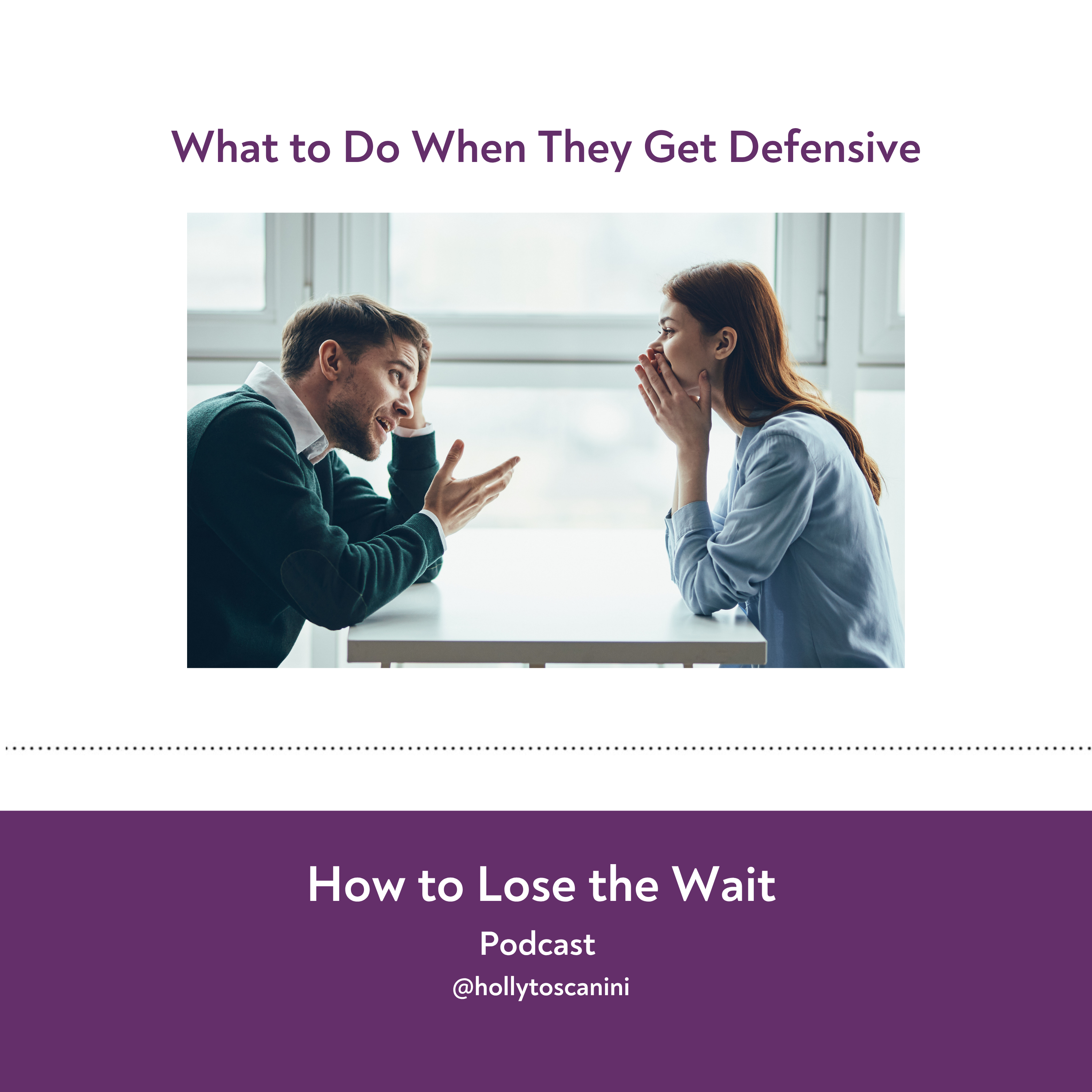
129. What to Do When They Get Defensive
About this episode
You finally said it. Then they got defensive and suddenly you’re explaining yourself instead of addressing the problem. Here’s how to stay connected to what you need.
You said the thing you’d been avoiding. Before you finished explaining what’s been bothering you, the other person said, “That’s not fair,” or “I didn’t mean it that way,” or “Why are you bringing this up now?”
And suddenly you’re no longer talking about the problem. You’re reassuring them that you don’t think they’re a bad person. By the end of the conversation, the concern you worked so hard to raise has almost disappeared.
Starting an honest conversation requires courage.
Staying connected to what you need after the other person becomes defensive requires self-trust.
Those are not always the same skill.
In this episode — part three of the honest conversation arc — I'll name what actually happens when defensiveness takes over a conversation and how to remain present and clear without either shutting down or losing the point.
In this episode, you’ll learn:
- Why defensiveness changes the conversation so quickly — and why understanding someone’s reaction doesn’t require you to let it replace your concern
- When the conversation shifts to your delivery: how to acknowledge what’s true without letting your communication style become the entire subject
- The urge to prove you’re reasonable — and why you don’t need identical interpretations before a problem can be addressed
- A simple structure for staying grounded: acknowledge their response, then return to the issue
- The difference between intent and impact — and why one doesn’t cancel the other
- What to do when someone brings up your grievances to redirect the conversation
- How to handle withdrawal and silence without chasing the conversation or giving up the issue
- When to pause a conversation — and what a pause looks like versus avoidance
Practice for this week: Think about a conversation you need to have and the defensive response you’re already expecting. Notice what you usually do when that happens. Choose one different response. Write down the central issue in one sentence and the line you’ll use to return to it.
Book an Honest Conversation Session — a focused 60-minute session to clarify what you need to say, prepare for the places where you’re most likely to lose your footing, and identify your next step.
The Honest Conversation Session
Book your session (five spots available):
https://calendly.com/hollytoscanini/honest-conversation?month=2026-07
Or send me a message on Instagram @hollytoscanini with the words “honest conversation.”
what to do when someone gets defensive, staying grounded in difficult conversations, how to hold your ground in an argument, difficult conversations women, how to stop over-explaining, staying connected to yourself, intent vs impact, how to address a pattern in a relationship, conflict avoidance women, people pleasing in arguments, how to return to the point, defensive partner, honest communication women, self-trust in relationships
https://uppbeat.io/t/mood-maze/trendsetter
License code: VGZ66UBEGXBP8YK8
Holly Toscanini: Congratulations, you finally said the thing you've been avoiding. But before you finished explaining what's been bothering you, the other person says, that's not fair, or I didn't mean it that way, or why are you bringing this up now? And suddenly you're no longer talking about the problem. You're reassuring them that you don't think they're a bad person. You're clarifying every detail, defending your tone, and trying to prove that you're being reasonable. And by the end of the conversation, the problem or concern you worked so hard to raise has almost entirely disappeared. That's the moment we're talking about today. Because starting an honest conversation requires courage. And staying connected to what you need after the other person becomes defensive, that requires self-trust. And let's face it, courage and self-trust aren't always the same skill. Welcome back to how to lose the weight. I'm Holly Toscanini. Now, last week we talked about how to begin the conversation you keep avoiding. We focused on finding that first honest sentence before you start minimizing, rehearsing, or managing the other person's reaction. Today we're taking the next logical step. What happens after you say the first honest sentence, and the other person doesn't respond so well? They may deny what happened. Explain why they did it, blame you for your part, or withdraw from the conversation, or even focus entirely on how you said what you said. They may tell you that you're overreacting or remembering incorrectly or just being unfair. And that reaction can make you lose your footing pretty quickly. You may begin arguing every detail because you think you need to prove that your interpretation of the situation is accurate. You might soften what you said because you don't want them to feel accused. You might even abandon the issue altogether and start taking care of their feelings instead. Now, this episode isn't about how to make somebody else less defensive. You don't have that kind of control. It's about how to remain present and clear when that defensiveness shows up so their reaction doesn't replace the issue you were trying to address. Now, the central idea is this: you don't need to win agreement from somebody before your concern is allowed to matter. So why does defensiveness change the conversation so quickly? Well, I think it's because defensiveness is often an attempt to protect something. The other person might be protecting how they see themselves. They may hear your concern as criticism and immediately begin explaining why they aren't selfish or unreliable or careless or even unkind. They may also be afraid of what your concern is going to require from them. If they accept that something hasn't been working for you, they may need to change their behavior or take on more responsibility or even acknowledge something that they would rather avoid. None of this means they're trying to manipulate you. See, human beings often become defensive when they feel criticized, surprised, ashamed, or uncertain about what's going to happen next. But understanding why someone is defensive doesn't require you to let their reaction take over the entire conversation. That is where a lot of intelligent, thoughtful women get stuck. You're good at seeing everybody else's perspective, and you understand that they have pressures and intentions and feelings of their own. The moment they explain themselves, you might even begin questioning whether you still have the right to be upset. You do. Their perspective can add information without canceling yours. So what do you do when the conversation starts becoming about how you said it or what your delivery was like. Because a common form of defensiveness is shifting the conversation away from what happened and to how you said it or how you brought it up. All right, maybe your tone wasn't perfect, or maybe you waited too long and sounded more frustrated than you intended to sound. You might even have chosen a better time or used different words. You can take responsibility for that without allowing the entire conversation to become a review of your Communication style. You might say, I can hear that my tone felt sharp, and I'm willing to tone that down. I still need us to address what I was trying to say. See, that response does two things at once. First, it acknowledges something that might be true while returning to the concern that brought you to the conversation in the first place. You don't need to pretend you communicated it perfectly. You also don't need perfect delivery before you're allowed to raise a legitimate issue. If perfection becomes the requirement, the conversation is always going to get postponed. There will always be a better sentence, a more perfect moment, or a more skillful way you could have handled it. You're allowed to be a human being while having a difficult conversation. The urge to prove that you're reasonable. Let's talk about that. Because when somebody becomes defensive, you might feel an immediate need to prove your position. You start listing examples and dates and details. You explain what you meant several different ways. You start answering every objection because you believe that once the other person understands the situation exactly the way you do, they're finally going to agree that your concern about this is valid. But I'm here to tell you that may not happen. See, two people can experience the same relationship very differently. They may remember events differently or place more importance on certain parts of what happened than others. You don't need identical interpretations of a situation before the problem can be addressed. And this is especially important when you're talking about a pattern rather than a single event. The other person might challenge one example and then act as though disproving that detail settles the entire issue. You can return to the bigger point. You might say, okay, maybe we remember that moment differently. The overall pattern is still affecting me, and that's what I want us to talk about. You see, the goal isn't to force an agreement about every single detail. The goal is to communicate what happened for you and what needs to change for you. When the conversation starts moving away from the original issue or problem, you need a way to come back without becoming aggressive or disappearing. And the easiest way to do that is to acknowledge what they said and then return to your initial concern. And that sentence might sound like, I hear that you see this differently. I still need us to talk about what hasn't been working for me. See, you're not pretending their response doesn't matter. You're showing that you heard it while making it very clear that the conversation isn't over. This is a useful distinction because a lot of women believe they only have two choices. They can become rigid and refuse to listen, or they can be understanding and just let the whole issue go. But I'm here to tell you there is another option. You can listen without losing the point. So I'm gonna give you an example. Maybe you're just taking on too much responsibility at home. So I want you to imagine that you've been carrying most of the planning and the day-to-day responsibility in your home. It may not be that hard. You're managing appointments, groceries, household tasks, family communication, and the mental work of remembering what needs to happen next for everybody. And you finally say, I'm exhausted. From carrying this much, and I need us to talk about how we're dividing things at home. Now the other person could say, hey, that's not fair. I do a lot around here. Nothing I do is ever enough for you. And this is where the conversation can quickly fall apart. You might begin trying to reassure them that yes, they're helpful, and then you list everything they do contribute because you don't want them to feel underappreciated. But before long, you're comforting them, and the workload that exhausted you has not been discussed or addressed in any real way. So perhaps a more grounded response would be, I hear that you feel criticized. I'm not saying you do nothing. I'm saying the current division isn't working for me, and I really need us to make some changes. I want you to notice what that response doesn't do. It doesn't argue about whether the other person is a good partner, and it doesn't review the entire history of the household. It returns to the practical concern. Now, the other person may still feel defensive, and you may need more than one conversation to work out all the details, but you have not abandoned the reason you brought it up in the first place. Now, another common response is an explanation. You tell somebody that something they've been doing is hurtful, and they immediately explain that they didn't mean it that way. Their intention matters. And it may help you understand what happened, and it may even reassure you that the hurt wasn't deliberate. It doesn't change the impact. Intent and impact are two different parts of the same conversation. You don't have to choose one and ignore the other. You can say, I believe that you didn't intend to hurt me. I still need you to understand that this has been bothering me. And that allows the other person to keep their intention without requiring you to deny. How it made you feel. The conversation starts to be difficult when their intention is treated as the only thing that matters. If they didn't mean to hurt you, then you're expected to stop being hurt. If they had a good reason, then you're expected to just accept the result. And healthy relationships need room for both people's experiences. So here's another example. Imagine a friend or a family member regularly makes dismissive or hurtful comments about your body. Or the choices you make. When you react, they say, they were joking or you're just taking it too seriously. But you decide to address it and you say, When you make comments about my body or my choices and then dismiss how I react, I feel disrespected and I need that to stop. Maybe they say, You're too sensitive. I can't say anything around you anymore. And you might start explaining that you can take a joke. You may even give examples of times you laughed at yourself or reassure them that you don't want them to feel uncomfortable around you. Now the conversation is about whether you're overly sensitive instead of the repeated comments that you asked them to stop making. So you could try saying, I hear that you think I'm taking it more seriously than you intended. I'm still asking you to stop making those comments around me. You don't have to convince them that your level of Sensitivity is somehow correct. You're just telling them how you want to be treated. What they do with that information is going to tell you something really important about your relationship. So, what do you do when they make it all about their pain? Because sometimes the other person is going to respond to your concern by bringing up everything you've ever done wrong. You say you've been feeling unsupported. And they immediately tell you about a time you disappointed them. You address a hurtful interaction and they respond with a list of their own unresolved grievances. Okay, their concerns might be real and they probably deserve some attention, but they don't have to be resolved in the same moment or the same conversation. You can say, hey, I'm willing to talk about what's been bothering you too, but I'd like us to finish this conversation first, and then we can set aside time for your concerns. Now I know this can feel uncomfortable if you're used to responding immediately whenever somebody's upset. You might worry that you're being dismissive. You're not refusing the conversation, though. You're preventing one issue from making the other issue impossible to address. Both people deserve time to speak. That works better when neither person's concern is used to silence the other. So let's talk about what to do if they withdraw, because defensiveness isn't always loud. Sometimes you get the silent treatment. Some people become quiet, shut down, leave the room, or say they don't want to talk about it. That response can be especially difficult if silence makes you anxious. You might start chasing the conversation or offering some reassurance or withdrawing everything you said so the communication feels more secure again. And sometimes a pause is necessary. People might need to calm down and think before they can continue productively. The difference is whether the pause has a clear path back to the conversation. So you might say, okay, I see that you don't want to continue right now, so let's take a break, but I don't want this to disappear. Can we come back to this tomorrow night? You're respecting their need for space without accepting indefinite avoidance. That's different. If they repeatedly refuse to return to your difficult conversation, then that's no longer a temporary reaction. It's a relationship pattern and it deserves some attention. You don't have to solve the defensiveness. When somebody gets defensive, you might think your next job is to calm them down. So you explain yourself more carefully. You reassure them that you still love them, you still value them, and appreciate everything they do. Some reassurance might be sincere and helpful, but too much can pull you away from your own concern. The goal is not to make the other person feel nothing. They may feel criticized or embarrassed or sad or even frustrated. And those feelings can definitely be a part of an honest conversation. You don't need to intensify them, but you also can't prevent them entirely. Your job is to remain respectful, listen for information that matters, and keep returning to what needs to be addressed. Their job is to decide whether they're willing to participate. That division of responsibility can feel unfamiliar when you've spent years carrying the emotional work for two people. So when is it time to pause the conversation? Staying connected to yourself doesn't mean continuing a conversation at any cost. If the discussion becomes hostile, keeps going in circles, or just impossible to follow, a pause may be more useful than pushing through. And you could say, we're not getting anywhere right now, and I don't want us to keep escalating this, so I'm going to take a break and I want to return to this when we're both calmer. See, pause is not the same as giving up. It gives you a chance to decide what you need. Next. You may need to clarify your point, change the setting, or accept that the other person is simply not willing to have the conversation you'd hope to have. That information matters too. Now, if defensiveness regularly becomes intimidation, threats, punishment, or an attempt to control your choices, that's a much bigger issue than communication. So please get support and think carefully about your emotional, physical, and financial safety first. You don't need to manage a threatening situation by finding better words. Not at all. I've had to learn that being understood and being clear aren't always the same thing. I can communicate carefully and still have somebody disagree with me. I can be thoughtful and still trigger a defensive response. I can acknowledge another person's perspective without deciding that mine no longer matters anymore. That's been an important part of building self-trust. For a long time, I really believed a conversation had gone well only if everybody felt better by the end of it. And that kind of a standard made it difficult to say anything another person might not want to hear. Now I think a conversation can be uncomfortable and still be useful. It may reveal a problem more clearly, it may show you what the other person is willing to acknowledge or change. And it could also help you hear yourself say something you've been minimizing for a really long time. The success of the conversation isn't measured only by whether or not the other person agrees with you. It also matters whether you remained honest and true to yourself. So let me share a question to help keep you grounded during this process. So before you begin a difficult conversation, ask yourself this: What is the one issue I need to stay with? Write it in one sentence, not the entire history, not every example, just your central or your main concern. If the other person becomes defensive, return to that sentence. Now, their response may add information or reveal another issue that needs attention later, but it doesn't have to erase the reason you started the conversation in the first place. You may also want to prepare one sentence that acknowledges their response without giving up your point. Something like, I hear that you see this differently. I still need us to talk about what hasn't been working for me. The sentence isn't designed to control the conversation, it just helps you remember your part in it. Okay, your practice this week. Think about a conversation you need to have and maybe a defensive response you are already expecting. Maybe you assume the other person's going to deny the problem or focus on your tone or explain their intentions or even bring up something you did three years ago. Now, Notice what you usually do when that happens. Do you start reassuring them? Do you argue until you're exhausted? Do you withdraw the concern and tell yourself it wasn't important after all, it really didn't matter? I want you to choose one different response. Write down your original issue in the sentence you use to return to it that we talked about earlier. Then remind yourself that you don't need immediate agreement before your experience deserves some attention. You're not trying to win. You're trying to stay present long enough to have an honest conversation. Look, another person's defensiveness doesn't automatically mean you communicated badly or raised the wrong concern. It might mean they feel criticized, surprised, ashamed, or afraid of what's going to have to change. And you can listen to that response without allowing it to replace your experience. Your concern is allowed to matter even when the other person sees the situation differently. The work is to remain clear enough to say, I hear you, and I still need us to address this. So if there's one conversation you need to have and you want help preparing for both the opening and what might be happening afterward, I'm offering five honest conversation sessions. Now during this focused 60-minute session, we'll clarify what you need to say, decide how you want to begin, and prepare a grounded response for the places where you're most likely to lose your footing. To reserve one of the five sessions, you can click the link in the show notes or send me an Instagram message with the words honest conversation. You don't need a perfect script. You just need enough clarity to begin and enough self-trust to remain connected to yourself once the other person responds. Until next time, remember, you don't need to win agreement before your concern is allowed to matter. And remember, there's nothing left to wait for. Bye for now.
 Apple Podcasts
 Spotify
 Castbox
 Castro
 Goodpods
 Moon FM
 Overcast
 Pocket Casts
 Podbean
 Podcast Addict
 Podcast Republic