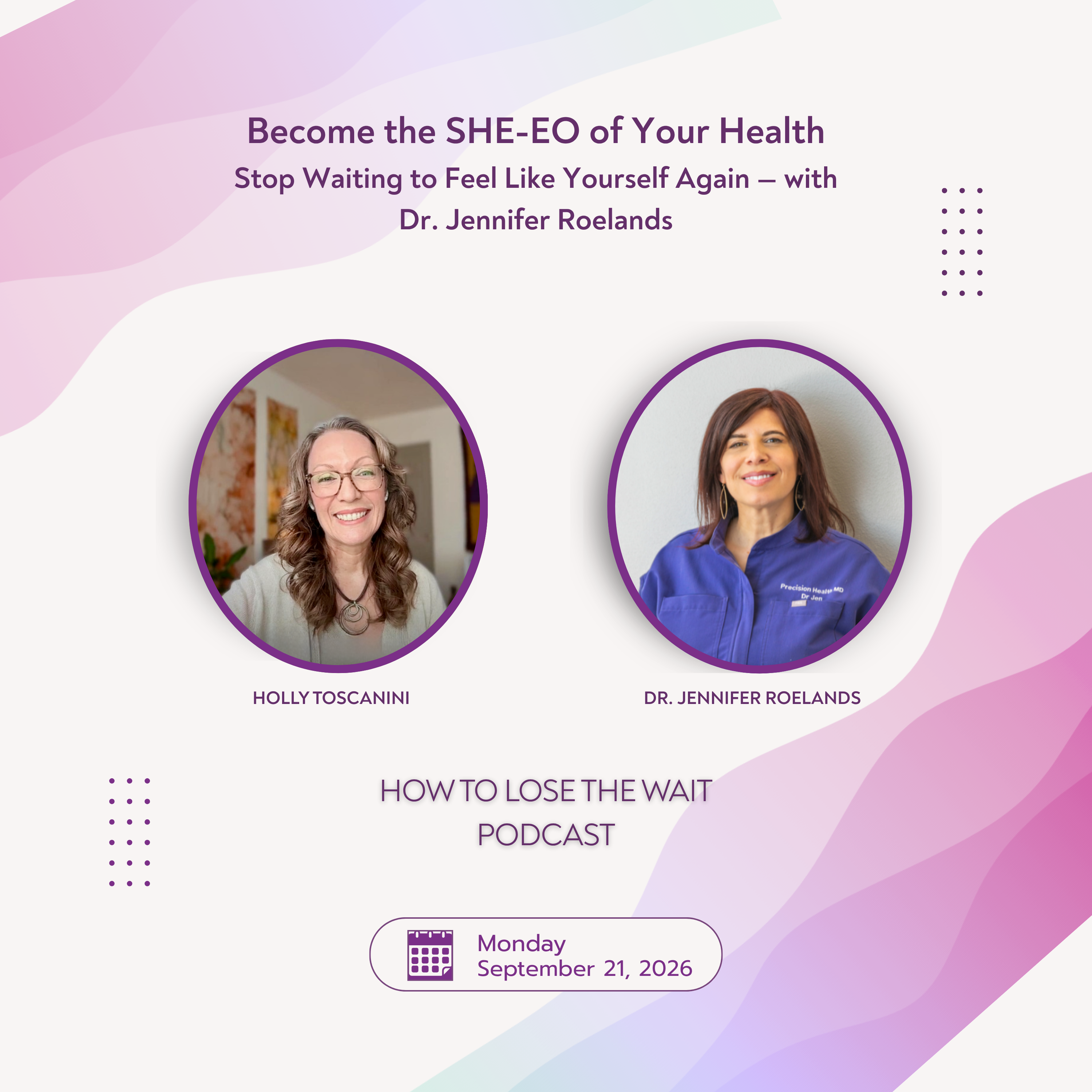
134. Stop Waiting to Feel Like Yourself Again- Dr. Jennifer Roelands
About this episode
OB-GYN Dr. Jennifer Roelands on why women normalize symptoms for years, how to advocate in the exam room, and what to know about hormones and sexual health.
You’ve noticed changes in your sleep, your energy, your mood, your body, or your sex drive — and you’ve been wondering whether you simply need to push through them — today’s conversation may help you ask a better question- What if you don’t have to keep waiting to feel like yourself again?
Holly’s guest is Dr. Jennifer Roelands, a board-certified OB-GYN and Integrative Medicine specialist with 17 years of active clinical practice at Precision Health MD in Orange County, California. She has spent nearly two decades watching women be dismissed, misdiagnosed, and undertreated — and built her practice around the conviction that women over 35 deserve the clinical explanation their 15-minute appointment never has time for.
Her book PIVOT | You Are Not Crazy: Perimenopause Edition releases October 15, 2026.
- What it means to become the SHE-EO of your health when you feel overwhelmed or talked over in the exam room
- The PIVOT framework from Dr. Roelands’ new book — and the step women most often skip
- The most persistent myths about hormone therapy that still keep women from having an informed conversation
- Why sexual health is still treated as optional rather than a core part of women’s healthcare
- How to talk with a partner about changes in desire, discomfort, or how you feel in your body
- How to think about long-term health without making aging another exhausting standard to meet
Resources from Dr. Roelands:
Free guide — How to Talk to Your Doctor:
https://drjenniferroelands.com/perimenopauseguide/
PIVOT | You Are Not Crazy: Perimenopause Edition (releases October 15, 2026):
https://drjenniferroelands.com/pivotbook/
Precision Health MD:
https://drjenniferroelands.com/
YouTube — Dr. Jen MD:
https://www.youtube.com/channel/UCC16IWACsU9FPpkYlLENEjg
Instagram: @dr.jenniferroelands
https://www.instagram.com/dr.jenniferroelands/
#perimenopause #womenshealth #womenover40 #drjenniferroelands #selftrust #PIVOTbook #womenover50 #menopause
Additional Resources Mentioned:
Dr. Kelly Caspern- You Are Not Broken
https://www.youtube.com/@kellycaspersonmd
Emily Morse- Sex with Emily
Dr. Emily Nagoski- Come As You Are
Subscribe for weekly episodes on self-trust, honest communication, and what it actually looks like to stop waiting and start living.
https://uppbeat.io/t/mood-maze/trendsetter
License code: VGZ66UBEGXBP8YK8
Holly Toscanini: If you've noticed changes in your sleep, your energy, your mood, your body, or your sex drive, and you've been wondering whether you simply need to push through them, today's conversation may help you ask a better question. What if you don't have to keep waiting to feel like yourself again? My guest is Dr. Jennifer Rollinson, board-certified OBGYN and integrative medicine specialist with 17 years of active clinical practice at Precision Health MD in Orange County, California. She built her practice around a single conviction that women over 35 deserve the clinical explanation their 15-minute appointment never seems to have time for. Now, her 33,000 subscriber YouTube channel delivers the hormonal mechanisms, the research, and the protocols that most physicians don't cover. And her clinical voice is direct, evidence-based, and shame-free because she spent nearly two decades watching women be dismissed, misdiagnosed, and undertreated. And her book, Pivot, You Are Not Crazy, Perimenopause Edition, is going to be released in October 2026. Now, Dr. Rowlands trained at UC Santa Barbara and UC San Diego School of Medicine and completed her residency at Duke University. Now, outside the clinic, she's an avid hiker, foodie, and the proud mother of four. And before we get started, I just want to say that what I appreciate about Dr. Rowland's approach is that she doesn't expect women to become medical experts or follow some generic plan created for somebody else. And somebody else's body. She actually gives women practical tools to prepare for their appointments, ask clearer questions, and understand their options, plus build a personalized plan for the years ahead. Now, in this episode, we're talking about why women so often dismiss or normalize their symptoms, how to advocate for yourself when you feel rushed or unheard, and what women need to understand about hormone therapy, sexual health, and choosing a provider they trust. Dr. Rolands, welcome to How to Lose the Weight.
Dr. Jennifer Roelands, OB GYN: Thank you so much. It's an honor to be here.
Holly Toscanini: You know, a lot of women know something has changed in their bodies, but they wait months, sometimes years before they ask for help. Why do so many women normalize their symptoms or convince themselves they should simply just tolerate them?
Dr. Jennifer Roelands, OB GYN: Think, you know, at this particular age when you're in your forties and fifties, a lot of things are going on. Sometimes you're at the peak of your career and people are really wanting a lot from you. Sometimes you're in a sandwich generation, you're taking care of your parents, but also your children. Sometimes you're just realiz you know, you're always prioritizing everybody else. You have maybe small children and it's about them and not necessarily about you. So it's pretty Pretty common I hear women that are like, I'm gonna get to that next year. I'm gonna worry about my bones next year. I'm gonna do this next year. Cause they're just always worrying about everybody else and taking care of everybody else. And I also think, and I know this to be true too, that that in, you know, there's a lot of pressure for women to be like, well, aging is normal. Like being stressed out is normal. wanting to s be woken up at four o'clock, like that's pretty normal. Like so people are being dismissed from culturally but also with your physician and sometimes even your partner who's like, dude, I'm forty five, I don't have a problem right? Like I'm good. So I think there's a lot of angles where in in someone who's used to basically pouring themselves to other people all the time, it's pretty easy and very nature to just kind of go, Okay, it must be me. I probably just need to
Holly Toscanini: Yeah.
Dr. Jennifer Roelands, OB GYN: work out harder, eat less, go to bed earlier, you know, like I need to do these things and not really necessarily reach for someone to help them in those times.
Holly Toscanini: Yeah. It's interesting because we're conditioned from birth to sort of take care of everybody else before ourselves, right? To be people pleasers and to do everything perfectly. And so when we think about creating a a plan for ourselves, it's always exactly what you mentioned. I'm going to do everything. I'm going to eat better. I'm going to exercise. I'm going to sleep. I'm going to drink water. I'm going to take my vitamins. I'm going to, I'm going to, right?
Dr. Jennifer Roelands, OB GYN: Mm-hmm.
Holly Toscanini: is there a symptom you hear most often that women have been carrying for years before they finally mention it or bring it up at an appointment?
Dr. Jennifer Roelands, OB GYN: Number one thing people say is I don't feel like myself. I feel like who is this person? How
Holly Toscanini: Right.
Dr. Jennifer Roelands, OB GYN: did I turn into this person? I'm not a person who yells at my kids. I'm not a person who feels edgy and annoyed. I'm not a person who doesn't want to go to events at my work, but I just feel not like myself. That's
Holly Toscanini: Yeah.
Dr. Jennifer Roelands, OB GYN: usually the number one thing people say when they walk in the door.
Holly Toscanini: No, when a woman comes to you describing this, or something that she's been tolerating for a a year or two or more, what's usually the first thing you notice that she's been missing? Maybe a a signal that she's been explaining away or a symptom that she's been not paying attention to?
Dr. Jennifer Roelands, OB GYN: I think, you know, I try to first start with a conversation about what is happening to you. Because by bringing up, okay, here's what happens when you get into your forties. You know, you start having issues related to progesterone, and here's what that looks like, and here's what this looks like when you have issues related to estrogen. I think for a lot of women that connects the dots, they suddenly go, So when I developed this new thyroid problem that has to do with what's going on, so you know, when I go to the dentist and they say I've now have cavities, like why did that happen suddenly? Like they can connect the dots a lot more than trying to specifically ask, like, what are your symptoms? Right? What are the symptoms that you're dealing with? Because a lot of women don't they know the classic hot flash, night sweats, those things, but they don't know issues like itchy ears, new skin conditions, ringing in the ears. I mean, the things down below change, you know, what they look like shrinking. These there's like a lot of things that women don't necessarily connect. So it's harder to for me to to say what are your symptoms 'cause they may not even realize that being woken up at four o'clock every single morning has to do with low progesterone. Has nothing to do with like you're super stressed out, you know?
Holly Toscanini: That is so right, right. That's so fascinating that you say that too, because you really just really pinpointed something amazing is that we feel like we're falling apart. We like you said, we don't feel like ourselves anymore. We feel like we're going a little crazy. And when somebody says, Look, you're not crazy, you're in perimenopause, and let me explain why and let me explain how these things are connected. That is a huge relief just to feel like someone not only saw you, but heard what you were saying and helped you understand what comes next.
Dr. Jennifer Roelands, OB GYN: Yes.
Holly Toscanini: Now, I love this phrase you use, the sheo of your health. What does that look like for a woman who feels kind of overwhelmed by all the conflicting informations, or maybe she's being talked over when she's in the room with her doctor?
Dr. Jennifer Roelands, OB GYN: Yeah, I in in the book on the section P for prepare for your appointment, it's it's really about being an advocate for yourself. I mean, it's sad, but we are in a healthcare system where it's five minutes, six minutes, seven minutes. And if you don't go in there with the agenda in a way, then you're going to lose that time to really get what you need. And by being the SHE-EO, you have to know like what are okay, what do I need out of this appointment? But also what do I want to do with that? with a plan. So usually when I ask patients even having the conversation about hormone replacement therapy, I often am like, is that something you're open to? Because They may a woman may go in there and go, I absolutely don't even want to talk about that. Well, don't waste your five minutes on talking about HRT if that's not within your moral compass to do so. Let's talk about herbals. Let's talk about lifestyle choices. Let's talk about the other options. So that's why you have to become the Shio of your own health because you have to know what aligns with your values. You have to know what the questions you need to ask. And that way you make that time most effective if you're gonna be in an insurance-based model for your care.
Holly Toscanini: Exactly. And I love that you just sort of hit on three different things when people think there may only be one. You talked about medicine, right? Hormone replacement therapy, but then you also talked about herbal remedies and lifestyle. And I think so often people think they can only choose one when maybe there's some combination of those things that's going to be best for them.
Dr. Jennifer Roelands, OB GYN: A lot of my patients dabble between multiple buckets because they're not it's not just one thing. You may be using magnesium to help you sleep, but you may prefer vaginal estrogen because you need something for dryness. Like that's okay. Like it's it's a mix of whatever makes sense for you.
Holly Toscanini: Right. Now you you touched on your book a little bit. It's organized around your pivot framework. Can you walk us through and kind of what the pivot framework is and where women most likely get stuck?
Dr. Jennifer Roelands, OB GYN: Yeah, the book is kind of in three parts. The first part is actually understanding the history of women's health. Because I think a lot of times women get frustrated, like, why can't I get this? Why can't I get testosterone? Why is this not happening? Why does my doctor not know what to tell me to eat? So you have to understand the history of where we came from, where we have to go to get these answers. Because it feels very frustrating if you walk into your doctor's office and you're like, What am I supposed to eat in menopause? And they're like, Mm, I don't know. You know, and so it's not a personal thing to that physician, it's that they were never taught anything. So understanding that. So the first part of the breakwork and then the middle part is about symptoms. So like quick fix, like you want to fix brain fog, here's the section. You want to fix sex is meh, here's the section. Like so it kind of goes through those sections. And then the last is a pivot framework. And P is for preparing for the appointment, going in there, being the EO of your health. What here's the questions to ask. Because many women will come into my practice and they're like, What are the questions I need to ask to make sure I know that this is the right provider or that this is the right they're gonna give me all the options to discuss. I is for in intervention. So what are the labs you need? What is the conversation about hormone replacement therapy that you need? Do you need a bone scan? Like, what's the assessment part of this? V is for vitality because you gotta build the foundations. Peptides, peptides are all the rage right now, but Peptides are the icing on the cake. Like you have to have the foundations of exercise, nutrition, sleep, sex. All the things have to be kind of put into place. Then you can add the fun stuff on top of it. And then O is for optimized, because we're not all exactly the same. What works for me, you and I may have exactly the same symptoms, but whatever. ch regimen I choose may be very different than you on what you choose. So there has to be some optimization based on someone's personal biology. And then T is transcend because perimenopause is only one stage of this whole thing. We got a whole nother category, postmenopausal coming up. We gotta know how to really to me that that section is about what do you want when you're 80, what do want to do? Like, I don't think any women women really wanna like live to a hundred and eighty. We just don't wanna sit on our c on the couch for twenty years watching CNN. Like we wanna have a good life, right? Nothing against CNN. But but but
Holly Toscanini: Exactly. Right, all right. No comments please.
Dr. Jennifer Roelands, OB GYN: Yeah, no comments, cooking channel. I don't know. I could have been, yeah, I don't want to get it all political, right? it was more of just like trying to to understand how do you do what you do now in your 40s and fifties and sixties and seventies to do what you want in your eighties? Like what is the goal?
Holly Toscanini: Exactly.
Dr. Jennifer Roelands, OB GYN: Carry groceries, play with your grandkids. What is it? What do you want to do? So let's build that framework.
Holly Toscanini: I think so many of us tend to get caught up in the whole perimenopause and initial stages of menopause that we forget that there's a whole life afterwards. And just being a woman who is in the afterwards, I I want to give some hope to everybody out there. It gets better. It does get better. And if you follow the framework, if you get the book, follow the framework, you will find such relief and and stabilization that you will start to feel like yourself again. So
Dr. Jennifer Roelands, OB GYN: Yes. far my favorite thing when someone's like, I'm back to myself. I feel like myself again.
Holly Toscanini: Yes.
Dr. Jennifer Roelands, OB GYN: I like I just, yeah, I'm like, woohoo, let's do this.
Holly Toscanini: That's where you can say success, right? I can check that person
Dr. Jennifer Roelands, OB GYN: Yes.
Holly Toscanini: off and say they did it. That's great. Is there a part of the pivot framework that you think women tend to skip? I mean, is there a part that you think they overlook and maybe don't put as much importance on that they really need to to to to consider and what is that costing them?
Dr. Jennifer Roelands, OB GYN: I would say the V Vitality or foundations. I think, you know, we get very and myself included as a 49-year-old female, you we get very distracted on, okay, should it be forty-four grams of protein? Should I have 10 grams of creatine? Should I we get sort of get into these like, I want to take the next menopause supplement or I better get a red light for my face and so I don't look I'm 80. Like we sort of get a little squirrelly on all the things going on and then forget the basics of wait, am I going to bed at 10? Am I getting up at six? Am I getting my steps in? Like, am I doing my HIT training? Like, so I think the foundations are the boring, unsexy part, right? It's not fun
Holly Toscanini: Mm-hmm.
Dr. Jennifer Roelands, OB GYN: to think about. Did I take care of my mental health this week? Did I prioritize hanging out with my husband? Like, that's not all the stuff that's easy to do. And so I think that's the part that's very easy. And so the first thing that people throw away when they're stressed out, right? When they're dealing with it suddenly a parent who's has illness and they're like, well now I'll go the gym in a week. Next week it'll be busy or or less busy. And so they it's very easy to sort of push those off. So I think the vitality
Holly Toscanini: Yeah.
Dr. Jennifer Roelands, OB GYN: part is is key.
Holly Toscanini: Excellent. That's a good point. you have a great guide, and there's a going to be a link in the in the show notes to this that kind of helps women prepare, gives them a lot of information, but helps them prepare for an appointment with their provider. Can you just give us some ideas about what a woman should track or write down before this appointment so she's able to communicate clearly, especially when she really, as you already mentioned, may only have a few minutes. and what do most women commonly leave out that ends up mattering the most?
Dr. Jennifer Roelands, OB GYN: Yeah, this this was actually created by a very good friend of mine. I gave her the book and she's in perimenopause and she was like, you know what? I find the most frustrating when I go to the doctor that I don't ask the questions fast enough or the right questions, and then I feel like I didn't get out any information I needed to get. So what can you give me to walk into the doctor's office and what are the questions I need to ask? So it asks so it's a couple things. One, it talks about before we even get to the doctor's office, like how do you know this provider takes care of menopause women? Here's the things you need to ask the front desk when you're answering. make it a call. Then it goes into what are the questions you need to ask specifically to get the answers that you're looking for. And then it also goes a little bit into like some hormone replacement therapy options so you know how to have the conversation with the right vocabulary with that physician so or provider. but I and once you sort of download the guide you get the second thing which is a symptom tracker. And I think that's actually really, really valuable because when you go in and you say I'm kind of tired, I'm a little anxious I don't feel like myself. Physici those are not words that click in physicians' heads, right? They'll be like, well, you're probably not sleeping, you're probably not exercising, you're probably we're we're we're we're kind of it doesn't click for us to say, we should think about this, this, and this. So I feel
Holly Toscanini: Right.
Dr. Jennifer Roelands, OB GYN: like a lot of times in those situations, saying the exact thing like I've been waking up at four o'clock in the morning. I feel a little crazy, a little anxious. Could I be going through perimenopause? Is a very different question to a physician than I'm tired and I don't think feel like myself because nothing's really sort of it,
Holly Toscanini: Yeah, good point.
Dr. Jennifer Roelands, OB GYN: you know. So it's more geared towards the actual where I want the conversation to go. I want that doctor to tell me, do you think I'm in perimenopause? Secondly, now that you think I am, what are we doing next? You know, so it's a little bit more of again, having the patient be the the person leading the conversation and the physician the guide. It's a different way to look at it.
Holly Toscanini: Right. How can women tell when their doctor is actually listening to them and willing to collaborate with them? I mean, what would that look like when they're in the room?
Dr. Jennifer Roelands, OB GYN: Yeah, I think you make the suggestions of what I think this is what might be right for me. What do you think? Like I think I need hormone replacement therapy. What do you think about that idea? Or I don't want to use hormone replacement therapy, but I'm interested in herbs. Is that something that you can talk to me about? So that conversation then guides again, I've already told that doctor what I am wanting to do, what makes sense for me, and then you can hear what is their philosophy, right? That's part of the reason when you call the office to understand, I always encourage people to say, How many menopause people do you take care of in your practice? 'Cause OBGN practices in general tend to be OB driven, right? They ninety percent of the people sitting in the waiting room are have bellies. So,
Holly Toscanini: Yeah.
Dr. Jennifer Roelands, OB GYN: you know, and I should say babies pregnant bellies 'cause sometimes the menopause you feel like you got
Holly Toscanini: Right. A little more specific.
Dr. Jennifer Roelands, OB GYN: Menopause belly, right? Maybe it's just me asking for a friend. So
Holly Toscanini: It's not just you trust.
Dr. Jennifer Roelands, OB GYN: I feel like it's that that time where you want to say, like, how many, like the questions that I tell people, like, how many people do you take care of in menopause in your practice? What are the options Dr. Roelands usually talks to patients about? And if they go, Well, we only do pellets here, okay. Well, now I know. Here's the car if that's not something that resonates with me, I already know. and then usually I also Think it's great to find out, okay, are there docs in this practice that don't take care of menopause women? Because you know, sometimes you get randomly assigned to somebody in a group of 12 or whatever, and you don't know if
Holly Toscanini: Mm-hmm.
Dr. Jennifer Roelands, OB GYN: they're even open to those ideas. So the front desk, man, they know everything, right? They know the ins and outs. So they can often kind of guide you and say, Yeah, yeah, Dr. Smith, she's your girl. Like this is where you need to go. So the more information that you give when you call to make the appointment, the more you're going to get out of that appointment because that front desk knows the staff.
Holly Toscanini: Just as a side note, I couldn't agree more. If you are kind to the front desk staff, you will have the smoothest experience because they do know the doctors, they do know the ins and outs, they can help you find an appointment that's going to work for you. Huge respect for anybody who works the front desk in a medical office. Thank you. I got a little follow-up to that. So when does a woman know when it's time to find a different provider? Like they're not getting what they need. When do they know it's time to find somebody else?
Dr. Jennifer Roelands, OB GYN: Yeah, I think you said exactly the the answer, which is, you know, when you feel like I don't think this person gets me. I don't think that they're in line with what I would like to do. or you had a particular thing that you wanted and that person is not willing to do it. And that happens. I've had patients who have come to see me because they went to their doctor and their doctor's I don't believe in hormone replacement therapy. I don't I believe it causes cancer, and they're like, it doesn't. I can show you the data myself. And so then they want to go somewhere else. Or I have patients more more often because I do integrative or functional medicine, they don't want hormone replacement therapy and they want an alternative. And the doctor's response is, well, eat less, exercise more. And so then they're like must be something else. So I think that's why asking those questions ahead of time before you even get into the office is really valuable because you already know what is the spin in and where where is that physician likely to come from. I think the other thing also is, you know, the journey evolves, right? As you go through period
Holly Toscanini: Mm-hmm.
Dr. Jennifer Roelands, OB GYN: periodopause. So sometimes women are like, just make me sleep, just get me to sleep. And then now they're sleeping, they're like, Yeah, I kind of want to talk about weight loss now, right? And so you also
Holly Toscanini: Mm-hmm. Right.
Dr. Jennifer Roelands, OB GYN: want to make sure that that person is providing that bigger scope because things will change. You'll kind of get solved one problem and think, you know, maybe I should work on this other thing too. Or in my
Holly Toscanini: Sure.
Dr. Jennifer Roelands, OB GYN: practice, I'm very preventative medicine. So I'm really proactively trying to tell people, go get your bones checked.
Holly Toscanini: Mm.
Dr. Jennifer Roelands, OB GYN: Let's do a f physical test to see what your muscle strength is. Let's so so I'm really trying to proactively find those things before we get down to a point when you don't have you have an issue.
Holly Toscanini: Right. Now you touched on kind of the myths around hormotherapy because it's been surrounded by a lot of conflicting information and fear and pretty strong opinions for decades. What do you think are the most persistent myths that still keep women from having this kind of informed conversation about whether or not it's right for them?
Dr. Jennifer Roelands, OB GYN: Yeah, I would say the number one would be estrogen causes breast cancer. That's still hanging around from 2002 for some reason. We dropped MC Hammer pants, but we're still holding on to this thing
Holly Toscanini: Right.
Dr. Jennifer Roelands, OB GYN: for some reason. So that's
Holly Toscanini: Good reddance.
Dr. Jennifer Roelands, OB GYN: I don't know. I don't know. So I feel like there's this connection still about, you know, the WHI and causing estrogen causing breast cancer. And so women are scared. Rightfully
Holly Toscanini: Mm-hmm.
Dr. Jennifer Roelands, OB GYN: so, breast cancer is is a scary concept. And so I think that's one big myth. Two big myths is I I think it comes from a cultural or like an online presence of, well, this is natural. Going, you know, going through this process is natural. So anything that happens to you is natural. And I feel like it, you know, we don't say that about people who become diabetics.
Holly Toscanini: Right.
Dr. Jennifer Roelands, OB GYN: We don't say to you, well, you now you're diabetic, it's natural for your pancreas to die off. So therefore you really don't need insulin,
Holly Toscanini: Right, good luck.
Dr. Jennifer Roelands, OB GYN: right? I mean, so I I feel like there's this stigma that hormones are a very different thing than or your thyroid. I mean, you develop a thyroid
Holly Toscanini: Mm-hmm. Yeah.
Dr. Jennifer Roelands, OB GYN: problem and you're f and you're 52 years old. We give you synthroid. We don't just say, Well,
Holly Toscanini: Mm-hmm.
Dr. Jennifer Roelands, OB GYN: I mean, your thyroid's going out. I'm sorry. Like these things happen. You know what I mean? And and
Holly Toscanini: Yeah.
Dr. Jennifer Roelands, OB GYN: we certainly don't do it to males.
Holly Toscanini: Sure.
Dr. Jennifer Roelands, OB GYN: We don't make them deal with erectile dysfunction. Well, it's I'm sorry, it won't go up anymore.
Holly Toscanini: No, even the it's a
Dr. Jennifer Roelands, OB GYN: That's never, my
Holly Toscanini: it's just the that's just the thing. God intended it.
Dr. Jennifer Roelands, OB GYN: gosh, never. I mean, I would even argue the opposite. I mean, I love my husband. He's gone into the primary care for he's 55 and they're like proactively asking him. Is everything
Holly Toscanini: Yeah.
Dr. Jennifer Roelands, OB GYN: working down there? I'm like, whoa. Like, and they're proactively
Holly Toscanini: Right.
Dr. Jennifer Roelands, OB GYN: asking him, right? So
Holly Toscanini: Yeah.
Dr. Jennifer Roelands, OB GYN: I feel like it's even the opposite of those things. And I think that's a myth that just needs to go away. It's like, it's not about just. Aging. It's about how do you this is a thing that happens and some women don't want to feel that way.
Holly Toscanini: Right. So let's say I've I've been to the clinic, I've got my prescription. How can I tell that my symptoms and that my care is being managed and not just somebody is just giving me some pills and saying good luck?
Dr. Jennifer Roelands, OB GYN: Yeah, you should be getting better. You should be feeling like you're going in the right direction. It takes time. It's not you can't sit, for example, start even any, especially if we're talking about herbal therapy. It takes three months for people to notice differences. So the timeline is longer. So you should be going that direction. They should be working with you to kind of tweak things, tailor things, make sure that this is the right choice for you. I personally check blood work for patients to make sure
Holly Toscanini: Mm-hmm.
Dr. Jennifer Roelands, OB GYN: that we're in a safe zone. We're using it to where it's more of a longevity option too. and and in and not just hormones, but I will check insulin to make sure someone's insulin resistance is getting better. Check their cholesterol. Are the lifestyle things changing? Like we're we're really monitoring people as they go through and figure out what works for them. And then ultimately, you know Success is about do I feel like back to myself? Do I feel
Holly Toscanini: Mm-hmm.
Dr. Jennifer Roelands, OB GYN: like I'm getting there and I'm understanding the changes that are happening to my body? And so in five years, when something else is different, I already know what I'm looking for and how to navigate that.
Holly Toscanini: So what questions should women ask if treatment doesn't seem to be helping or if she's got some new symptoms that have come up from that or her treatment just doesn't seem to fit her anymore? And and then just to follow up quickly, who decides, the patient or the provider whether to adjust the medications or how does that work?
Dr. Jennifer Roelands, OB GYN: So during the conversation, whatever treatment choice that you have, the expectations should be set for you as to how long does this take to kick in? What is the time frame that I should be expecting to feel better? And when should I know when something's wrong? When should I know when we need to switch? So for example, let's just say we started an estrogen patch for some reason. We would I would tell a patient that, you know, the symptoms will continue to improve over thirty days, but we're not even gonna make any adjustments in that first thirty to forty five days because it just continues to get better with time. So right away in the first seven days, you'll probably notice your hot flashes go away, but certainly to get things like less dryness in your skin or brain fog, it's gonna take more time. So we wanna sort of see the progress going that direction and we won't make any adjustments for at least a month, sometimes even two months, depending on what where we're starting from with what regimen. And so you're laying the expectations ahead of time of what the patient should be expecting during that timeframe. Now if she calls me, she puts on the patch and day three, she's like, my gosh, my breasts are killing me. This is the worst thing I've ever done, then I'm gonna say, okay. We're gonna change this up and this is what we're going to do. That's why it's a partnership in this kind of healthcare journey, because we need to troubleshoot what is going on. Is it actually maybe an expected side effect? Or maybe it's that you this isn't the right regimen for you. It's not gonna work.
Holly Toscanini: Right. Now, telehealth and telemedicine has made menopause care a lot more accessible. But, you know, I've used it myself and I know the quality and level of support can vary pretty widely. How can women evaluate an online provider before trusting that kind of company with their care?
Dr. Jennifer Roelands, OB GYN: Ooh, that's an that's a that's an interesting question because you know, not all the telehealth companies are structured the same. Sometimes you're only seeing a nurse practitioner, no physician, and they don't they have a little bit more of a cookie-cutter model. Sometimes you're
Holly Toscanini: Mm-hmm.
Dr. Jennifer Roelands, OB GYN: seeing physicians. Sometimes you're just being put through an algorithm. It just depends on which company. They're all very different on how they choose to structure it. I think the downside of telehealth is it does take And I've worked as a telehealth provider for some of these companies
Holly Toscanini: Mm-hmm.
Dr. Jennifer Roelands, OB GYN: you're referencing. It's hard because the There's not a direct link to the person that you're working with. So you go and
Holly Toscanini: Yeah.
Dr. Jennifer Roelands, OB GYN: you know, you email back or you text back, and it's in this pool of a bunch of people answering questions and the answer can I mean the the physician or person managing you may not even see it for a week, the information. So it's a little harder because it's a big system. But for a lot of women, I mean, I've worked with it through those companies. I've worked with people in like Nevada. They just don't have a care for two or three hours to go drive. Like this is a fantastic option for those. Situations. And certainly it doesn't replace getting an exam and all the, you know,
Holly Toscanini: Sure.
Dr. Jennifer Roelands, OB GYN: if you have a problem, you need to have a local doctor as well that you can go in if you feel like, what's going on with this? You know, is there a lump in my breast? Is there weird
Holly Toscanini: Yeah.
Dr. Jennifer Roelands, OB GYN: bleeding? Like, you need to be able to have someone that you can see as well. So I think
Holly Toscanini: Right.
Dr. Jennifer Roelands, OB GYN: that providing access to people who don't have access is fantastic. I think when you're evaluating the type of company, I would say. look at the way that they structure how the visits are going to go. Are you typically always seeing a the same person? Are
Holly Toscanini: Mm-hmm.
Dr. Jennifer Roelands, OB GYN: you ever, if you're more complex, do they have somebody who like a MD supervising to be able to see that person? So there's you need to understand the structure of that particular company. And do
Holly Toscanini: Right.
Dr. Jennifer Roelands, OB GYN: they provide all the options? Because honestly some of the companies won't do certain things because they're maybe more traditional in nature.
Holly Toscanini: Mm-hmm.
Dr. Jennifer Roelands, OB GYN: So they won't their conversation may be very different. If you're going in there, for example, if you're going in there going, I want to talk about testosterone,
Holly Toscanini: Mm-hmm.
Dr. Jennifer Roelands, OB GYN: some companies won't even talk to you about that. So these
Holly Toscanini: This is true, yeah.
Dr. Jennifer Roelands, OB GYN: are things you have to sort of know. And I would imagine that understanding how the structure of their vi your visits will be set up will help you as well.
Holly Toscanini: Good advice. Yeah, I agree. I think your telemedicine has been really helpful, especially with people who cannot get to, you know, a Wednesday afternoon appointment. You know, maybe they still have a job that just isn't going to give them the time off to do things like that, but they can take a break
Dr. Jennifer Roelands, OB GYN: Mm-hmm.
Holly Toscanini: and do a telehealth, you know, visit. So I think that's all that's great. So earlier we touched a little bit on sexual health. And it's one of the subjects that we kind of already know doctors don't talk about with women very often. We're expected just
Dr. Jennifer Roelands, OB GYN: Yep.
Holly Toscanini: to sort of silently suffer with our symptoms, why is it still treated as an optional conversation instead of a legitimate part of women's health care?
Dr. Jennifer Roelands, OB GYN: I think first of all, w I would say three things. One is that women I f you know, first of all, there's a cultural aspect to it, right? You don't know from the other end what these conversations have been having with women as they age, right? I mean, I'm Italian, like we're kind of, you know, that we're Catholic, you know, we don't there's none of these conversations happen, right? Like you just
Holly Toscanini: Right, right.
Dr. Jennifer Roelands, OB GYN: you find your husband, then you have sex then, like there's just there's just sort of this taboo that's associated with it. So so there's sort of a cultural narrative and physicians are definitely, and I would go If some physician fights me on this, I'd be like, you show me the evidence. But we do not learn that in medical school. They don't
Holly Toscanini: Yeah.
Dr. Jennifer Roelands, OB GYN: say, and I'm an object, they don't say, here's the cultural context of how you would talk to someone who's like from the Middle East or who's
Holly Toscanini: Mm.
Dr. Jennifer Roelands, OB GYN: Catholic or who may be having different conversations. Never ever. Never would they have they have they ever had any of those conversations. And I would feel strongly that probably it doesn't happen very often. And so that
Holly Toscanini: Right.
Dr. Jennifer Roelands, OB GYN: makes it very difficult to know, even as a doctor, and I want to help somebody, how do I phrase this? So that the two things you understand what I'm asking you without being straight up like, how's your vagina today? Like, I mean, you know, like the
Holly Toscanini: Yeah. Which is a great question all on its own.
Dr. Jennifer Roelands, OB GYN: Which is a great yeah, is that a great question. Yeah. So I feel like there's sort of that cultural context that makes it difficult. I think too, we don't get sex health in in I'm an Obi Joanne. We did not talk about sexual health. We did not talk about how
Holly Toscanini: What's so surprising?
Dr. Jennifer Roelands, OB GYN: to like what are the parts of an orgasm.
Holly Toscanini: Mm-hmm.
Dr. Jennifer Roelands, OB GYN: never talked about those things. We never talked about those things. We didn't even well, first of all, there wasn't even any drugs available eighteen years ago to even give anybody. Now there's two FDA approved medications. So it wasn't even in the context, but we didn't get educated on it at all. So now you have to have a provider who's willing to teach themselves. And then who's also willing to ask the questions in a short amount of time. That's three, the
Holly Toscanini: Mm-hmm.
Dr. Jennifer Roelands, OB GYN: third one. So if someone comes in and they're like, doc, I'm having irregular periods, I can't sleep, I feel like I'm angry all the time. Usually in that five minutes, it's like, okay, when did this happen? What happened? What's your cycle happening? Like we're at we're kind of peppering the usual questions. Most
Holly Toscanini: Right.
Dr. Jennifer Roelands, OB GYN: of us aren't going, I wonder if she also has libido problems. I wonder if her husband wants to have sex four times a week and she only wants to have two. Like we're we're not thinking those things because it's
Holly Toscanini: Right.
Dr. Jennifer Roelands, OB GYN: not innate part of our training. So I feel like that also gets very much dismissed. And women sometimes don't know how to say something without feeling guilty of it. It feels very guilty, right? I mean, I'm a 49-year-old female.
Holly Toscanini: And shameful.
Dr. Jennifer Roelands, OB GYN: I certainly have had low libido in the last year
Holly Toscanini: Yeah.
Dr. Jennifer Roelands, OB GYN: with perimenopause, and it feels like. Dude, I love my husband, but I kind of don't like him sometimes. Like I don't, you know what I mean? Like, how do I say that to my doctor? Like,
Holly Toscanini: Yeah. Right.
Dr. Jennifer Roelands, OB GYN: I kinda don't want to have sex with them, right? Like, because then they're gonna be like,
Holly Toscanini: Yeah, yeah.
Dr. Jennifer Roelands, OB GYN: she needs to go to the shrink because she doesn't like her husband. I'm like, it has nothing to do with that. Has to be that it
Holly Toscanini: Right.
Dr. Jennifer Roelands, OB GYN: feels like things are not awake like they used to be. Like that's what it's about.
Holly Toscanini: Exactly.
Dr. Jennifer Roelands, OB GYN: But how do you phrase that to your doctor? So I think those are kind of
Holly Toscanini: Things yeah.
Dr. Jennifer Roelands, OB GYN: harder questions for women to ask.
Holly Toscanini: I love things are not awake. I think that is a great way to describe it because a lot of women don't know how to describe what's changed for them sexually. So in addition to I'm not as awake, what words can they use with their doctor when I'm just not interested anymore doesn't tell the whole story?
Dr. Jennifer Roelands, OB GYN: Yeah, so how I have the conversation is I say, women, libido is incredibly complicated in women, right? Guys, it's testosterone, you're somewhere in the building, they'll find you. It's a straight line.
Holly Toscanini: Ha ha.
Dr. Jennifer Roelands, OB GYN: It's just a very straight line. Women, we have to have estrogen working, we to have testosterone working, they have to have clean the dishes, right? The kids have
Holly Toscanini: Right.
Dr. Jennifer Roelands, OB GYN: to be asleep, we have to get like cute in our outfit. Like there's a lot of things that kind of come into the play. And so often when someone says, I don't think I have I my libido is low, I'm like, what does that mean? Does it mean that you're not sleeping so sad? Is definitely off the table because you just want to sleep? Does it mean I look fat in the mirror and I don't really want him to see me naked? Does
Holly Toscanini: Mm-hmm.
Dr. Jennifer Roelands, OB GYN: it mean that, you know, you're getting things going, but you lost your orgasm? Does it mean that you just don't have those feelings? Like, you know, he swipes your shoulder and you're like, I mean, okay. You know, like what Are you having a lack of arousal, lack of desire? What part does libido low libido mean? Because sometimes in when women go through when they lose testosterone, they for example feel there's less blood flow to that area. So they feel like it almost feels kind of numb, like I can't get there. Like I he needs to work a little harder to get me
Holly Toscanini: Yeah. Yeah. Yeah.
Dr. Jennifer Roelands, OB GYN: to get going. That's a very different thing than, you know, I'm just too tired. I just I I
Holly Toscanini: Exactly.
Dr. Jennifer Roelands, OB GYN: don't sleep. I don't I just want him to go away 'cause I'm tired. You know, that's a very different sort of so I think naming the thing when you say when your brain goes, I have low libido, what does that exactly mean to you? And it can also
Holly Toscanini: Right.
Dr. Jennifer Roelands, OB GYN: mean, by the way, my husband just got started on Viagra and he's in the game five days a week. We've
Holly Toscanini: Sure.
Dr. Jennifer Roelands, OB GYN: only been in the game three days a week for the last ten years. Like
Holly Toscanini: Right.
Dr. Jennifer Roelands, OB GYN: what How is this gonna work? And that's a lot of the conversations I have when I ask for partners to come into the visit is the partner
Holly Toscanini: Mm-hmm.
Dr. Jennifer Roelands, OB GYN: mismatch question is what is normal? What is normal? You know what I mean?
Holly Toscanini: Right, right. So how can women begin to have this kind of conversation with their partner about the changes in their desire, their discomfort, maybe? I mean, yeah, hot flashes and and sleep, but also, you know, there's a lot of vaginal dryness going on. How does she talk about how she's feeling in her body without it landing like rejection or blame?
Dr. Jennifer Roelands, OB GYN: Yeah, I asked you asked my husband this about a year ago. And I was like, How would you want me to talk to you about this? Because he's a very simple dude. So
Holly Toscanini: Okay.
Dr. Jennifer Roelands, OB GYN: he was like, Yeah, I just want you to tell me what's up and what I gotta do. I just need
Holly Toscanini: Okay.
Dr. Jennifer Roelands, OB GYN: to know. Like, so what and so when I explained to him, like these things are happening to me, it feels like I'm a different person. And so I'm
Holly Toscanini: Mm.
Dr. Jennifer Roelands, OB GYN: trying to figure out who this new gen is. He was like, okay. Like this is not kind of like because everybody understands what growth is, like personal growth,
Holly Toscanini: Mm-hmm.
Dr. Jennifer Roelands, OB GYN: right? Even you know, you you the way you are in your 40s is very different than the way you were in your twenties. You've learned to sort
Holly Toscanini: Yeah.
Dr. Jennifer Roelands, OB GYN: of change things and adapt things. So I kind of explained it, like, this is what's happening to me. I'm losing my hormones. They used to make me feel this way, and now I feel like things are numb. I feel like I j I think about the grocery store more than I think about you. Like I think, you know, like I just want to go to sleep. Like I just feel me. Like, and so he was like, I had no idea that all those other things you were feeling also. And then I would, you know, then I said to him, like, I do want to get this back. I do
Holly Toscanini: Yeah.
Dr. Jennifer Roelands, OB GYN: want to be able to enjoy it while we're having sex. I feel like I not only feel numb, but it just doesn't feel good. So
Holly Toscanini: Mm-hmm.
Dr. Jennifer Roelands, OB GYN: I need to talk to the doctor about like how do I get this back for me? And,
Holly Toscanini: Right.
Dr. Jennifer Roelands, OB GYN: you know, what's normal for me is this. So it's kind of like trying to sort of explain to them this is the thing that's happening to you and what I need for you to let me figure out how to get a better situation and
Holly Toscanini: Mm-hmm.
Dr. Jennifer Roelands, OB GYN: I'll be chatting with you about what I learned about myself and what I learned about what could be better. Maybe different positions or different this or different timing so that so that I can be a better partner to you too. Does
Holly Toscanini: Right.
Dr. Jennifer Roelands, OB GYN: that make sense?
Holly Toscanini: Absolutely. what do you wish sort of like generally, what do you wish our partners understood about the emotional and physical experience of perimenopause and menopause? And when they are trying to be supportive, what do you see they get wrong most often?
Dr. Jennifer Roelands, OB GYN: think that you know, I mean not to sound funny, but like we can be a little ragey, like a little a little a little short fused, a little a little
Holly Toscanini: Really? What do you mean by that, Jen?
Dr. Jennifer Roelands, OB GYN: have you know, and and subconsciously, and I can say this, you know, I'll never say it to my husband, but I know that I can be over the top when I'm having these like moments, but it's almost like uncontrollable. Like you have
Holly Toscanini: Yeah.
Dr. Jennifer Roelands, OB GYN: You know, when you're twenty something years old, you're like, I sh I wanna say that, but I shouldn't say that because that's a bad idea and this is gonna land me. But it almost just kinda happens without you having those control. So I think sometimes same thing could happen even in sort of a sexual context where you're like,
Holly Toscanini: Mm-hmm.
Dr. Jennifer Roelands, OB GYN: you know, that doesn't feel good. Or, you know, like, I don't know, like something like that. And I think sometimes having that that conversation to say, I really don't wanna feel like this myself either. Like I don't
Holly Toscanini: Yeah.
Dr. Jennifer Roelands, OB GYN: wanna feel like I'm yelling at you for something or I'm getting mad about something, I don't want to feel like this either. I just have to figure out a better way. So I I think that's often happens with couples where they're, you know, the husband comes in, he's like, She's yelling at me about this. She doesn't want to do have sex anymore. She's, you know, every day she's in a bad mood. Like those kind of things. And I'm trying to ex to help them bridge that gap to say, she doesn't really want to do this either. It feels
Holly Toscanini: Mm. Yeah.
Dr. Jennifer Roelands, OB GYN: like kind of like when you go through puberty the first time and you're like, what is happening to this body? Like, do you remember
Holly Toscanini: Right.
Dr. Jennifer Roelands, OB GYN: being in puberty when you were 14 years old and suddenly you got hair and suddenly your voice is funky and you look awkward and you have chunkiness around your waist and all these things happen like This is a bench it basically happening again. So
Holly Toscanini: Right.
Dr. Jennifer Roelands, OB GYN: I I think that's part of it is trying to have a good communication. And if you have a hard time having those conversations, bring them into your provider. I love when the guys come. It's great. Come into the appointments. Let's do it. Let's have let's
Holly Toscanini: Right. that's great advice. Yes.
Dr. Jennifer Roelands, OB GYN: go in and let's have a conversation because it also validates the fact that she's not the only one that's doing this, that's having
Holly Toscanini: Right.
Dr. Jennifer Roelands, OB GYN: these things happen to her. There are many women going through the same thing. So I think that helps too.
Holly Toscanini: And I think they also need to know it's not personal. You know what I mean? Not always. I mean, maybe once in a while it might be, but general rule, it's not personal. It's not because you've the partner has actually done something wrong and and it's not something that we are choosing to bring out, right? I mean, it's
Dr. Jennifer Roelands, OB GYN: Mm-hmm.
Holly Toscanini: it's happening, it's natural, and we just need to work on it together. And I I kind of love that you have these frank and open conversations with your husband about kind of what's going on. I wish more people understood it's okay to talk to your partner about these things. And if you're feeling uncomfortable, both of you go to the doctor and have, you know, some third party perspective on this and and figure out what we can do together to kind of get back into a normal rhythm with our sex life. I think that's huge in a relationship.
Dr. Jennifer Roelands, OB GYN: Yep. Yep. Or even if it's not going to happen, that's a good conversation too. Like, you know,
Holly Toscanini: Yes.
Dr. Jennifer Roelands, OB GYN: I'm not interested in doing this anymore. Like that's a conversation too. Like it needs to be it goes better when both people feel like their their thoughts are being heard and then there's some sort
Holly Toscanini: Mm-hmm.
Dr. Jennifer Roelands, OB GYN: of middle ground, right? Just like you've done your marriage the whole time.
Holly Toscanini: Yeah.
Dr. Jennifer Roelands, OB GYN: So trying to have those conversations and I also I think sometimes it also brings up Men can be very intuitive and say, Yeah, like this one time we were having sex, you didn't like this. And then she's like, Yeah, this is why. Like so sometimes they can even bring up the conversation because they notice something and
Holly Toscanini: Mm-hmm.
Dr. Jennifer Roelands, OB GYN: therefore sh it gives her an opportunity to say, Yeah, this is this is why I didn't like that. You know what I mean?
Holly Toscanini: Right. And I love the c the idea of talking about it before. You know, when you're in the throes of it, when you're in it, it's hard to have a a good conversation about what's working and what's not. But if you can have that conversation, you know, over coffee somewhere else and and have it in a neutral area, it's a lot easier when the time does come to kind of know how to work together again. Yeah. So how do we okay, great.
Dr. Jennifer Roelands, OB GYN: Mm-hmm. Mm-hmm. And there's great resources out there. I mean, Kelly, Kelly Caspern has a fantastic podcast called You Are Not Broken. Amazing. There's a fantastic book called Come As You Are. Fantastic book. She also
Holly Toscanini: Love it.
Dr. Jennifer Roelands, OB GYN: has a podcast called Sex with Emily, fantastic podcast. So there are a lot of resources for, and those both of those podcasts have episodes for men and women separately. And then, you know, for both. So I I think those are great resources sometimes where women go, yeah, she's speaking to me there. Now I get it. Now I should, you know, ha be able to have this conversation. So I love their podcasts. They're fantastic.
Holly Toscanini: Terrific. And I'll try to see if I can find the links for those and put those in the show notes so somebody else can check them out because
Dr. Jennifer Roelands, OB GYN: Mm-hmm. Yeah.
Holly Toscanini: not knowing where to turn for good advice is huge. So having a already vetted podcaster two that you can go to and know you're gonna get good information is invaluable. How do we help women think about long-term health without turning this whole thing into another personal failure or making wellness another exhausting? journey, another exhausting checklist that we have to go through and be perfect at.
Dr. Jennifer Roelands, OB GYN: Yeah, I think that goes back to the what do you want to do at eighty conversation. Like what's important to you? What is the thing like for me, I wanna be able to get groceries out of my car. Like I wanna get groceries out of my car. I wanna get up off the floor without assistance. Like those two
Holly Toscanini: It's huge.
Dr. Jennifer Roelands, OB GYN: things are really important to me. Being able to still go to like my grandkids events, I wanna and not be like, like someone wheeled me over there or like I wanna be able to be mobile. Like I would I would rather die 'cause I was hiking in Monto Picchu and I my legs gave out, then sitting on the walking, you know, sitting on the couch and something happened. So those
Holly Toscanini: Right.
Dr. Jennifer Roelands, OB GYN: are my goals, personal goals. So I so I sort of have changed up even exercise. I mean I am a longtime runner. I'm a cardio, I love cardio. Like cardio, cardio.
Holly Toscanini: Mm-hmm.
Dr. Jennifer Roelands, OB GYN: I marathons, I did all those things. And now I'm like, ooh, marathon running is not gonna get me there.
Holly Toscanini: Mm.
Dr. Jennifer Roelands, OB GYN: What's gonna get me there is working on balance.
Holly Toscanini: Mm-hmm.
Dr. Jennifer Roelands, OB GYN: Agility, strength. Like I gotta do some things I've never done in the gym. Like
Holly Toscanini: Mm-hmm.
Dr. Jennifer Roelands, OB GYN: Those I gotta change what I'm doing because I can't lift groceries. Marathon running is not gonna help me lifting groceries. If I have no grip strength, don't do me any good. So I have to think
Holly Toscanini: Right.
Dr. Jennifer Roelands, OB GYN: about how I do those things. Same thing with nutrition, same thing with sleep, same thing with relationships. Like those are all parts of the puzzle to who am I gonna go get groceries for at 80? I have a good relationship. I scared my husband off. Like, you know, I guess.
Holly Toscanini: Right.
Dr. Jennifer Roelands, OB GYN: Women outlive men, maybe a bunch of girlfriends, like I gotta go have a
Holly Toscanini: Sure.
Dr. Jennifer Roelands, OB GYN: little party. But it has to be really kind of what how do you build what you're doing? And it doesn't have to be I do it overnight. It's gonna like, here's what I wanna think about for the next forty years. Like I got a DEXA scan at forty six because I know I need to have good bone health and I already had osteopenia, weirdly enough. So
Holly Toscanini: Mm, wow.
Dr. Jennifer Roelands, OB GYN: that's kind of important. Like I need to really focus on building bone so that I don't fall and break a hip, you know?
Holly Toscanini: R right, because without balance and agility, what tripping on the sidewalk can ruin your life, right? If you can't recover. So
Dr. Jennifer Roelands, OB GYN: Yeah. Yep.
Holly Toscanini: I think those things, balance, strength, and you know, agility are really important. And with they may not be things that we thought about in our twenties or thirties, or maybe even our 40s, but they're definitely something we need to add to our kind of routine in terms of our physical health now. So thank you for bringing that up. It's a great reminder.
Dr. Jennifer Roelands, OB GYN: Yep. Mm-hmm.
Holly Toscanini: Okay, so for the women listening. That have been ignoring their symptoms or postponing those appointments or feeling overwhelmed by conflicting information or advice, what's the one step we can take this week to begin trusting ourselves with our health again?
Dr. Jennifer Roelands, OB GYN: I would say tracking those symptoms, tracking those things, writing them down and then what and you know, it may not be that you're ready to go talk to somebody. It might be that you want to look for things online. It might not be, I'm not saying that there's people have different ways they get to the end result, but sometimes just writing them down, old school piece of paper and pencil, you're like, I didn't know I have 20 things that are actually bothering me. I thought it was just sleep. But now that I've sort of
Holly Toscanini: Yes. Right.
Dr. Jennifer Roelands, OB GYN: sat down and thought about, I also don't like that my skin is saggy and I got wrinkles now. And I also don't like that I have er urinary urgency. And I also, you
Holly Toscanini: Mm-hmm.
Dr. Jennifer Roelands, OB GYN: know, like you start kind of like going, there's a collection here of things that seem to be bothering me. And that also makes it easier to go in or or, you know, seek f find the provider that makes sense for you as well as like writing those down.
Holly Toscanini: Excellent. Great advice. Okay, before we wrap up, I want to make sure everybody listening knows about this resource that Dr. Roelands has put together specifically for this because what we've been talking about today is exactly the kind of conversation that needs to continue in the exam room. She's got a free guide called How to Talk to Your Doctor, and it gives you the language, the questions, and the framework to walk you into an appointment and actually be heard. You can find it at Dr Jennifer Rollins.com/slash guide. And I'm going to put the link in the show notes and I'll have the link to the book as well. Dr. Roelands, thank you for helping us understand what it really means to become the SHE-EO of your health. And I hope today's conversation reminded our listeners that noticing something has changed isn't complaining. Asking questions isn't being difficult. And advocating for yourself does not require you to become a medical expert. You're allowed to expect care that considers your symptoms. Your history, your priorities, and the life you want to be living years from now. Dr. Roland, what final thoughts do you have that you might like to share with our audience?
Dr. Jennifer Roelands, OB GYN: My final thoughts would be just, you know, listen to that inner voice that tells you what is the right option for you or what is the right step you want to take or maybe who you want to talk to about certain things. I think we often kind of go, No, I don't think I'm right. Maybe I should, you know, maybe I should listen to what my mom is telling me, or maybe I should listen to what my friend who's telling me to suck it up buttercup. Like, and we kind
Holly Toscanini: Right.
Dr. Jennifer Roelands, OB GYN: of but we feel differently inside. And I think that's really important to follow that. guide as to the way you feel. I also really, really important is like you're not alone. There
Holly Toscanini: Mm.
Dr. Jennifer Roelands, OB GYN: are women who come to me who have very outside the box perimenopause symptoms and they're like, yeah, like I have these swollen joints in my hands. And you know, and I can't lift my arm above my head. Is this normal?
Holly Toscanini: Yeah.
Dr. Jennifer Roelands, OB GYN: So so sometimes these symptoms get often, you know, they feel alone, like, okay, I went online and everybody's having hot flashes. Everybody wants to kill their husband, but I don't feel that way. So maybe it's not
Holly Toscanini: Mm-hmm.
Dr. Jennifer Roelands, OB GYN: me. Maybe I'm the only one that has the problem. And it's and so they feel like, gosh, I have to navigate this on my own, which isn't necessarily the case. So I think it's important being part of a community. I can't stress that enough that Everybody wants to feel like they belong. Everyone wants to feel like somebody else understands them. And I think
Holly Toscanini: Mm-hmm.
Dr. Jennifer Roelands, OB GYN: being a part of a community where women get you is really, really important.
Holly Toscanini: I agree. Having especially having friends as we age and and we do change and you know, people come in and out of your lives, but maintaining a group of people that you know you can trust and that you know are there for you and that you can do the same for them is invaluable as we get older. As you said, men don't live as long. So we gotta keep our friendships together so we know who to get groceries for.
Dr. Jennifer Roelands, OB GYN: Yes. Exactly. Exactly. I actually that's one of my favorite things I love about the Blue Zone series with Dan Butner when if you've seen the the episodes online, it's very cute. They ha in Japan they have these little communities of women 'cause they outlive the men. And they live together. And they have like still roles within like you're the laundry lady. You're the and it's cute, like these little communities and it's like so valuable that they continue to sort of support each other through those times. Mm-hmm.
Holly Toscanini: Exactly. Support. It's it's what you need. You can learn a lot more about Dr. Jennifer Roelands and her work at drjeniferoelands.com. You can find her book Pivot, You Are Not Crazy, Peri Menopause Edition, coming out in October. And her Are You and Peri Menopause Quiz and information about becoming a patient at Precision Health MD. Everything is going to be linked in the show notes, her YouTube channel, her Instagram channel, everything, everything you need. Follow her on Instagram at DrJenMD and find her videos, which are fantastic by the way, on YouTube at Dr.JenMD. And remember, you don't have to solve every part of your health today. You can begin by paying attention to what your body's been telling you and just writing down the questions you've been afraid or embarrassed to ask, and then just make the appointment. That one step may be how you stop waiting to feel like yourself again. Until next time. Thank you, Dr. Jennifer Rowland, and bye for now.
Dr. Jennifer Roelands, OB GYN: Thank you so much. I appreciate it.
 Apple Podcasts
 Spotify
 Castbox
 Castro
 Goodpods
 Moon FM
 Overcast
 Pocket Casts
 Podbean
 Podcast Addict
 Podcast Republic