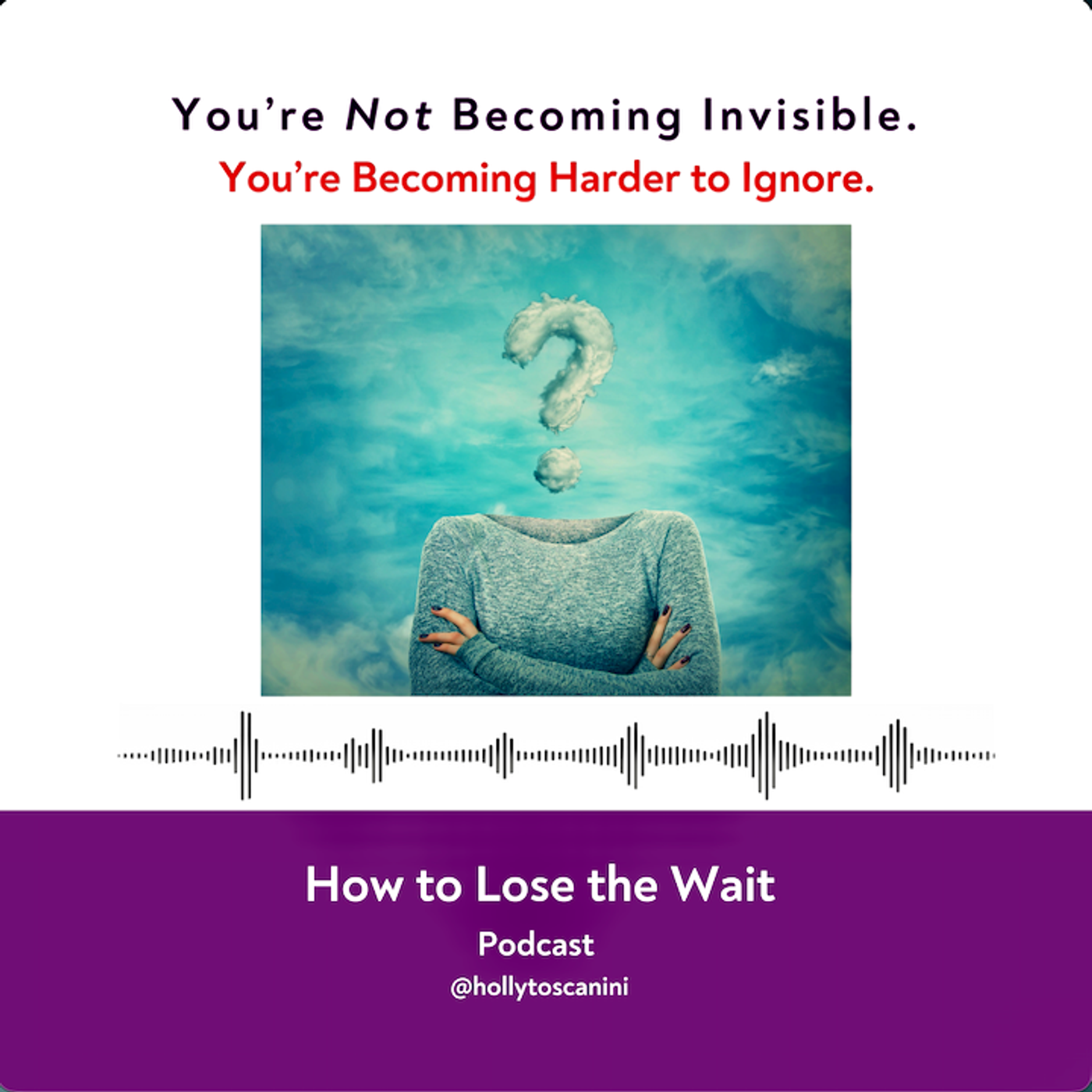
133. You’re Not Becoming Invisible. You’re Becoming Harder to Ignore
About this episode
There’s a conversation happening about midlife invisibility. About the moment women realize they’re no longer turning heads, no longer registering the way they once did. And most of the responses are about how to fix it.
I think the framing is off.
Not because the experience isn’t real — it is. But because there’s a question nobody is asking before the style tips arrive: what kind of visible were you? And is that what you actually want back?
In this episode of How to Lose the ‘WAIT’, I'll draw a distinction most conversations about midlife invisibility miss: the difference between the genuine experience of being dismissed or overlooked, and the loss of a conditional visibility that required women to perform, accommodate, and make themselves useful in order to be seen.
Those aren’t the same thing. And treating them the same leads to the wrong solution.
What you’ll learn:
- Why the experience of feeling invisible in midlife is real and worth taking seriously — without a list of style tips
- The two very different experiences women conflate when they say they feel invisible
- The question that changes everything: what were you visible as?
- What conditional visibility actually cost — and why its fading might not be entirely a loss
- What the most compelling, clear-eyed women in midlife have in common
- The specific waiting pattern the invisibility experience activates
- Why the visibility that actually sustains you doesn’t come from being confirmed by the right people
Subscribe for weekly episodes on self-trust, honest communication, and what it actually looks like to stop waiting and start living.
https://holly-toscanini-f50a.mykajabi.com/newsletters/the-unwaiting-room/subscribe
feeling invisible in midlife, midlife women visibility, women over 40 confidence, midlife identity, women feeling invisible at 50, midlife women empowerment, how to feel visible again, midlife invisibility, aging and self-worth, self-trust women over 40, women and aging, midlife confidence, women becoming invisible, showing up
https://uppbeat.io/t/mood-maze/trendsetter
License code: VGZ66UBEGXBP8YK8
Holly Toscanini: I read an article recently that stopped me mid-scroll. It was about the age women start to feel invisible, and it was full of quotes from doctors and style consultants about why this happens. Changing skin, shifting hormones, society's obsession with youth and thinness. All of that is real, and I'm not dismissing any of it. But what stopped me was the solutions. The article's answer to feeling invisible was essentially: update your style. Maintain your appearance and stay relevant by looking as young and thin as possible. And I sat with that for a long time because I think the framing is off. And it's not because appearance doesn't matter or because aging isn't real or because the experience of feeling unseen isn't genuine and painful. It is. But because I think we've been naming the wrong problem. The question I want to ask today isn't how do we become more visible again? In midlife, the question is: what kind of visible do we actually want to be? And is the visibility we're grieving the loss of something we actually want back? Because I think for a lot of women, the answer is a lot more complicated than the style tips suggest. Welcome back to How to Lose the Weight. I'm Holly Toscanini. Today's episode is one I've been wanting to do for a while, and I wanted to be upfront about it because it goes somewhere the usual conversation about midlife invisibility and being a woman of a certain age just doesn't go. We're going to talk about what the experience of feeling invisible actually is, where it comes from, and why I think the conventional response to do it look better, show up differently, perform your way back into relevance. All that might be solving the wrong problem entirely. And then I want to shift over to a different question. Not how do you become more visible again, but what do you actually want to be seen for, and by whom? And why are you willing to stop waiting for the kind of visibility before you let yourself take up some space? So first, I just want to name the experience honestly because I think it deserves that. The feeling of becoming invisible in midlife is a real thing. It's documented. It's something women describe across cultures, professions, definitely across body types and backgrounds. And it tends to arrive not in one big dramatic moment, but gradually. It's a series of small, quiet recognitions. The waiter who addresses the young person at the table first. The meeting where your idea is received differently than it would have been five or ten years ago. The social situation where you notice You're simply not registering in the way you once did. People aren't noticing you the way they used to. One doctor quoted in the article I read put it this way: Women don't suddenly become invisible at 50. What changes is both how they see themselves and how society tends to see them. And that's an honest and important distinction. See, both things are happening at the same time. There's a real shift in how midlife women are perceived and treated in a culture that places an enormous value. On youth and physical attractiveness, particularly in women, and not to the same degree in men. That's not paranoia. That's a documented and measurable bias. There's also something happening internally. The way a woman sees herself shifts. Her confidence in certain spaces may change. Her relationship with her appearance is definitely going to be different. And her sense of who she is outside all of the roles she's been filling for decades may feel less defined than it used to. Both of those things are real, and both of them deserve to be taken seriously rather than met with a big list of style tips. But here's what I really want to push back on, because I think we've been conflating two very different experiences and calling them invisibility. The first is the genuine experience of being just dismissed, overlooked, or treated as less relevant because of your age. And that's real. It's unjust and it matters. And I see it every day. The second is something else. It's the loss of a very particular kind of visibility, one that was always conditional. Visibility based on appearing a certain way, being perceived as attractive or useful or agreeable, occupying roles that gave you a clear and legible social function. And as those things shift, the conditional visibility starts to fade. And that loss is real too. But I want to ask. Whether it's a loss in the way we think it is. Here's the question I keep coming back to. When we say we feel invisible, what were we visible as? For a lot of women, the visibility of their younger years was bound up in things that were ultimately not even about them. They were seen as attractive, as available, as capable and competent and endlessly willing to accommodate everybody else's needs. And is the person who held things together or managed all the household logistics, smooth the edges of the rough conversations, the one who showed up, who could be counted on, who didn't make things difficult. And that is a particular kind of visibility. It's real and it brought real rewards: warmth, belonging, approval, a sense of being valued. And I'm not dismissing any of that. But it was also conditional. It was visibility in exchange for performance. You were seen because of what you provided, how you looked, what function you served in society. And here's what I think is actually happening for a lot of women of a certain age. The performance is getting harder to maintain. Our bodies are changing. The energy we have for maintaining everybody else's comfort is depleting, and the roles that gave us a clear identity are shifting. And as the performance fades, the conditional visibility fades with it, which is experienced. As becoming invisible. But what if it's not actually invisibility? What if it's just the performance is over? Now I want to be careful here because I'm certainly not trying to minimize something genuinely painful. Losing your sense of visibility and viability and relevance is disorienting. And it affects how you move through the world, how you're treated, and more importantly, how you feel about yourself. And that's real. But I think there's a difference between losing your visibility and losing a conditional version of it that required you to stay small in certain ways to maintain it. And I think a lot of the grief that arrives in midlife, the grief of feeling unseen, is actually grief for two different things that have gotten sort of tangled up together. One, genuine loss. Aging involves real losses. Our bodies change in ways that aren't always comfortable. And the culture's way of treating older women is. Honestly, awful and unkind, and these losses deserve to be mourned. The other is something that might actually be worth letting go. The exhaustion of maintaining all that performing, the particular kind of self-monitoring that came with being visible and the way you were visible, that narrowness of being seen primarily for what you look like or how useful you were or how easily you could be managed. What would it mean? To grieve the first without chasing the second. I want to say something that might make some of you a little uncomfortable, and I want to say it carefully. The women I find most compelling, the women who seem most alive in midlife and old age, most clear eyed, most genuinely present, are almost never the ones who crack the code on staying visible in a conventional way. They're not the ones who found the right style formula or the right way to remain, I don't know, important to a culture that doesn't know what to do with older women. They're the ones who stopped orienting their lives around that kind of visibility. Not because they stopped caring about how they looked or how they're perceived, but because they shifted the question from how do I stay visible to people who value what I used to offer, to who do I actually want to be seen by and what I actually want to be seen for? That's a completely different question. And it leads somewhere completely different. Because when you ask Who do I want to be seen by? You stop trying to be visible to rooms that don't register your presence and start building presence in spaces where what you actually have to offer is valued. When you ask, what do I want to be seen for? You stop performing the version of yourself that was built for other people's comfort and you start showing up as the version of yourself that's actually yours. And that's not invisibility. That's a different kind of presence. And it tends to be quieter, especially to people and institutions that valued you when you were playing a certain role, which can genuinely feel like invisibility if you're still orienting towards those particular audiences. But here's what I've noticed: when women stop trying to be visible to the wrong people in the wrong rooms, something interesting happens. They become much harder to ignore in the right rooms. Not because they've optimized their appearance or performed in the their way back to that sort of relevance, but because they've gotten clearer about what they're actually there to do and who they're actually there for. And clarity in my experience is far more magnetic than the kind of visibility that depends on maintaining a performance. So I want to bring this back to the core of what this show is about. Because I think there is a specific version of the waiting pattern that gets activated by this invisibility experience. And it sounds like this. I'll take up more space when I feel more confident. I'll speak up when I feel like people will hear me. I'll start the thing I want to start when I feel less invisible. And I'll show up fully when I feel more certain of what it is I have to offer and that it's wanted. And the invisibility becomes a reason to wait. To wait until culture changes and starts valuing older women differently. To wait until you've figured out how to be visible in a more conventional sense again. To wait until you feel seen before you act like someone worth seeing. But here's the problem with that particular version of waiting. The kind of visibility that makes you feel worth showing up for, the deep, settled, grounded sense that you matter and what you have to offer is real. That doesn't come from being seen by the right people. It comes from acting as though you matter whether or not anybody else is confirming it. That's uncomfortable. It requires you to show up before you have evidence that the showing up is warranted. It requires you to take up space before the room has made you feel welcome. And it requires you to act as though what you know and who you've become are worth offering, even when the culture is slow to agree. But that is how the self-trust that actually sustains you gets built. Not from waiting for visibility to arrive as confirmation, from building a track record of showing up anyway. The women who become compelling presences in midlife are not the ones who waited until the world caught up with the value of what they had to offer. They're the ones who stopped waiting. Now, here's what I want to leave you with. If you've been feeling invisible, if midlife has brought with it a quieting of the ways you used to be seen and noticed and valued, I want you to do something before you decide that's a problem that needs to be solved. I want you to ask yourself, what was I visible as? Not to shame yourself for it, and certainly not to reject the warmth and belonging and approval it brought, but to get honest about whether the kind of visibility you're grieving was the kind you actually want to rebuild. Or whether the grief is partly a signal that you've been seen in a narrow way for a long time and something in you knows it's time for something more, something different. Because the alternative to conventional midlife visibility isn't disappearing, it's deciding to be seen on your own terms by people who can see what's actually there for the things that actually matter to you. That's not smaller, that's more honest. And honest visibility and my experience is the kind that actually sustains you. Your practice this week? Name one place where you've been waiting to feel visible before you take up space. One room, one relationship, one context, and then ask what it would look like to show up there fully. Not when you feel more confident, not when the conditions are better, but this week, as you are right now. You have been waiting long enough to be seen. Start by seeing yourself clearly. Thanks for listening, and bye for now.
 Apple Podcasts
 Spotify
 Castbox
 Castro
 Goodpods
 Moon FM
 Overcast
 Pocket Casts
 Podbean
 Podcast Addict
 Podcast Republic