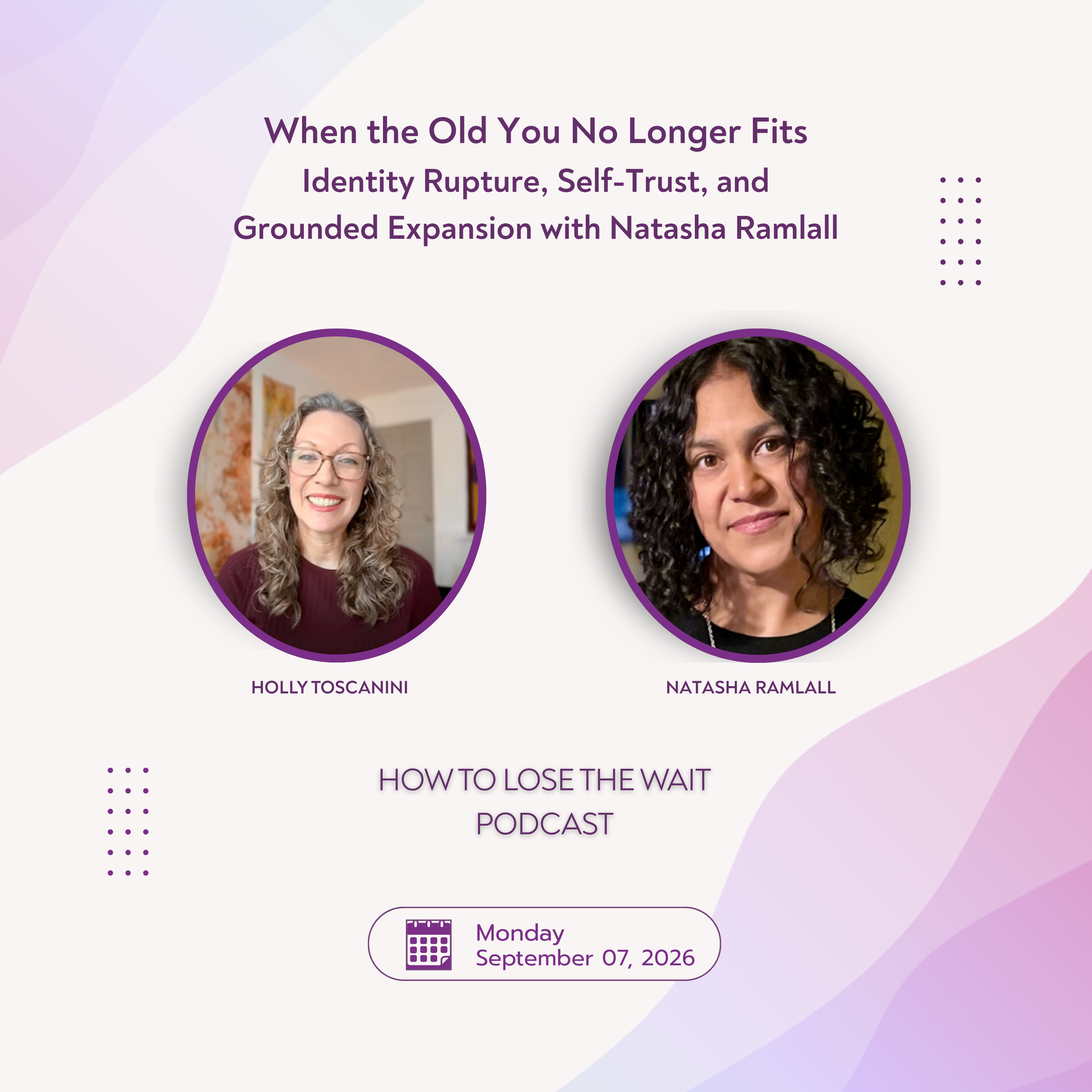
132. When the Old You No Longer Fits: Identity Rupture, Self-Trust, and Grounded Expansion
About this episode
There’s a particular kind of stuck that happens when you’ve already thought about the problem from every angle.
You know something needs to change. You may even know what the change is. But taking action still feels strangely difficult.
Holly’s guest today, Embodied Integration Coach Natasha Ramlall, has a phrase that explains why: “You can’t think your way out of an overthinking problem.”
Change isn’t only happening in your thoughts. Your body is part of the conversation too.
After making her own pivot following a 25-year career, Natasha became deeply interested in the disorienting in-between — the space between who you’ve been and who you’re becoming. Her work now centers on Identity Rupture and Grounded Expansion: creating enough internal stability to experience the grief, uncertainty, possibility, and growth that come with real change.
What you’ll learn in this conversation:
What Identity Rupture means — and why it’s more precise than saying you’re “going through a transition”
What it looks like for a woman who appears completely functional from the outside
Why being highly capable can make major transitions harder, not easier
What women do during this period that unintentionally makes the disorientation worse
Why more thinking, planning, and self-improvement often keeps you stuck
What somatic safety means in plain language — and how to recognize it
How Grounded Expansion helps women move forward without rushing into a new identity
Why grief and possibility need to coexist during a real identity shift
How to tell the difference between a grounding pause and avoidance
What aligned action feels like compared to action driven by pressure or panic
Free Guided Resourcing Audio:
https://humanistcoaching.eo.page/free-resourcing-audio
Learn more about Natasha’s work:
https://www.humanistcoaching.ca/
Subscribe for weekly episodes on self-trust, honest communication, and what it actually looks like to stop waiting and start moving.
https://uppbeat.io/t/mood-maze/trendsetter
License code: VGZ66UBEGXBP8YK8
Holly Toscanini: You know that feeling when you're stuck. You know you're stuck and you've already thought about it from every possible angle. You've analyzed it, you've journaled about it, you've talked to your therapist, your best friend, and probably yourself in the car a lot more times than you want to admit. And yet somehow you're still standing in the same place. My guest today, Natasha Romlal, has a phrase I think a lot of you are going to recognize immediately. You can't think your way out of an overthinking problem. Because sometimes you can understand exactly what's happening and still have a hard time moving forward because change isn't happening only in your head. Your body is part of the conversation too. And Natasha is an embodied integration coach who works with high-functioning, capable women who are navigating what she calls an identity rupture. And those are those seasons when a major transition, loss, awakening, or realization changes more than just your circumstances. It changes your understanding of who you are. And after making her own pivot following a 25-year career, Natasha became deeply interested in that disorienting space between the woman you've been and the woman you're becoming. And her work now centers on what she calls grounded expansion, creating enough internal stability to experience the grief, uncertainty, possibility, and growth that come with real change. And this is where Natasha's work connects so closely to what we talk about here on How to Lose the WAIT Because sometimes waiting isn't about needing more information. You already know something needs to change. The question becomes whether you can trust yourself enough to stay present in the uncertainty while you begin taking the next steps. So today we're talking about why being the capable one can actually make major transitions harder, and why insight alone doesn't always lead to change, and how to move forward when your old life no longer fits the new one that maybe hasn't fully taken shape yet. Welcome Natasha to How to Lose the Weight.
Natasha Ramlall: ⁓ thank you so much, Holly. What a great introduction. I was like all ears completely absorbed. And then I realized, ⁓ she's talking about me. It's it's me. ⁓ cool. ⁓ That's very kind.
Holly Toscanini: It's you, Natasha. Great. Well, there was your reminder of how amazing you are. Now, before before we ⁓ get into this concept of identity rupture and grounded expansion, I'd like to hear a little bit about your own experience because as I mentioned in the introduction, you made a major pivot after a twenty five year career. Well, what was what was happening in your life that made you realize the identity you'd been living just didn't fit any longer?
Natasha Ramlall: Well, to be honest, the the career ⁓ kind of coincided with some ⁓ health things and honestly just that point of midlife that I think a lot of women are familiar with where they realize that for several decades they've been kind of pushing themselves along ⁓ with a limited understanding of who they are and why they're doing the things that they're doing. After so many decades of doing that, I think a lot of women just wake up to realize, hmm, I don't know if I've ever stopped to question why I've made the choices I've made and if they're really based on what feels right to me. ⁓ and so that's kind of part of my story as well. ⁓ you know, I became a mom and a wife, and I was in my mid-twenties, which ⁓ you know, is not necessarily the youngest of ages, but I still was in that place in my life where I was learning about myself and really starting to just dip into this self-understanding, kind of separating myself from my family of origin and all of the patterns that I had inherited from them. And quickly I was, you know, thrust into this new identity of wife and mother, and then finding a job that could sustain those roles. So very quickly, ⁓ because I didn't know how else to approach that big change, I kind of entered into this survival mode, this state of pushing and kind of fighting my way through. And you know they say that when we're talking about these different nervous states that nervous system states rather that are that we inhabit when we're going through our life, Sometimes we focus on the ways that they haven't been serving us, but there's always a positive gain and a and a you know kind of a strength in the other side of it as well. And so through that pushing and kind of becoming a very capable, very productive person, I got really efficient. I recognized I was good at problem solving, I was very organized, ⁓ I stepped into some leadership roles eventually. But The energy with which I was using to kind of push my way through wasn't sustainable. It was very much up in the head, not connected to the experience of my body at all. And so that kept me really disconnected from the present. And it kept me really disconnected from experiencing life through pleasure and sensory delight and joy. and the things that really kind of make life worth living, you know. ⁓ and so in my early forties ⁓ I had ⁓ a chronic back issue that Know left me quite debilitated, and and that was really my forcing moment where I couldn't keep pushing past what I had been ignoring for so many decades, and I really had to turn all of my attention on healing. And it was at that time that I recognized: ⁓ there's this entire field of mind-body health that Kind of dips into all the things that I've been curious about and interested in for my whole life, all in one place. And I got really excited by that. And that was sort of Again, it kind of the timing, it just coincided with me having been in the same career for such a long time and just recognizing that I was ready for something new, something expansive, ⁓ something novel. And and so all of these things just kind of happened at the same time. And if I step back, I can say that was all by design, but in the moment it definitely wasn't clear to me that that's what was going on. ⁓ and that's when I made that shift. Yeah.
Holly Toscanini: Hehehe. Great. So let's talk about the term identity rupture. What does it mean? And why do you think that using that language ⁓ differently or instead of just saying I'm going through a transition, tell me a little bit about the term identity rupture. I think a lot of my listeners are very capable women and they've built careers, managed families, kind of everything you just described. ⁓ what can an identity rupture look like for a woman who appears completely
Natasha Ramlall: Yeah.
Holly Toscanini: Capable and functional from the outside.
Natasha Ramlall: Yeah. I think that that's you're you're you're hitting on some really important key words in that question because as somebody who identifies our worth through the way that we're able to show up to life, support others, that we're reliable, that we can, you know, be check all the boxes and get all the things done, when we have something in our understanding of self. That cracks or falls away or breaks or stops functioning in the way that we've come to rely on it. that is the the catalyst for this experience of identity rupture. And you know, we kind of learn to identify ourselves through our relationship to other people, to our work, to our home environment, to our bodies. And so if something ⁓ changes or shifts or breaks in one of those relationships, we can be left really questioning where does that leave me? Who am I if if that thing that I've been using to understand myself doesn't make sense anymore? And so for somebody who it identifies as hyper capable, that feeling of I don't know what to do. I don't know who I am. I don't know what's ahead of me. I don't know how to continue on this path that doesn't have a map or a certainty to look at ahead of me because I've been putting all of my focus and energy into this relationship that I've been identifying with and that I've been using to create meaning and worth in my self-understanding. So the experience of the identity rupture. is massive and I think that's why the word rupture is so important because we're really familiar with this term of midlife crisis. and I think that transitions and crisis, we can kind of think of those things as something that we manage externally. So we're looking at the context and we're fixing the things that need to be fixed. ⁓ kind of like ⁓ you know cleaning cleaning house but it's on an external level. ⁓ And the rupture is really about what's happening internally. And yeah, I think that it's an yeah, go ahead, sorry.
Holly Toscanini: I was gonna say what no, no, I just this just came up. It's like what do women I mean, we are these highly capable, highly functioning women with multitasking like crazy. What do women tend to do during this sort of period of uncertainty or disorientation that unintentionally makes the experience more difficult?
Natasha Ramlall: Yeah. Hmm. I think there's a lot of resistance. There's a lot of self-judgment and blame. ⁓ we often, you know. ⁓ and women in general re whether we identify as you know hyper capable or hyp hyper productive or not women in general tend to always look to ourselves first as the place to blame or fix when something's not working and so we can kind of see this period of disorientation as a personal failure. Or a character flaw within us and not recognize the magnitude of the transition or the rupture that we're experiencing. And I think that resistance and that focus on fixing or getting out of the discomfort as quickly as possible is where we really miss a golden opportunity and an invitation to actually use the rupture. as a catalyst for deeper self-understanding.
Holly Toscanini: Yeah, because I can imagine ⁓ the first thing a lot of us do is there's a problem, I'm gonna fix it. Right. So we go into I'm gonna research everything about my my problem or my issue, and then I'm gonna apply all the fixes I see on YouTube or TikTok or from my, you know, my Instagram page, whatever, whatever the experts say I'm gonna do, but that rarely fixes anything. ⁓ because we're trying to create a new plan instead of kind of getting back to the person that we're supposed to be in. It sounds like you are creating a space. Just to be still with that experience without immediately having to rush in and try to fix everything. Yeah. So many of us have built this whole identity of be around being a woman who handles everything. ⁓ so what happens when the thing we're facing can't just be handled or organized or checked off a list? Do you think being a highly capable person sometimes makes it harder to tolerate the uncertainty of the change that we're going through?
Natasha Ramlall: Yeah, that's exactly it. I do because I think that one of the personality ⁓ characteristics of women who tend to be very high functioning and capable is that we have a a very specific relationship with control and our understanding of control. And we, you know, honestly come by this understanding that if I make all the right choices, if I plan well enough. If I'm organized enough, if I'm on top of it enough, I can control the outcomes. And it's an illusion. We actually cannot control outcomes. We've never been able to control outcomes. But we have this relationship to control that helps us to feel as though we can be safe in our life. We can protect ourselves and protect the people we love from the inevitable, ⁓ unsafe and uncomfortable. Things that are going to come about in life. It's inevitable. ⁓ And so I think that's one of the things that makes it especially hard for this profile of woman because we have to realize: well, if I don't have control over outcomes, and I think that that's what a rupture is really a It's a powerful way of coming to understand that viscerally, because I have been making all the right choices and I have been doing all the right things and I have been playing my role as perfectly as possible, and yet here I am. This thing, this relationship, this job, this issue with my health and body is still happening. ⁓ and so I think that the shift really becomes about. Understanding how we've been understanding our identity, sorry, in relationship to something outside of ourselves. And that we can't really engage in self-trust from that. But if we can learn how to cultivate self-trust from a more internally referenced place, that is something that can never be taken from us. That's not something that is an outcome that we can't control. That's something that we can choose to be with and to nurture and to cultivate ⁓ in our own time and space, in our own way that makes sense to us.
Holly Toscanini: Yeah, there's so much messaging aimed at women about finding your purpose and, you know, creating your next chapter. What do you think I I know because I've said it myself. So what do you what do you think gets skipped when we rush directly into trying to fix or figure out what comes next?
Natasha Ramlall: Yeah. I think that that idea of self-improvement is is a noble thing. I think that as humans we do want to grow and expand and evolve. That's what we're here to do. But it's really it really matters where the energy is coming, what the energy is that's fueling that desire for self-improvement. Because if we're coming at it from a place of fear and not enoughness, then we end up in this perpetual loop. Of never feeling like we can just land in our human experience and just be in our life and be in acceptance with ourselves as we are. And that's not sustainable, nor is it a pleasurable way to be experiencing life. And it's really, it keeps us up in our head. So we're really more in a performative experience of life rather than actually inhabiting it from the place of felt direct experience. We can also engage in self-improvement from the energy of self-love. And I think that that is what we are here to do. But it requires us to get really honest and slow down and develop that deeper self-understanding so that we know. Am I choosing these things? Am I pushing myself in this direction from a place of fear? Or is it actually self-love that's kind of holding me through these changes? And I think that's a really key thing to ⁓ discern.
Holly Toscanini: I love that. being in a place of acceptance of ourselves as who we are, that's really powerful. And you're right, we are always trying to fix ourselves and thinking about how to do something better or be more. It's a it's a powerful experience to just say this is where I am, and it's okay to just sit with this for a little while. That's an important reminder. Yeah. Yeah. Now
Natasha Ramlall: Absolutely. Yeah. Self-acceptance is an incredibly challenging thing to do. And we're up against a culture in an environment that is absolutely not helping at all. Like I have a memory of ⁓ I had gone to visit ⁓ plastic surgeon's office ⁓ at one point because I had this I had this little thing on my arm and I was wondering if there was a process that could remove it. And I remember sitting in the waiting room for my appointment and every space on the wall, every corner of the floor had another procedure to address every possible thing that we could Even conceive of on our body and in our appearance. There was something for our hair, our skin, our eyes, the shape of things, the tone of things. Like, I mean, down to things that I would never have even considered, there was a fix for it. And I just thought, like, I actually felt kind of sick. being in the office and I and I was I I noticed that when when it came time for me to actually talk to the doctor, I had to restrain from telling him how offensive it felt to be sitting in his waiting room. ⁓ because it just I thought anybody who comes into this space, the entire energy of this room is just saying, look at all the things that you could fix about yourself to get closer to perfection. And So I we're up against that. We're up against this idea that we're not perfect as we are, and that we should be doing everything possible and biohacking our way and ⁓ bypassing all of the natural things that happen to us as humans in order to get closer to that perfect vision. And yeah, it's just such a shame.
Holly Toscanini: Yeah.
Natasha Ramlall: It's yeah, and and for women in particular, as as we all know. Yeah.
Holly Toscanini: Yeah. Now you say you can't think your way out of an overthinking problem. And I absolutely love that line because ⁓ my listeners are champion thinkers. So why does more thinking sometimes keep us stuck instead of bringing us some kind of clarity?
Natasha Ramlall: ⁓ yeah. Yeah, I well, if you think about the human experience as having all these different parts, we have our thinking mind, which helps us to understand our experience and interpret our experience through stories. And a lot of those stories are based on our under our memories and and our past experiences. And you know, we've got these different functions of the brain that are helping us to filter and really prioritizing. ideas of threat and safety. And so when we are in the overthinking mind, we're tending to just kind of spiral and ruminate on the same thoughts. And if something is uncomfortable, if something is ⁓ traumatic, all we're doing is just kind of reinforcing that story, sort of like digging deeper neural pathways and reinforcing the trauma as we understand it. If we are able to actually inhabit the physical somatic experience of the present moment, we get a different lens, we get a truer sense of how we feel in any given moment. And that opens up a whole new world of data, a whole new way of self-understanding. And it also helps us to. Grow our capacity to be with the different experiences that we go through in any given day, in any given season, in any given lifetime. And that I think can really shift the way that we're showing up to the different contexts in our life. Because if I understand that I'm feeling really Angry about something like I was with that doctor after sitting in the waiting room. I understand that when I go into the doctor's office, I'm entering that conversation with a filter of anger. And that is going to be a very different experience for me and for the doctor than it would be had I gone in with a filter of gratitude for a filter of curiosity or a filter of relaxation and calm and comfort. And we carry these different emotional filters into all the different contexts of our life. So having that self-understanding, coming back into that ⁓ reconnection with our sensory experience, ⁓ it it really kind of empowers
Holly Toscanini: Mm-hmm.
Natasha Ramlall: empowers us because we cut become more of ourselves. We become more of a the whole human. I become more of the Natasha that I that I am and you become more of the holly that you are ⁓ with a with a deeper level of self-understanding.
Holly Toscanini: Mm-hmm. Yeah. Now when we're talking about our nervous system needing to feel safe enough for change, what would that actually mean? I mean, what might a woman notice in herself when her nervous system is essentially saying, Nope, I'm gonna stay right here? And then how would that be maybe different from deciding that something just isn't right for you? How do we know when we're safe in our nervous system?
Natasha Ramlall: Mmm. So there are definitely different states of our nervous system that are nuanced and a little bit specific to different individuals and different contexts. You know, we might have sort of that fight energy that I was mentioning when I was younger, that kind of pushing and forcing our way through something. we might have more of ⁓ a freeze state where we're kind of functionally. stuck and unable to move forward. ⁓ And we might have that energy of just wanting to avoid, run away, get out of the situation. And so those are, you know, kind of really clear giveaways when we become aware of the different patterns that we that we inhabit. But I think that learning what it feels like to be safe or to experience safety. within our own physical experience, that can be a real game changer. And you know, for me, that was a process of because I was somebody who was up in my head. I remember the first time I was in a therapy session and the therapist asked me to ⁓ what was going on in my in my body. I was like, what are you talking about? I have no idea. I I don't I don't even I can't even answer the question. It doesn't even make sense to me. So coming from that lens and and then You know, learning how ⁓ there's actually a lot of energy moving inside of my body. My emotions have very specific ⁓ energies and feelings and sensations associated to them. And learning all of that has helped me to also learn that when I come into the present moment, I can usually find a place of safety that is not based on. Projecting into the worries of the future or sort of spiraling on the regrets of the past, which is what I tend to do if I'm stuck up in my head. ⁓ So really, like the I feel like I'm talking a lot around it. There's a lot of words here, but at the heart of it, coming back into the body brings us into a state of presence. And I think that when we're inhabiting a present experience.
Holly Toscanini: Yeah.
Natasha Ramlall: of what it feels like in any given moment, we're really truly able to discern what it feels like in the body and what is simply a story that we're telling ourselves in our head. And that can be a really powerful step toward determining the difference between that fear and love energy. Yeah.
Holly Toscanini: ⁓ absolutely. Yeah. So does feeling safe mean that fear disappears, or can you still be afraid and make some changes and and move forward?
Natasha Ramlall: ⁓ that's such a good question. I think that the most important thing that I've learned about embodiment is that what we're in fact doing is learning how to be in the full experience of humanness, which includes fear, it includes anger, sadness, grief, all of the emotions that we traditionally try to avoid and distract ourselves from and make us uncomfortable. And Whereas a lot of other kinds of practices are trying to bypass that experience, get us out of that discomfort, embodiment is really about Can I learn how to be with the discomfort? Can I learn how to grow my capacity for discomfort and still recognize that I'm okay? And recognize that I can hold different experiences of safety and some of these more contractive emotional experiences at the same time. ⁓ Can I pause you for a second?
Holly Toscanini: What changes in the way we ⁓ yeah.
Natasha Ramlall: So your face has been frozen for about 15 minutes and I don't know Okay. So I don't know I don't know if that's gonna impact your ⁓ Okay.
Holly Toscanini: Yours keeps freezing too. Sorry. It it shouldn't. ⁓ it it's it's happened in the past and it shouldn't, but ⁓ we'll just keep rolling and you know, if I do find that it's impacted the interview, we can always do it again.
Natasha Ramlall: Okay. Okay. Okay, sounds good. Yeah, I just wanted to let you know because I I've been waiting for your face to break. And it hasn't, and I'm like, no, it's okay. And it's so funny because I've actually had sessions with clients where something similar has happened, but because of we're doing a resourcing practice, they can often be very still. And you know, we'll sit in the stillness for a little while. And then every now and then I'll kind of be like, okay.
Holly Toscanini: Sorry about that. Uh-huh. Is she there?
Natasha Ramlall: Either is she still like has her screen frozen or is she really that still? And I
Holly Toscanini: really it I'm really still. No, it's fine. It shouldn't impact the video at all. But like I said, if it does it does, we'll just do a take two. So yeah. Yeah. all right, let's back up. I wanted to.
Natasha Ramlall: Ha ha ha ha. Okay, sounds good. Okay. Okay.
Holly Toscanini: Once we're grounded in this sense of presence, what changes in the way we make decisions?
Natasha Ramlall: I think that when we are really truly present with our experience, we have the ability to pause, and pausing can separate us from reactivity. So oftentimes we will be really reactive in our behavior, in the words we say, in the choices we make. This particularly shows up in relationships and the way that we interact with other people. And that ability to really slow down and notice because The key piece about presence is really about the slowing down and allowing ourselves to actually be in the experience of what's happening for us. We can understand the experience from a place with less judgment, a little bit more compassion, and a little bit more acceptance. And so we understand that, hmm, I'm having this reaction. ⁓ Obviously, this is creating feelings in me. Maybe I'm feeling angered, maybe I'm feeling sad, maybe I'm feeling hurt. ⁓ but I understand what that feels like in my body. I understand the things in my journey that have created this emotion to kind of express itself in me in this way. It doesn't mean that I need to react. It means I need to be with the feeling so that I can care for myself through this experience. And then once have really allowed myself to sit with the experience, then I can respond in a way that I would want to, if when I'm not so reactive, if that if that makes sense. Yeah.
Holly Toscanini: Yeah, that's that's so important. Yeah, it absolutely makes sense because so many times we react out of a sense of ⁓ self-protection or fear or anger, and we regret kind of what we did and we wish we could go back and make a different decision. And it sounds like just giving yourself the permission to be present in your body and just experience the all of the feelings and things that might be coming up also gives you an opportunity to make a decision that better suits the situation and what you really want. Yeah.
Natasha Ramlall: Yeah, absolutely. And and alongside of that, when we are learning how to create a new relationship with different emotions that we carry in the body, we can also gain new tools for processing those feelings and ⁓ allowing them to move through us energetically in a different way. So anger is a really good example. Sometimes that sensation of anger makes us it kind of comes up and out, and it's like this aggressive, projected type of energy. And so if we are not aware, if we don't have self-awareness, that can come out and be an attack on the other person. If we have the capacity to actually recognize ⁓ my goodness, I'm so activated right now because I'm feeling so much anger. And then we can lean into the tools that we've learned for processing that anger in a healthier way. We can do that work before we even involve the other person. Or we can recognize in the moment, I'm feeling really activated. I need to just step away for a minute. Can we continue this conversation in a minute? Or If you know, really quickly, I need to leave for a second, I'll be back. Maybe go for a walk, go for a run, shake your body, you know, different tools, different strategies that we can use. ⁓ and I think that that's a really key piece as well, because each of us has a very no nuanced relationship with our various emotions. And when we kind of cultivate and nurture that relationship and allow it to be there rather than resisting the anger.
Holly Toscanini: Right.
Natasha Ramlall: Thinking, I'm a bad person for feeling angry. I'm a monster when I get angry, recognizing that no, my anger is actually a healthy and necessary emotion for me because it helps me to touch into my boundaries. But can I, you know, make use of this anger in a way that's actually helpful and in a way that is
Holly Toscanini: Mm-hmm. Yeah.
Natasha Ramlall: Moving me in the direction that I want to be moving rather than again back to that reactive kind of up and out energy.
Holly Toscanini: Right. Now you call your approach grounded expansion. Can tell us a little bit about what that what that means and what that is.
Natasha Ramlall: I'm glad you brought it up because one of the things we haven't really touched on yet is the expansion piece. For me, is really, really about having some kind of a spiritual anchor. And I use the word spirituality very loosely because I think it can mean a lot of different things to different people. But at the heart of it, it is some sort of faith or belief in something greater than just this human experience. Something that gives us purpose, something that can help us to withstand the challenge of being in the messy ups and downs of our emotions. And the expansion part is really about.
Holly Toscanini: Yeah.
Natasha Ramlall: Holding the trust in that greater thing beyond us that's holding us through the experience while we are still grounded in the human part. Because I think that you know we tend to sometimes over-emphasize one or the other. I think a lot of people struggle.
Holly Toscanini: Mm-hmm.
Natasha Ramlall: ⁓ with all kinds of human afflictions from addiction to depression, anxiety, a lot of different terrible human experiences because they don't have that spiritual anchor. So that can be a really, really key piece. And I think for a lot of people who heal, recover, and come through difficult experiences, that spiritual anchor is often the key piece that they turn to. Likewise, a lot of people can try to bypass the discomfort of being human by over valuing the spiritual experience and forgetting that we're not just here to be energetic spiritual beings, but we are here having a human experience and being grounded in the
Holly Toscanini: Mm-hmm.
Natasha Ramlall: the full spectrum of what that means and understanding what we can learn from, how we can grow and expand from that, from the discomfort and from the pleasure and joy, is also part of the experience. So really my orientation in my personal life, but also in the work that I do is to help people come to a more balanced state of grounding in the humanness while expanding into that bigger, ⁓ more larger purpose. Yeah.
Holly Toscanini: Right. Something I immediately saw in your work was the connection between grounded expansion and what I talk about is moving before we have complete certainty or clarity. How do you begin expanding into something new without using your new life as just another way to run around run away from the discomfort of maybe your old life?
Natasha Ramlall: Yeah. Hmm, that's a great question. And I think that a really big Shh, a really big difference between those two energies is our our expectation around outcomes. And again, coming back to what is driving me? Am I doing this out of a fear of not being enough if it doesn't get accomplished? Am I doing this because I'm feeling some sort of vibrant energy within me that wants to create and wants to express? Because those are really ⁓ expansive human drivers. as opposed to this sort of wanting to escape the feeling of not enoughness, which is, you know, coming from a place of fear. ⁓ And so I think that a lot of times when we are able to lean into the process Of getting to whatever the goal or the outcome or the achievement is. And we can really be in the full experience of the process and detach a little bit from what the outcome is going to look like, that can signal that we're really approaching it from a growth energy that's from a place of expansion and love. ⁓ When we start to create all kinds of stories about success and failure and ⁓ mistakes and what it means to to try to make a change and for it to not go the way that we want it to, in the timeline that we want it to, those are signals that we're probably pushing at something because we're trying to fill a hole that this this may not necessarily be the right way to fill.
Holly Toscanini: Now you talk about holding the grief of what's ending alongside the potential of what could be coming next. Why do you think we need to hold space for both?
Natasha Ramlall: I think that a lot of people, again, because grief is such an uncomfortable place to be, that we may move into the place where we can escape the experience of grief. But if we never actually sit with and understand what the grief is teaching us about ourselves. Whatever we're moving into is likely just going to bring us back into a similar pattern. We're going to have the same kinds of experiences ⁓ that want us to reckon with that part of us that we're kind of denying, resisting, or embracing against. So sitting with grief, sitting with the uncomfortable emotions, learning the value of having. our various experiences. You know, like grief, for example, obviously is not something that we'd ever want to wish on ourselves because it's incredibly painful. But without grief, well, grief is the other side of love. It just shows us that we've loved something deeply enough to feel that much grief when it's gone. And when we start to understand that life is this process of continual contraction and expansion. We can learn how to be an acceptance of that kind of discomfort allows us to move forward and expand into something bigger. And I don't want to say better necessarily, but that feels more like us or like a fuller version of us. ⁓ And yeah, if we never allow ourselves to accept the contracted state, we kind of deny ourselves of the expansion that accompanies it at the same time.
Holly Toscanini: Yeah. Yeah. I think ⁓ sometimes women just replace one set of expectations with another. We finally leave the identity that wasn't working and immediately start reconstructing this woman that we think we're supposed to be next. Do you see that happen? And and if you do, this is gonna be a two-parter here, sorry, if you see that happen, how do we give ourselves enough room to discover who we're becoming instead of turning reinvention into just another set of performances?
Natasha Ramlall: Yeah. ⁓ absolutely. Okay, that's okay. Mm-hmm. Hmm. I think it it really is allowing ourselves to take the time and space to slow down. If if we really start to recognize that these identity ruptures, the thing that's that's caused me to get to this place, is not something that again needs to be externally managed and then as quickly as possible get back on the path. But It is an invitation to actually slow down and get some really deeper introspective ⁓ space to kind of reconnect with ourselves, with our body, and really gain a deeper self-understanding is really at the heart of it. If we are open to that, if we have the capacity for that, if we have the privilege to take that time. That that slowing down and that sense of presence, I think, will naturally open us up to understanding, seeing understanding our experience in a new way. But if we don't recognize that this is an internal job, I think that perpetual pattern of just pushing forward will continue until something you know out of our control really stops us and says, nope, you're not pushing anymore. You really need to stop and look at it.
Holly Toscanini: Yeah. So let's say that there's a woman listening right now who maybe knows her life just doesn't fit who she is anymore. Career, relationship, I don't know, even just her sense of identity, but she doesn't know quite what comes next. What would you want her to do first?
Natasha Ramlall: I would want her to slow down. I would want her to take some time to recognize that this could potentially be a really beautiful time of shifting. And even though when we are wanting something new, it feels like let me let me reframe that. We have this idea of change, we we want something different, we have a desire. Oftentimes that will be coming from our thinking mind. Maybe in the body, something signaling that I'm not satisfied, I want more, something's off. But we start to visualize and we start to plan and we start to idealize what it is that we want to be moving toward. And if we don't take the time to slow down and understand. what the driving factors are, what emotions it is that we're actually seeking to soothe or to meet. ⁓ Whatever it is that we're moving toward is not going to be the thing that that fills our cup. I feel like I didn't answer your question there. I got a little bit off there.
Holly Toscanini: That's okay. Maybe so let's say this woman is recognizing that that her life needs to change. Can you give us something that she could practice today that helps her get out of that mental loop and maybe reconnect with what she's experiencing in her body?
Natasha Ramlall: Mm-hmm. Yeah. Well, actually, I do have ⁓ a free guided audio that I'd love to offer to your listeners. And this is a resourcing practice that helps women to come back into the experience of the body and to really feel ⁓ connected to that sensory experience. ⁓ this is a really good practice for people who've never really connected with the body up in this way. But it's also good for people who have experimented with resourcing and tried to feel into their body, but they would like a fresh approach. ⁓ and what I think is important is that when we kind of sit In stillness, maybe with our eyes closed. We often assume that that's meditation. And ⁓ I just want to differentiate between a meditation practice and an embodiment practice because meditation is really escaping the experience of the body and kind of getting beyond the body into something that is, you know, beyond the thoughts and more of this consciousness that is outside of us. ⁓ this resourcing practice is about coming into an experience of the body. And settling in and finding, you know, like a glimmer of neutrality, stillness, calm. And that is a really first step back into feeling safe in the body. ⁓ So that's a really great place to start. I think that. ⁓ breathing is also a really wonderful foundational practice. It's something that we sometimes take for granted that we're breathing all day, but we don't necessarily stop and notice if we're breathing in a way that feels deep and nourishing or if we're just kind of shallow breathing. And I think once we start paying attention to it, it becomes intolerable to not be taking deeper breaths on a regular basis. So that's a really good practice as well. ⁓ ⁓ yeah, I would start there.
Holly Toscanini: Great. You know, I talk a lot about waiting on this podcast, but I don't honestly believe every pause is avoidance. Sometimes we actually need some time. How can we tell the difference between a grounding pause that's helping us integrate change and waiting because we're afraid to move?
Natasha Ramlall: Yeah. Mm-hmm. Yeah, that's a really, really great question because I think that our relationship to waiting is one of those places where when we gain deeper self-understanding can be very illuminating. Am I uncomfortable with waiting? Which is, you know, the profile for a lot of women is Moving into the next thing, staying really busy, staying occupied all the time because they don't want to be with the emotions that surface when they stop and enter stillness for a little while. ⁓ And that relationship with waiting is, you know, another clue that something is off. ⁓
Holly Toscanini: Yeah.
Natasha Ramlall: But likewise, if we are noticing that there's something that we want to start, but we're preventing ourselves from doing it because we have ideas of perfectionism, or we think that it has to be a particular way, or it's not worth doing. ⁓ Or there are parts of us that are feeling threatened and challenged by the new unfamiliar thing that we want to try. Slowing down and being with that present experience can help us to understand: okay, what is the part of me that's feeling threatened by doing the thing that I'm waiting on? And when we can give attention and space to that part. We can sometimes lose the resistance to it. It's like there's that famous expression, what we resist persists. And that's very true in terms of our emotional experience. If something feels like we don't want to go there and we resist it, it's going to just get louder and take up more space in our experience.
Holly Toscanini: Yeah. Now both of us work with women who have spent years being really good at meeting everybody's expectations. What happens when a woman finally realizes, Hey, I I don't want to live by these rules anymore? I mean, where does the resistance usually come from when she starts making choices that are more honest for her?
Natasha Ramlall: That's interesting because it I it's unbelievable to me, and this has been my experience as well, that we don't recognize that we have needs, that we can go so many, so many decades of life without actually recognizing that we have needs too. ⁓ And so I think it's a mix. Sometimes it is the relationships that we've been in where we find resistance because we have taught those relationships. a particular way to understand us and expect from us. And we've kind of taught them how to treat us. And so if we want to change and we want to be meeting our needs in a different way, we might you know get some resistance from the people around us. Sometimes that's by design as well, because it's really almost like a test to ourselves: like, do you really want this? Because I think what's actually the strongest one in the mix is our own resistance. It's our own feelings of guilt and shame and not enoughness, and our relationship to worthiness and deservedness that keeps us from meeting our own needs. And so we really need to get honest and reckon with all. Of the different parts of us that are scared and that are resisting and bracing against the unfamiliar new thing. and if we are honest and we are making these changes from a place of deeper self-trust, I think our relationship with other people will also change and we'll start to understand ⁓ how how those relationships are functioning in a way that's serving us or not serving us and and feel more empowered to change that.
Holly Toscanini: I I know we we've both talked about women not needing to fix themselves and I've shared that I spent a lot of my own life thinking I needed to become a more acceptable version of myself before I could fully participate in my own life. Why is it that this impulse to fix ourselves is so powerful during a transition? I mean, what's changing when women begin treating discomfort as information instead of evidence that something is wrong?
Natasha Ramlall: I think that we have been really socially conditioned to externally reference our life. So we trust other people over ourselves. And we learn this from a really young age, right? ⁓ from the time that we are small children, we get cues from our caregivers and from the adults in our life that are taking care of us that. These things can be trusted and these things are safe and these things are okay to feel, but these things are gonna lose you love, they're gonna lose you connection, they're gonna lose you belonging. And oftentimes we learn kind of what we can trust within ourselves based on the cues that we get from the adults and caregivers in our lives as well. You know, if something happens, for example, and we have an inner knowing that it's wrong or it's off or somebody something's not right, but our family kind of doesn't want to talk about it and they sweep it under the rug and it becomes, ⁓ that's nothing. You're just being too sensitive. Don't make a big deal out of it. From a very young age, we're already starting to erode that self-trust that tells us, no, that thing inside of me that said something's wrong, that's that's there for a reason and I can trust it. That becomes, ⁓ well, these people who obviously know more than me, I have to trust in them, are telling me that that's nothing. So I guess I must be being too much, and that's that signal that I'm detecting from within is the thing that can't be trusted. And over time we really lose an ability to internally reference our own choices. And you know, we all have probably been in that experience where we needed to make a decision. And we knew we knew what the decision, the best decision was for us. But before we could actually step forward, we had to ask 10 of our friends what their opinion was. Or we now we'd jump on jump on Chat GPT and get Chat GPT's opinion on it. ⁓ and just because obviously the the opinions of others hold more value than my own knowing.
Holly Toscanini: Right.
Natasha Ramlall: And I think that this this reorientation is kind of the is reclaiming that autonomy of I actually know me better than than Chat GPT does.
Holly Toscanini: Right, yeah. True, right? Now when you're when when you think back on your own 25 year career pivot and the period of disorientation that followed that, what do you wish somebody had told you then that you understand now?
Natasha Ramlall: ⁓ that's really good. One of the thing, one of the biggest lessons that I've learned through that experience ⁓ was around the idea of masculine and feminine energy and how that flows through our experience. I had been very masculine, energetically oriented because I was up in my head, because I was performing my life, and because I was meeting expectations and trying to do things from a very logical, linear, cerebral, problem-solving type of way. And entering into a new career, which was, you know, based on entrepreneurship and I'm responsible for me. ⁓ Is there's a lot of power in the feminine energetic experience because we can really start to trust ourselves and it can be a very relational experience and leaning into our intuition and starting to learn our relationship to receiving and ⁓ you know that sort of customized way of approaching what what we're doing in a new way. But those things both need to exist in balance. One of one of the other, one too much of one and not enough of the other always leads us to a problematic place. And so in the functional free state, I was lacking a sort of a masculine framework to allow the feminine flow to have space
Holly Toscanini: Mm, mm-hmm.
Natasha Ramlall: to flow freely. And so recognizing that it's not one or the other. And even though I had been overvaluing the one, there was still a lot of good and a lot of ⁓ there were a lot of benefits to that way of approaching my new career, my business, and what I was doing in my life. But the key was finding how to balance those two parts in a way where I wasn't overly indexing in one type of energy or the other. And I've heard that experience from a lot of women where they find they kind of swing from one extreme of the pendulum to the other. And they're either just pushing and pushing and pushing in hyperproductive mode, we leading to burnout,
Holly Toscanini: Mm-hmm.
Natasha Ramlall: And then they burn out and they kind of go to the other extreme where their being is massively improved, but they're stuck and they can't kind of get beyond that that place of just sitting and allowing and receiving. And so finding the flow between those two energies, I think if I had had some more guidance around that and didn't have to figure it out myself, that would have been incredibly helpful. But
Holly Toscanini: Mm-hmm. Mm-hmm. Absolutely.
Natasha Ramlall: But like most, but like most things, it's sort of living through the experience where we get to embody it at a different level. So I suppose I am still grateful for the experience of having gone through it all.
Holly Toscanini: Yeah, yeah, that's a great answer. So for any woman listening that's in that uncomfortable space between who she's becoming and who she is, what do you most want her to be able to understand about herself where she is right now?
Natasha Ramlall: That she's okay, that everything is okay as it is, and that if we slow down to the point of inhabiting our life, like in the v absolute present moment, there's nothing that needs to be urgently solved today. And we can really Give ourselves permission to accept that this is what life is. Sometimes things are clearer, sometimes we don't know yet, sometimes things are slower and we need more rest. And sometimes we're inspired and we're in action and things are moving and flowing, and that all of it is okay. And that we're allowed to take space. For all of those expressions of life without judgment, without feeling guilty, without feeling shame, without feeling that we're wrong, without feeling like we're doing life poorly. ⁓ and that I think is a really powerful shift. If women can really, really drop into that, that that's a game changer. Yeah.
Holly Toscanini: Yeah. Yeah. I 100% agree. Absolutely. Okay, Natasha. We've talked about embodied integration throughout our conversation and you actually created a special way for listeners who are curious about this work to experience it for themselves. So tell us just a little bit about what happens in an embodiment integration session and who do you think is really going to benefit from this the most?
Natasha Ramlall: Mm. So embodied integration, to be honest, sessions look different from person to person just because we are also nuanced and we all exist on a very different, we exist on a spectrum in terms of how easy it is for us to drop into the experience of our body. That said, this is a really great Modality for women like me who have spent a lot of time up in their head and sort of performing life from a place of survival and learning how to drop back into the body, learning how to slow down, learning how to find little glimmers of places within our experience that feel a little bit calmer, a little bit more still, or maybe just neutral. that is a really huge benefit for women that are stuck up in their head and kind of ruminating and overthinking and looping on things that are causing a great deal of discomfort and anxiety or depression. ⁓ so this offer is is a is a really great introduction to just try it and kind of get a sense of actually what is my relationship to being in my body? Because for some women it feels really wonderful. and it's ⁓ it kind of cracks something open for them. And for other women it can be ⁓ a really great awareness exercise in understanding, ⁓ wow, there's it feels really uncomfortable to be in my body. And I I feel a lot of it doesn't feel safe to be in my body and that's a very very important thing to understand about ourselves if that's the case. ⁓ so I think it would benefit everyone to be honest. That might be my bias but yeah and so yeah if your listeners are curious I I have an introductory embodied integration coaching session discounted for your listeners ⁓ and they can I think access that through your show notes. Yeah.
Holly Toscanini: Yeah. Yeah. Ha ha ha Yes. Yes. Natasha, thank you for this conversation. I think this has been really enlightening and I hope that there's somebody out there that's gonna take you up on there. I probably more than one somebody, because this is a really good experience and a good opportunity to get back into your body without the guilt or the shame, ⁓ or just that uncomfortable feeling. You're maybe not not quite sure that you want to be in there. I think one of the most important things that you've reminded us today is that the The in-between doesn't mean we're doing change wrong. You know, we're not doing it incorrectly. And sometimes the old identity has loosened its grip before the new one has had time to really take shape. Yeah. Okay. So if you're out there and you want to experience Natasha's work for yourself, she's offering the How to Lose the WAIT Listeners a discounted embodiment integration session.
Natasha Ramlall: Mm. Yeah, absolutely. Absolutely.
Holly Toscanini: It is $44 Canadian or about 30 US. And you can book that session through the special link in the show notes that are going to be included in today's episode. And you can also learn more about Natasha and her work at humanistcoaching.ca. And we'll link her free guided audio that she mentioned earlier as well. And if you're currently standing somewhere between a life that no longer fits and whatever comes next, you don't have to have the entire new identity figured out before you move. So pay attention to what you know now. Find enough ground beneath you to take just one honest step because you can allow the rest to reveal itself as it goes. Remember, there is really nothing left to wait for. Until next time, bye for now.
 Apple Podcasts
 Spotify
 Castbox
 Castro
 Goodpods
 Moon FM
 Overcast
 Pocket Casts
 Podbean
 Podcast Addict
 Podcast Republic