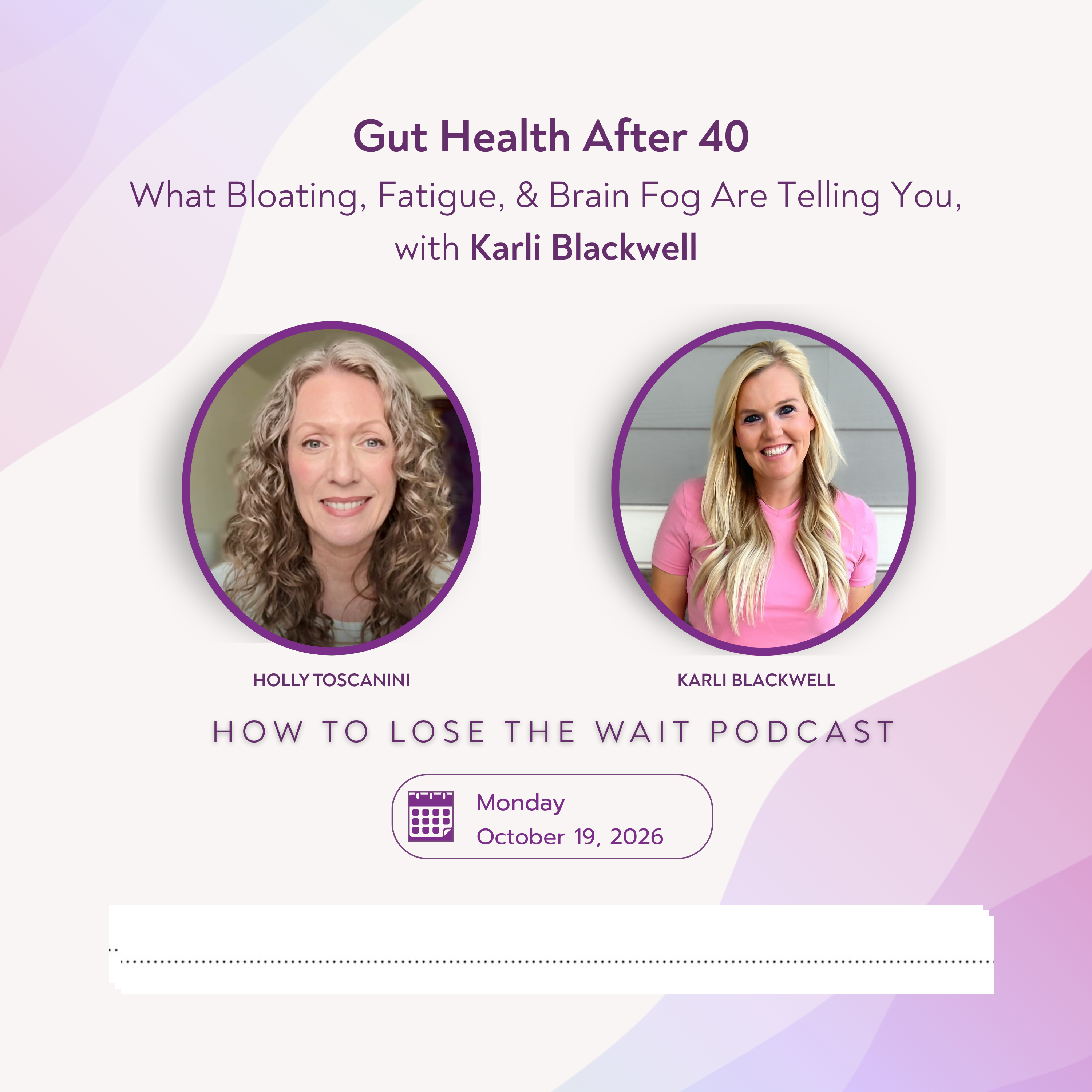
138. Gut Health After 40: What Bloating, Fatigue, & Brain Fog Are Telling You, with Karli Blackwell
About this episode
Wellness coach Karli Blackwell explains how gut health, inflammation, and blood sugar affect energy, bloating, and sleep for women over 40 and in menopause.
Fatigue, bloating, brain fog, and the 3 p.m. crash often get brushed off as part of getting older. In this episode of How to Lose the 'WAIT,' life coach Holly Toscanini talks with wellness coach Karli Blackwell about gut health after 40 and what those everyday symptoms may be telling you.
Karli spent nearly twenty years with digestive issues, saw five GI doctors, and tried every diet from SlimFast to Weight Watchers before she started asking why her body felt the way it did. She now works with clients on three areas she calls the pillars of health: gut health, inflammation, and blood sugar balance. She and Holly talk about why so many women push through symptoms for years, how these three areas show up in perimenopause and menopause, and how to start listening to your body again after decades of following someone else's food rules.
In this episode:
- Why Karli started asking "why" after her fifth GI doctor diagnosed IBS
- The difference between symptoms that are common and symptoms you have to live with
- Everyday signs your gut could use more support, including sugar cravings and mood
- What inflammation has to do with how you feel day to day
- Why blood sugar matters for energy, cravings, and sleep even if you aren't diabetic
- How gut health, inflammation, and blood sugar show up in midlife and menopause
- How to start trusting your body's signals after years of dieting
- Why a human coach can see things a midnight Google search can't
- One micro move for this week: track your energy for a few days
Connect with Karli Blackwell:
Instagram: @loving.my.gut https://www.instagram.com/loving.my.gut
FACEBOOK: https://www.facebook.com/p/Loving-My-Gut-100077920909689/
WEBSITE: https://karlibguthealthcoach.wixsite.com/mysite
Resources from Holly:
The "What's Next?" Self-Coaching Session (free): https://withme.so/hollytoscanini/lead_542
When You Can't Stop Second-Guessing Yourself, a 5-day private podcast ($37): https://withme.so/hollytoscanini/dm_7519
This episode is for educational purposes and is not medical advice. Talk with your doctor before making changes to your health care, medications, or supplements.
Licensed Podcast music https://uppbeat.io/t/mood-maze/trendsetter License code: VGZ66UBEGXBP8YK8
gut health, gut health after 40, bloating, fatigue, brain fog, inflammation, blood sugar, menopause, perimenopause, women over 40, IBS, energy, sleep, non-diet, listening to your body, wellness coach, midlife health
Holly Toscanini: How many of us have been told some version of that's just part of getting older? The fatigue, the bloating, the brain fog, the 3 p.m. crash that causes you to reach for another cup of coffee. At some point, a lot of women decide this is just how they feel now and they stop asking questions. My guest today kept asking. For nearly two decades, Karli Blackwell struggled with health issues that didn't come with easy answers.
Karli Blackwell: .
Holly Toscanini: She tried different approaches, spent thousands of dollars, like all of us, and still felt hopeless. Then she found a way of looking at health that started with the foundation and it changed the direction of her life. Now, for the past seven years, Karli has immersed herself in gut health and wellness, learning from and working alongside medical and health professionals. Today, she's a wellness coach who helps people connect the dots between how they feel and what may be happening underneath the surface. Her work centers on three main areas gut health, inflammation, and blood sugar balance. And what I appreciate about Karli is that she has no interest in handing anybody another restrictive diet. She helps people ask better questions and understand their own bodies. And for those of us who have spent years following somebody else's food rules, that matters. So if you've been waiting to feel like yourself again, this conversation is for you. Karli welcome to How to Lose the WAIT
Karli Blackwell: Thank you. Yeah, thank you for having me. I'm excited.
Holly Toscanini: Well, you know, I want to start with saying that y you did deal with health issues for almost twenty years, you said. What finally happened that made you get more interested and decide to take matters into your own hands? What shifted for you?
Karli Blackwell: Yeah, I did deal with it for a long time and my issues started in college and it was just a really rough time to have issues with my health because, you know, people were out having fun, having the time of their lives and I just wasn't and I was really feeling most of the time bloated and just not myself, my low energy, all the things. And you start to lose your confidence as well when you don't feel good and especially when you don't feel good for so long. It also takes a toll on your mental and emotional health. And that was that for me. And so I just think I just saw so many doctors. I thought that they would have the answers for me. I just figured, you know, there's one problem, right? And I need to fix that. It wasn't until I started asking different questions, like you had mentioned, I started just thinking about but why does my body feel this way? It really shifted when I saw my last of five GI doctors and they told me you have irritable bowel syndrome. And I said to them, I know I do, but why do I? I don't need to come to you to say your bowels are irritable. I know that's why I'm here, but why are they irritable? And people couldn't answer that question for me. And so that's really where my shift came to focus on. I don't want a band-aid solution. I want to understand what's happening because I feel like once you have that understanding, That's when you can really start to figure out how to fix it and how to change what's going on. That's really where my shift came in. It was a massive blessing when all that happened.
Holly Toscanini: That must have been a real struggle because I know so many young college age women, I mean, we have so much going on anyway, but going to a doctor as a woman, especially a young woman, it's not surprising that you get sort of dismissed and y they just blame it on something, right? You knew what you knew you had IBS, you were there for answers. And so that must have been really frustrating.
Karli Blackwell: It was really frustrating. And I think we grew up in a world where we rely so much on Western medicine. And I do believe in Western medicine because my daughter has seizures and she's on medication and her neurologist is amazing. And I believe it's important, but I do think we need to take steps into opening to a broader scope of what might be happening when you're not finding answers. You don't have to just keep like pounding the same thing over and over again because That's honestly insanity is trying to do the same thing but expect different results. And so it can be extremely frustrating. And I think that's where I was able to meet a friend who finally kind of opened my eyes to that thought of there's something deeper, there's something more, our health is very layered. And that was a huge blessing and something that helped me really understand that. Lots of people are going through these things and we can ask questions differently than we have been in this culture.
Holly Toscanini: Yeah. you must have been feeling a little skeptical about trying something different. you know, we're raised to believe that you go to the doctor and you get the medicine. So what made you willing to try something different anyway?
Karli Blackwell: Yeah, skeptical is a great way to put it because I was very skeptical and I'm very open about that. Whenever I talk to anybody, I always say, I was one of those people that was rolling my eyes, like talking to this girl about all these things she was doing. And I'm like, why wouldn't I have heard of that before? Why would the doctors have not have said that if it works? You know, if it's worked for hundreds of thousands of people, why have I not heard about it yet? So I definitely was skeptical. I think what happened too is I just got to the point where I had tried so many things. I had tried cleanses and diets and doctors and even weight loss things like SlimFast and Special K Diet and Adkins and Weight Watchers. I tried so many things for my health that it just wasn't working. The skepticism was there, but it's also getting to the point where you have to keep searching until you do find what works. And my husband was really great and he was really supportive and just said like, what do you have to lose? Try it. If doesn't work, you stop. You you don't do it. It's not, it's not as serious as you're making it in your mind. But skepticism can be a real thing when you're just exploring something you haven't explored before. can be, it can be scary.
Holly Toscanini: Yeah, because you kind of go into it thinking it's not gonna work. So y I think your husband
Karli Blackwell: Mm-hmm.
Holly Toscanini: had great advice. Just have an open mind and try it and see what happens and you know, try to be objective, right, about what you're experiencing. Great advice, yeah. Well, tell me a little bit more about how your own experience turned into helping other people. How did you make that transition?
Karli Blackwell: Yeah, it was really natural actually. And to be honest, when I first started, I didn't talk about it with anybody and I didn't think I was gonna talk about it with anybody.
Holly Toscanini: interesting.
Karli Blackwell: Yeah, I just started on this program and I thought, well, we'll see if it works. But as it worked, people started to notice. I thought I was hiding my health, but apparently it was more obvious than I thought. So when I just started to look better, look. have more energy, my eyes were brighter, my skin was better, I had less bloating, like I was wearing clothes that were more appropriate for the season, because I used to wear baggy sweatshirts when I was bloated And people noticed, you know, and they wanted to know what I was doing. And so then I started to open up to telling them what I was doing. And as I did that, it was amazing how many people struggled. Like every person I met. would have something similar to what I was going through. Whether they were struggling with digestion, which was a big part for me, or whether it was their energy, whether it was sleep, whether it was weight, you you get kind of moody when you're feeling off and
Holly Toscanini: yeah.
Karli Blackwell: you're unbalanced. And so, like so many people I talked to felt off and felt crappy and a lot of us just don't talk about it. And so I just made this thought in my mind that if this is working so much for me, I want to tell people because it's been a massive life changing blessing and my heart just goes out to people I hear have these health struggles that they can't figure out. And then I just wanted to shout it from the rooftops. And so I really just started to help people and I started to help them on their program. And I really, trained and I learned and I was educated. And then I was able to build this this wellness coaching business that I have that I absolutely love because I've experienced it myself and that's what I wanted to help other people with as well.
Holly Toscanini: Amazing. Yeah, you know, there you mentioned a few things that you tried at wellness products and protocols and and really in the last twenty or thirty years wellness has become a whole industry in itself. There's so many things out there. What do you think people are missing when they are trying to try some of these products or or fads for lack of a better word, to try to make themselves feel better? What what's missing when they're looking for an answer?
Karli Blackwell: Yeah, I think what's missing is a lot of us look at treating symptoms instead of treating the root cause of problems. And that's what I dealt with for like 16 years. I was just trying to help myself digest properly. And so I would get a pill that would be like, here, you can poop better that way. Or eat more fiber and you'll be able to poop better. Or why don't you exercise and get more sleep and you'll feel more energy. It wasn't symptoms I wanted to treat. It was figuring out. how to stop these symptoms from happening, not just masking them and treating them. And I think that's what we miss is that there's so many products that will just cover the surface, mask the symptoms. And I look at it like a rug with garbage underneath, right? If you wanna lose weight, people are like, well, eat healthier and do those things. And it's like, you can layer those rugs all you want, but if there's stuff happening underneath that you're not addressing, it's not gonna work. That stuff's never gonna go away. You're gonna be fighting an uphill battle. And I think that really makes people frustrated and it makes them feel helpless and hopeless. And I really think that's what we're missing is the really the base foundation of what's happening.
Holly Toscanini: And in our desperation to find a solution, we ups end up spending thousands of dollars on a supplement for a symptom. And you end up having multiple bottles or droppers or powders, and none of them really help you what like what you said, kind of get to the root cause that's underlying all of these issues. Can you talk a little bit about the root of the problem? What does that actually mean
Karli Blackwell: in new.
Holly Toscanini: to somebody in plain English?
Karli Blackwell: Yeah, yeah, that's a great question because I didn't really understand it either at first. But the more that you are educated on what actually is going on in your body, you think about what you eat and drink is fueling your body. So that goes down into your digestive system. So your digestive system is what fuels your body. And so starting there and making sure your digestive system is healthy will help your other body parts function properly. And asking why is this happening instead of what is happening? I know that I am hormonal, for example, but why am I hormonal? And I wanna work on that. And when you figure out that, then you can get to the root of your problem. And yeah, and I think paying attention to symptoms are very important because you do need to know what's going on in your body, but we need to fix the main problems of what's going on instead of just treating symptoms. And to me, that's what the root cause is.
Holly Toscanini: Yeah, and you know, so many like disproportionately I think w women over men suffer from IBS and digestive issues. Why do you think so many women just accept feeling tired or bloated or low energy or, you know, suffer with brain fog? Why do you think they just accept that as norm?
Karli Blackwell: I think women are incredibly good at pushing through things. And I feel like women are very strong, honestly, and they don't want to complain and they don't want to look weak. And we have so many things in our lives that we do. We take care of kids, we work, we manage a household, we do all the things, and then we tend to put ourselves on the back burner. And I think society in general makes us feel like the way we're feeling is normal. If you're tired, it's because you're a mom or you're busy. If you have brain fog, it's because you're stressed. If you are bloated all the time, it's because you're getting older and your digestive system isn't working. We hear these things in society and we start to believe them and accept them as normal and just the way that life is going to be. But what's so important for women, especially over 40, is to realize it doesn't have to be normal. It is very common. There's a difference between this is normal and this is common. Because common, our bodies are out of whack because of what we eat, because of our stress, because of environmental factors and medications and know, birth controls and antibiotics, all of these things are messing up our body. They are doing that. So the symptoms are telling us, yes, your body is messed up and that's okay. We're going to fix it. And instead of... you know, just accepting it, understanding that there's some things that you can do to combat the societal, you know, negative problems that we have within our systems and improve our health and not just accept that this is the way life is.
Holly Toscanini: Right, right. Now in the introduction, I kind of mentioned the you focus on three pillars of health, on gut health, inflammation, and blood sugar balance. Why these three things?
Karli Blackwell: We call them the pillars of health because if you look up almost any ailments that you have, you will find they are connected to one of those three things. And like I was mentioning with our gut, is we often think that gut health is about pooping or not pooping, right? Digesting well, bloated, it's just like that's the circle we put, the bubble we put around gut health. It's not true.
Holly Toscanini: True.
Karli Blackwell: Yeah, it's not true that that's not gut health, but that's what we say
Holly Toscanini: Yeah.
Karli Blackwell: exactly. And if we do think about the fact that our gut health is anything we put in our body until it comes out the back. So everything our body's fueled with is causing either problems or helping our bodies. And we are in massive control of that. But over time, our bodies struggle to function properly in our guts. Our bodies struggle to balance bad and good bacteria. That has a lot to do with antibiotics, big part of it. Our bodies. are inflamed because they're trying to protect itself and they're having these inflammatory responses. And our blood sugar, that's so important for everybody, not just diabetics, because our body is regulated by this insulin, and insulin is actually our master hormone. So as our insulin is controlled in a natural and positive way, it trickles down to all of our other hormones. So these three pillars are really where our body health starts. This is our overall body health and wellbeing starts with these three core things that really affect how our bodies function.
Holly Toscanini: Okay, so if we just start with the gut, what are some everyday signs that somebody's gut could use more support?
Karli Blackwell: Yeah, and there's the obvious ones, you know, the digestion and sensitivities to food and the bloating and those things like that. Most people don't recognize that you actually should be having bowel movements multiple times a day. We all think you should go at least once a day or every other day, that's fine. But if you think about the amount of times you eat in a day, your body's processing all that food and breaking it down. It needs to be released. Whether it's the excess that your body can't absorb or whether it's toxins or other things, it needs to be released. And so a big factor is the amount of times that you have bowel movements. That's a big factor. But there's also some other important parts of our gut health, which is the major production of our serotonin, which is our happy hormone, and our melatonin, which is our sleep hormone, is produced in the gut. The majority percentage is produced in the gut. So if we do not have a healthy gut, our productions of those hormones is not functioning like it should. When we feel depressed, when we feel anxious, when we feel moody, those things can all stem from our guts being out of balance, the bad bacteria being out of balance, yeast and inflammation in our guts. And those are certain things that people don't think to look for. You don't realize that that's coming from your gut. And so those are the major ones that I would definitely recognize that there's more to our guts than just pooping. A lot of times too our sugar cravings come from our guts. Our guts are overgrown with yeast and if you're a baker you understand that sugar and carbs that turn into sugar, those things will grow that yeast and as the yeast grows it wreaks havoc on our guts. And it will also make our bodies crave that sugar. And that's a good sign that your body and your gut is out of balance. Some signs that people don't think about. It's very interesting.
Holly Toscanini: It is. So let's talk about inflammation a little bit because I know that word is tossed around constantly in a variety of different contexts, but what does it have to do with how somebody feels day to day? What is the inflammation, what is that all about?
Karli Blackwell: Inflammation is really actually important in the fact that it does protect our bodies at certain times. My husband is a physical therapist, and so if you, let's say you bump your head or you twist your ankle or your wrist, your body will swell up in order to protect the injury. And my husband will tell you, and most physical therapists and trainers will tell you, the first thing you do is ice the injury to reduce the swelling. And then that's when your body heals. The same thing is true with our inner inside of our body, our digestive tract and all the things is our body needs to reduce that inflammation in order to heal. The problem is we don't do that. We continue to do the things that cause our bodies to have this inflammatory response and then we don't feel good. We don't feel like ourselves. We have headaches. We can't lose weight because our body's not allowing those things to happen. It's not allowing us to gain health. And so inflammation needs to be reduced and a lot of ways we do that is to rebalance that bad bacteria and good bacteria, reduce the yeast. We also need to balance our insulin levels so our hormones can help and our body will stop trying to protect itself and thinking that it needs to work against us and it will start working for us and with us.
Holly Toscanini: And then the third part you talked about was blood sugar. Why would somebody who isn't diabetic care about their blood sugar? And how do you see that it really connects to our cravings and our energy?
Karli Blackwell: This is one of my favorite things to talk to people about because you do hear the word blood sugar and you instantly think about diabetics and diabetes. That's just what we've all done, right? But blood sugar is something that we all have in our bodies to regulate whether you're diabetic or not. I don't wanna oversimplify it, but basically what happens is our food choices and our movement and our sleep, they affect... how our body regulates that insulin. And when we have fluctuations of our insulin, whether we're diabetic or not, we start to feel that energy difference, right? Our insulin levels are low, we feel that dip. And then a lot of times what happens is we need, or we feel like we need, sugar and caffeine in order to bump that up. But then sometimes it also, it doesn't fluctuate right. So then it goes high and then you're feeling this really long crash and it's just this vicious cycle of instead of keeping this healthy balance of insulin, you're lowering and hiring your insulin levels and struggling to find that balance. And that wreaks havoc on the cravings, the energy, all of those things and your sleep. You cannot get into your REM cycle of sleep, which is your healing sleep. if your blood sugar is not functioning properly. I actually used to pee throughout the night a ton. And I didn't recognize that it was a lot related to my blood sugar and then my body was not healing because I wasn't sleeping well. And that plays a massive role in just overall health and healing and it's something that we all really need to focus on.
Holly Toscanini: Yeah, I think that that's really interesting about kind of waking up in the middle of the night because I've also heard that when your blood sugar drops too low, it can make you wake up in the middle of the night as well. So that's really interesting. And getting up in the middle of the night is common, I think, for most of my listeners who are women over 40. a lot of us are in perimenopause or menopause. How do these three pillars show up differently for women in midlife than they might for women in their 20s or 30s?
Karli Blackwell: I think it's important when we are in midlife to really understand and be okay with our body changing and recognize that it is normal. We talk about normal and not normal. Our bodies will change. That's just the way we are. That's just the nature of life. And these things, the three pillars of health are just really important to continue to focus on at any age, whether you're young, whether you're older. whether you're going through health struggles or just trying to be the healthiest version of yourself, all of these pillars affect how our bodies function and how we feel. And my mom started on my program actually years ago and she's 65 now. And it really helped with her menopausal symptoms, the hot flashes, because her hormones were regulated. It helped with her weight because she wasn't craving food so much and... You know, again, with the balance of energy, she could work out more. She could feel better with her reducing inflammation. Her body wasn't aching as bad. And so she could also have the energy to go for her walks every week, multiple times a week with her friends and do those kinds of things. And so I think it's important that when we go through these changes, that we're not just angry with our body and we don't just throw in the towel. We don't just say, well, I'm going to go through menopause for the next however many years and I'm going to feel like crap. and I'm gonna be hot all the time and I'm gonna be moody.
Holly Toscanini: Yeah.
Karli Blackwell: Like don't settle for that. Don't go through life thinking that this is just what's gonna happen. Recognize that there can be these natural things that will help your body function better through these changes because they are coming. And know that like you can feel better. I was that person even as a in my 20s is feeling like I'm hopeless. Like this is just
Holly Toscanini: Mm.
Karli Blackwell: how my life is.
Holly Toscanini: Yeah.
Karli Blackwell: And when we go through perimenopause or menopausal symptoms, it doesn't have to just be how life is. We can work through these symptoms.
Holly Toscanini: Now, a lot of women listening have spent decades dieting and learning to ignore their hunger, their fullness, their energy cues. How do you think somebody can start listening to her body again after years of overriding it? What would be kind of the first thing you would ask her to do?
Karli Blackwell: I grew up in the 90s, so I understand the mental space that we grew up in, which was you have to be skinny. Skinny
Holly Toscanini: Mm-hmm.
Karli Blackwell: was the thing. Nobody talked about healthy. Everyone talked about skinny. And I was not a skinny person. I was a chubbier kid. And I understand that feeling and that being conditioned to think that you have to be skinny and then to hate yourself if you're not skinny. Like I mentioned before, I've tried all the diets, I've tried supplements before. But in order for us to really shake off of that and get over those feelings, we do need to recognize that our bodies need health more than skinny. It's not about a pant size, it's about what are you fueling your body with? I have a 14-year-old daughter, like I mentioned, and I am adamant about using health. We never talk about weight. We never talk about size. We don't talk about pant size. We talk about health. And sometimes we're conditioned to think that food and calories are the enemy when really
Holly Toscanini: Mm-hmm.
Karli Blackwell: calories give you energy. I always tell my daughter that you have to have calories. You have to have fat and protein and calories and fiber and all the things. They are good for us. But it depends on how our body processes all of those things. What we put in our body cannot be healthy and good, but if our body is not functioning right and our gut is off, then it won't absorb the nutrients we need and it won't process the food correctly. So I would honestly say too, don't be mad at yourself. Don't give up. Don't think that I am just over it. because there could be things that are always gonna fight against you until you get into that mindset of why is this happening and how do I fix it at the root? Don't let yourself believe you have to be skinny to be worthy of anything. Don't let yourself believe you have to go on a fad diet or do this magical infomercial thing. There's real scientific proven evidence
Holly Toscanini: Yeah.
Karli Blackwell: behind those three pillars of health that we need to get to the bottom of and really heal in order to get over that mental block that we have.
Holly Toscanini: Yeah. So I know there's at least one woman listening out there who has done everything you've just said, tried all of the things and the stuff and the supplements and everything, and she's feeling like nothing is working. What would you say to her? What what what advice do you have for her specifically that's just about ready to throw in the towel?
Karli Blackwell: Don't throw in the towel. That's what I would say first.
Holly Toscanini: Don't do it.
Karli Blackwell: But I would say good for you for keep trying. Failing is just stopping and not continuing to try. Continuing to try, you're having success and still motivating yourself enough to keep searching. And the frustration is real. I'm getting like chills because I just know that feeling so much. I know the feeling of nothing is working and I'm feeling like crap and there's no answers and nobody can help me. Like I get those feelings, but know that you're not alone. You're not alone. This is a very common, unfortunately, thing. The amount of autoimmune diseases people are are crazy. People used to never develop autoimmune. You were born with autoimmune or you never had it. There's people developing diabetes. There's so many health concerns that we have in this society. There's a problem and we need to fix it. And so know that you're not alone and don't give up and reach out to me. Just start a conversation, right? I was skeptical. I understand and I will be open with people to say, I hope this works for you and I can walk you through things. If it's right for you, great. If it's not, then keep searching. There's no pressure, but I would love to start conversations with people and just continue to search until you find something that works. As stressful and frustrating as it can be, there's something out there for you, I promise.
Holly Toscanini: So when somebody comes to you during during one of your consultations and says, I'm tired, my digestion's off, I don't feel like me, where do you help her start? What what's sort of the first thing that you would help her do?
Karli Blackwell: I love to get to know people. That's just my nature. I love to talk. I love to get to know people. And I want to see the person before I see a symptom. I want to know what is happening. I need to know the story behind it. How long has it been happening? Like the basic lifestyle things we need to know. How is your sleep? What kinds of foods do you eat? How much exercise do you get? Are you taking medications? What are your stressors, major stressors, or stressors in life? And getting to know where they're coming from helps me see the bigger picture and helps me to get to know somebody that I can work with them in a personal basis. And that's what my wellness coaching is, is I want to work with people and stay with them through this process. Not just tell them something and move on from them, but to really get to know who they are so that I can help work with them and help really personalize the program that's right for them to really see these results.
Holly Toscanini: So what specific role we talked about nutrition and hydration and sleep and supplements and movement even, what role do each of those things play in the way that you work with your clients?
Karli Blackwell: They all play a role altogether and I think that's what's important is keeping in mind that there's not one thing. There's not one thing that's the problem. There's not one single thing that's gonna work. It is a lifestyle. know, the world we live in, we have to be aware of exercise and sleep and all those things and so I really, they really need to coexist together. There's no supplement that you can take that's going to make you magically sleep all through the night in a healthy way. There's no food that's going to magically make you lose weight. It's a whole balanced approach and that's what I love about what I do is it's a wellness whole body approach. That's what I was missing for decades is missing that part of it, trying to fix this thing, trying to mask this symptom instead of saying there needs to be a whole body approach and a whole lifestyle approach to what you're doing. And I am there to coach you through it. I've been through it. I've done the training and I've worked with people. And that's where I feel like it's really important to understand that there are so many facets to our health that we can't ignore.
Holly Toscanini: True, it sounds like there's a real synergy between these different things. You know, it's not just you need to exercise more or you need to change your diet or add this supplement, but you're really looking at the person as a whole, their specific lifestyle, and then trying to figure out how to get a more more synergy in these different things. And it also sounds like you you probably I mean, there it doesn't sound like there's like a boilerplate that you use or a template that you use for every single person. It sounds like you adjust and modify and really personalize. your approach to each individual person that you work with.
Karli Blackwell: Yeah, and I think that's really important. That's something I really loved about it when I started because, know, again, I think doctors are incredible for lots of things and I don't want to discount that. But I also feel like I don't want to walk in and just be one of the many. I want to feel seen. And I think we discredit how much we really know ourselves and we get, you know, society or medical professionals that try and tell us differently and discredit what we feel. And so it's important to recognize that you do know yourself well. And it's important that I know what's going on and that you have the accountability and your own right to do these programs or to do what you need to do to feel your best but have the education behind it. and the options that will really work best for the individual person. Because let's be honest, you do something that's not you, you're not gonna stick with it. It's not gonna last.
Holly Toscanini: Yeah. Yeah, and I'm sure that you are able to differentiate with a a client when it's time to work with a coach and when it's time to see her doctor and kind of help her understand how those two things can work together.
Karli Blackwell: And I think that's what makes what I do and why I was also interested in it is because I'm not trying, I'm not going to cure diseases. That's not what we do. And I think when people try and tell you that they will, that's when you need to be extra skeptical. But when people tell you, no, but there's some scientific proof that will help you and work with you, that's what we need. And I'm never diagnosing people and I'm never telling them it will cure them. I want to be upfront and real that I do feel like there's natural ways to heal our body and that's what's really important too.
Holly Toscanini: Yeah, and in the age of AI, you know, all the different artificial intelligence places we can go, what do you see the difference being between working with a coach, a human coach, and Googling or chat GPTing or clotting or whatever your symptoms at at midnight when you can't sleep?
Karli Blackwell: Yeah, Googling, feel like something scares us, right? If we Google, why am I so tired? You're gonna get a whole list of things. And then
Holly Toscanini: Yeah.
Karli Blackwell: you're gonna freak yourself out and think, my gosh, this or that or that or that. Instead of looking at more, the bigger picture, the whole picture. And when
Holly Toscanini: Mm-hmm.
Karli Blackwell: you work with someone, you can also talk to them regularly. I keep in touch with my people on a regular daily basis. So life changes, things change. And it's important that you work with somebody that can tweak things according to your lifestyle. And Google can tell you lots of things, but it can't tell you very personalized things. It doesn't know you. It doesn't get to know you on a consistent basis. And so I think it's important that coaches also have a background in this specific area that you're looking for. Google does it. They have a ton of knowledge, but they don't have the same training that. comes with this individual personal coach that can really help guide you in the right direction.
Holly Toscanini: Yeah, you know, the other thing that I think is so important that that is missed when somebody is just, you know, Googling or searching or whatever, is they are the the model, whatever the model is that you're speaking to online, doesn't see you. They they take what you put in there and then they make assumptions based on what you've said and the words you've used and the language you've used, but they're not looking at your body language. They can't see the color of your eyes or j what I don't don't mean blue or brown. I mean do your eyes look bright, do they look Sallow, you know, what does your skin look like? What is your hair doing? How to what's your body language? You know, it doesn't take all of that into account, which is really unfortunate. And it's one of the reasons that I think, even though it's perfectly fine to ask Claude to help you with your issues, speaking to a human being who's actually had the same experiences can be so much more insightful. And I think you're going to get a lot more out of it than just your midnight Google search.
Karli Blackwell: I agree, I agree, because they can get to know you.
Holly Toscanini: Exactly. So what's one little thing, just one small little thing, I call them, you know, micro moves that a listener could do to start paying attention to their bodies and their symptoms this week?
Karli Blackwell: think energy is really important. think especially women over 40, we tell ourselves that our energy is just gonna go down. The more kids we have, the less time we have, the busier we are, our energy's just gonna go down. And I think it's really important to pay attention to those signs. When do you feel your crashes? Are you waking up tired? Are you reaching for caffeine and sugar? There's some major signs of your energy level that will tell you there's something going on in your body that is not functioning the way it should. And don't try and mask the symptom, but pay attention to it. And don't be mad at it. Recognize that I need to work to figure out why this is happening. And so pay attention a lot to that energy because also energy affects, you might get short with people because you're irritable, because you just. can't stand what's happening or you're not gonna work out because you're tired and that affects your weight and your mood. So definitely I would say pay attention to your energy. Write it down if you need to at two o'clock in the afternoon. Write down a little note that says I feel like I need a nap. I am so tired. And then at four be like I might wake again. And then I went to bed at midnight last night and woke up at two and four and six. Really pay attention to your energy and take some notes to see kind of what's happening. Reach out to me, we can have a conversation about it.
Holly Toscanini: What you wish you could tell your 20-year-old college girl self that you now know about kind of like at this stage of your journey? Looking back, what's the one word of advice you would have given her twenty years ago?
Karli Blackwell: I'd say don't give up.
Holly Toscanini: Yeah.
Karli Blackwell: Don't give up because it was hard. It was really hard and it was really depressing. And I think it's just so important that you Feel your worth and don't let your body indicate to you what you're worth. Don't let your frustrations of I'm not functioning right take a toll on your confidence. I wish I would have told myself that and to keep trying, keep working and I just see the place I'm at now in my life and I just, I. have so much pain for what I went through. And so I would say to continue to value yourself as a human being and as a person and as a woman and be grateful for your body, even if it's frustrating you and continue to search for those answers, because they're out there.
Holly Toscanini: That's good advice for everybody, regardless of our age. So you're clearly very passionate about what you do. What keeps you going every day? What keeps you doing this work?
Karli Blackwell: For me, it's seeing that girl in my 20s, seeing and understanding and remembering that that's miserable. And I don't want other people to feel that way. When I work with people, the responses I get that they've found, people will message me and be like, my gosh, it was Halloween and I didn't eat all the candy with my kids or. You know, I have energy to go to the park with my kids or my relationship with my husband is so much better because I'm feeling less moody and less irritable. you know, those things, when you see these results of the things that really do work, these are life changing things. And it's such a blessing to me to know that what I'm doing works. And you know, I get to also be a stay at home mom. That's a huge blessing too. financially for our family. It's been a huge blessing. And knowing that I just am the person I want to be and the mom I want to be and the wife I want to be and want to give that to other people and give them that hope that I didn't have, that's really helpful and motivating to continue on.
Holly Toscanini: It is motivating. So for anybody out there who is interested in scheduling a consultation, where is the easiest place to find you?
Karli Blackwell: The easiest place is on Instagram, I would say, or Facebook. My Instagram is linked, it's atloving.my.gut. That is a great place to find, I have a website that's on there and links to different social media pages. I really love to share on my Instagram just the ins and outs of everything. My real life, you know, as a wellness coach, I still sometimes, have this whole thing about cooking. I hate to cook even though I'm a wellness coach. I try to keep it real about my life as a mom.
Holly Toscanini: Absolutely.
Karli Blackwell: And that's a really good place too to get lots of education and then you can reach out to me on any of those platforms and my website.
Holly Toscanini: Fantastic. Karli thank you. I really love that this conversation gave women permission to get curious about how they feel instead of just pushing through it or slapping some I don't know, easy fix on it. Do you have any last thoughts that you'd like to share with our listeners?
Karli Blackwell: Don't be scared to try something different. Don't be skeptical or I think what's more important is it's okay that you're skeptical. It's
Holly Toscanini: Yeah.
Karli Blackwell: okay that you're scared. It's okay that you're frustrated, but try it anyways and just see. Don't be afraid to try something even if it seems weird or different because that really could be the answer that you need.
Holly Toscanini: Amazing. All right, my friends, here's what I want you to take with you. Feeling exhausted or foggy or disconnected from your body is information. And you're allowed to ask what that means. So this week, pick one thing Karli talked about and just notice it, like she said. Your energy after meals, your sleep, how your digestion feels on a really stressful day. You don't have to fix anything, just pay attention. That's really where self-trust starts. Now, if you'd like to learn more about Karli and her work, visit her website. The link is going to be in the show notes. You can also follow her on Instagram at loving.my.gut and on Facebook at loving my gut, where she shares everyday tips on gut health, inflammation, and blood sugar. If this episode helped you, please send it to somebody you know who's been telling herself she's just tired. And subscribe so you don't miss what's coming next. Thank you so much, Karli It was such a good time having you on the show, and I wish you all the best. And I'm sure our listeners are fascinated by what you said. And everybody go to Karli's website, check it out, see what she has to say, follow her on Instagram.
Karli Blackwell: Thank you, Holly. It was so fun.
Holly Toscanini: You're very welcome. Until next time. Bye for now.
 Apple Podcasts
 Spotify
 Castbox
 Castro
 Goodpods
 Moon FM
 Overcast
 Pocket Casts
 Podbean
 Podcast Addict
 Podcast Republic