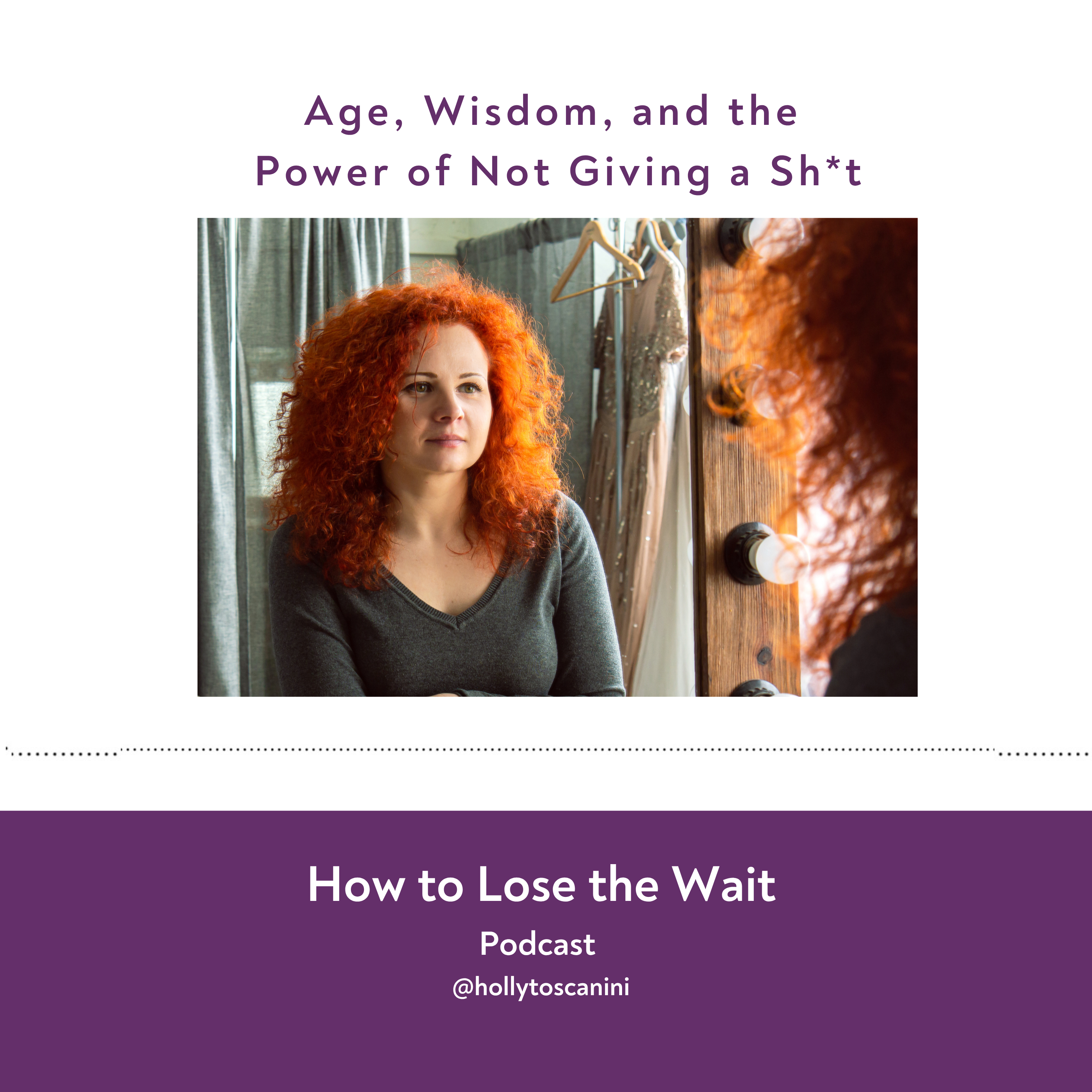
137. Age, Wisdom, and the Power of Not Giving a Sh*t
About this episode
Why body insecurity and ageism keep women waiting to live, and three practices to rebuild self-trust and body confidence after 40 and 50.
If you've been putting something off until your body looks right or you feel young enough, this episode is for you.
Holly Toscanini looks at where body insecurity really comes from, why ageism makes it louder in midlife, and how self-trust helps you stop waiting. You'll get three practices to start this week and one honest question to sit with.
Try "What's Next?”, Holly's free self-coaching tool: https://whats-next.hollytoscanini.workers.dev/
body image after 50, body confidence, midlife, aging, ageism, menopause, self-trust, intuition, diet culture, How to Lose the WAIT
Licensed Podcast music https://uppbeat.io/t/mood-maze/trendsetter License code: VGZ66UBEGXBP8YK8
Holly Toscanini: When I was a little girl, I had to shop in the husky section. I didn't know what that word meant. I just knew how the grown-up said it, and I knew it wasn't good. And I remember the look on the saleswoman's face. A little pity, a little disapproval, and I remember deciding right there between the clothing racks that something about me was wrong. And that label stayed with me for years, long after I'd outgrown those clothes. I was still wearing it. Welcome to How to Lose the WAIT I'm Holly Toscanini, and today's episode is called Age, Wisdom, and the Power of Not Giving a Shit. And I'll admit I had a little fun with that title. This one is for every woman who has put something on hold until her body looked right or until she felt young enough or acceptable enough to go after the things she really wanted. We're going to look at where that feeling came from and why it tends to get louder as we get older. And then we'll talk about what to do with it now. By the end, I want you walking away with three practices you can start this week and one honest question to sit with. So go get your coffee and let's go. I want to talk about the waiting cycle. Let's start with something I hear all the time in one version or another. I'll get back into the dating once I lose 20 pounds, or I'll start that podcast when I feel better about how I look on camera. I'll buy the clothes I actually like once I'm a size I'm happy with. And I know it feels responsible and it feels like a plan. And meanwhile, a year goes by and then five. I call this the waiting cycle, and body shame keeps it running better than almost anything else. The waiting usually comes from a very understandable place. It protects you. If you hold off until your body is fixed, nobody can judge you, and you can't fail at something you haven't started. The trouble is that that finish line keeps moving. And while you wait for it, your life keeps happening without you fully in it. So where did it come from? Where did it all start? For most of us, body insecurity didn't show up out of nowhere. Somebody planted it. Maybe it was a magazine cover or a comment from an aunt at Thanksgiving. Maybe it was watching your mother push her plate away, saying she'd been bad that week. We grew up surrounded by one picture of the ideal body. And that picture was thin, toned, and young. Diet culture taught us that thinness meant discipline and even moral goodness. And the anti-aging industry taught us that smooth skin was the price of staying relevant. All of that has been very profitable. And the weight loss industry is worth billions of dollars. And it depends on women feeling like they're never quite there. And there's a generational piece too. A lot of the women who raised us were caught in these very same standards. They passed down what they'd been handed, usually with love and the very best of intentions. And when you see that it see it that way, body insecurity looks like what it is, something you inherited. It came from outside of you, which means you're allowed to let it go. And then there's the midlife layer. Midlife arrives and adds a whole new layer. Our bodies change in ways we did not choose. Perimenopause and menopause shift where weight sits, how our skin feels, how we sleep. Gray hair shows up, our energy changes. These are normal parts of being a woman who has lived a while, and yet we're sold a steady stream of products and programs to fix them, as if aging were a problem we somehow forgot to solve. So the finish line moves again. Now you're supposed to be thin and look young. At 55, which is a fascinating assignment to give anybody. For a lot of women, the workplace is where this hits the hardest. You've got decades of experience and judgment, and you watch a younger colleague get that project because leadership wants fresh energy. I call this the age cage. It's the pressure to look young enough to be taken seriously and the quiet invisibility that shows up when you don't. It hurts because you know that what you bring to the table, the resilience and the judgment that come with age are real, and you have earned every bit of it. What I want you to know is that none of these standards were your idea. So let's talk about the turning point. I want to tell you about a moment that changed things for me. Years ago, I was standing in front of the mirror doing what I'd done a thousand times before, picking apart every inch of my body. And I was so tired. emotionally tired, spiritually tired. I'd been at war with my reflection for most of my life, and it's a battle nobody wins. So I made a decision. I was gonna stop fighting my body and start listening to it. Now that decision didn't change everything overnight. It took years of unlearning and honestly I'm still practicing. But it opened a door. Once I started pouring all my energy into what was wrong with my body I had energy left over from my life. And I started to hear something I'd been drowning out for a long time. My own voice. You see, self-trust is the way out. That voice is what I mean when I talk about intuition. And intuition is a kind of inner knowing. It's what you sense to be true about yourself before you talk yourself out of it. Now, most of us were taught to override it with diet rules or beauty rules or Everybody else's opinion. And after decades of that, it gets really quiet. The good news is that it comes back with practice. When you start trusting that voice again, you get clearer about what you want, and you can set boundaries with those expectations that never served you. You can say, that doesn't work for me, and mean it. Self-trust also lets you decide what aging well looks like for you. Maybe you let your hair go grow. Maybe you keep coloring it. Maybe you get Botox. Maybe you recommit to wearing sunscreen every day. Any of these can be a self-respecting choice. What matters is where the choice comes from. Respect for yourself feels very different from fear of being judged. And your body can usually tell you which one is in control. And this is what I mean by not giving a shit. It's the moment you stop asking the word world for permission and you start asking yourself what you want. My body, my rules. That's the whole idea. I have three practices for you. So let's make this practical. Here are three things you can start this week. Pick one. You don't need all three for it to start making a difference. Label it not mine. First, for one week, notice the body and age messages that are coming at you every day. The ad for the wrinkle cream, the co-worker who was so bad at lunch. The headline promising to get your pre-menopause body back. Say, each time, say to yourself, that's not mine. Just notice them and name them. And once you can see them clearly, they start to lose their grip. The fear or nourish check. So, second, before you buy the product, start the program, or book that treatment, ask yourself one question. Am I doing this because I'm afraid or because it feels good to me? There's no wrong answer. You're just gathering information about yourself. And over time, you're going to see which choices leave you feeling cared for and which ones feel like running from something. The friend test. Third, when your inner critic starts in on you, pause and ask, would I say that to my friend? And if the answer is no, and it almost always is, say what you'd say to her instead. Your inner critic is not a qualified life coach. You're allowed to stop taking her advice. I want to tell you about a client of mine. She'd spent decades hiding her age. Every new wrinkle was a source of stress, and she had a whole routine built around looking younger than she was. And honestly, it was wearing her out. At some point in our work together, she saw how much energy all of that was costing her. Energy she could have been putting into the things she really wanted. So she started releasing the fear a little bit at a time. And what happened surprised her. She felt more visible. She was more present with her family and more relaxed at work. And she told me she finally felt at peace in her own skin. And that's what becomes possible when you stop waiting to be acceptable and decide you already are. Here's your invitation for this week. Choose one of those three practices and try it for seven days. And for my journalers out there, here's the question I want you to sit with. What have I been waiting to do until my body or my age felt acceptable? Write down whatever comes up, even if it feels small, especially if it feels small. You'll find the link in the show notes. Before I let you go, let's come back to where we started. That little girl in the husky section believed something was wrong with her. It took me a long time to understand that she was fine. She'd been handed a story that was never hers to carry, and the same is true for you. Your body has carried you through a whole life, and your age holds everything you've learned along the way. You are the sum of all of it, every part. Thank you for spending this time with me. Take good care of yourself this week, and I'll talk to you soon. Bye for now.
 Apple Podcasts
 Spotify
 Castbox
 Castro
 Goodpods
 Moon FM
 Overcast
 Pocket Casts
 Podbean
 Podcast Addict
 Podcast Republic