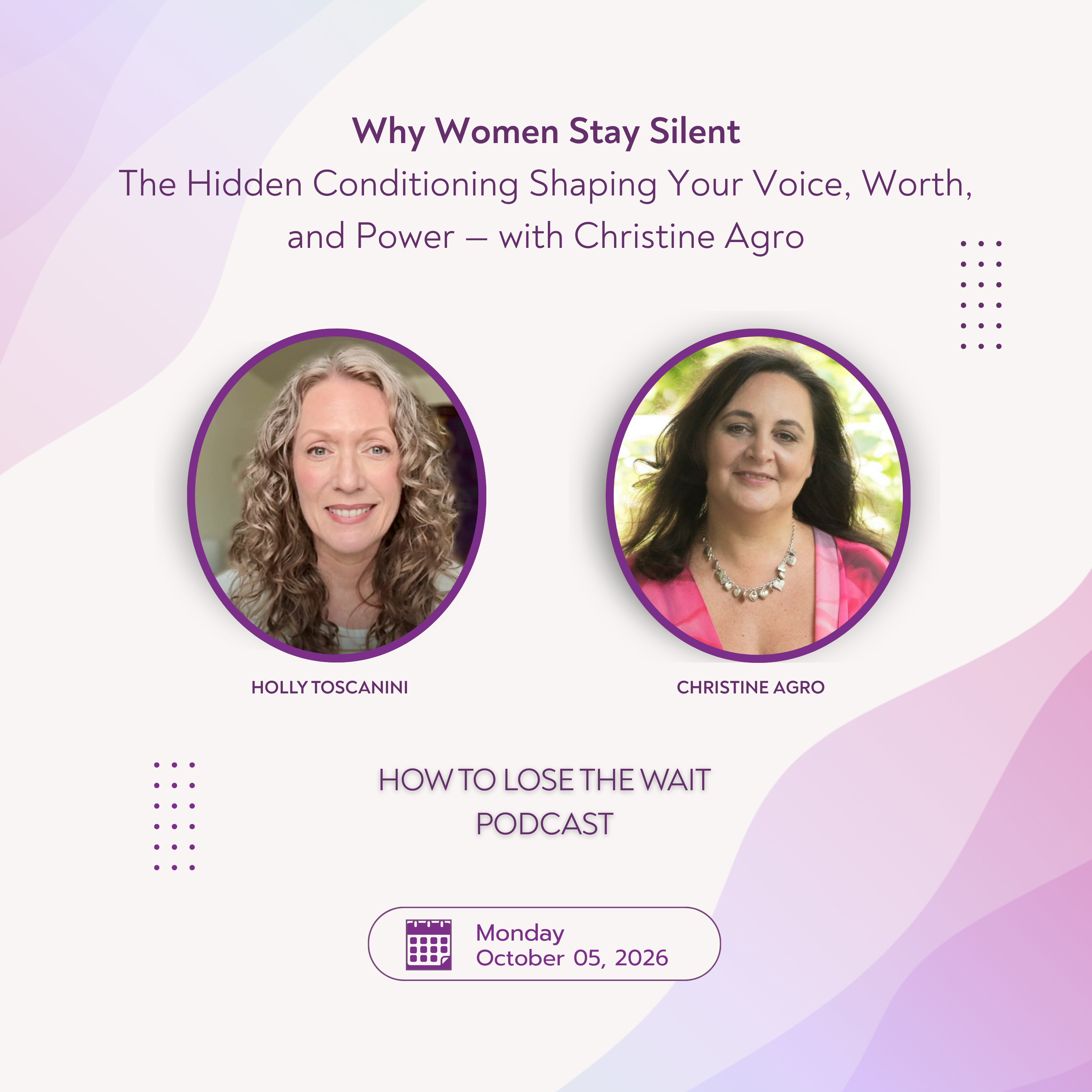
136. How You Were Conditioned to Stay Small with Christine Agro
About this episode
Most women have had this experience at least once. They’re in a conversation — a meeting, a relationship, a family situation — and they know exactly what they want to say. And then something happens in the space between knowing and speaking. What comes out is smaller, softer, more careful. Or nothing comes out at all.
It’s not a confidence problem. It’s not a mindset problem. According to today’s guest, it’s something more specific — and something that most healing and growth approaches never reach.
In this episode, Holly is in conversation with Christine Agro, founder of the Intrinsic Energy® Institute and the woman who identified and named Patriarchal Encodement™ — an energetic conditioning so embedded in women’s experience that it shapes how they think, feel, speak, and relate to themselves, often without any awareness that it’s happening.
In this conversation, Holly and Christine cover:
- What Christine was observing in her clients that led her to identify Patriarchal Encodement™ — and the moment she realized it was systemic, not individual
- What Patriarchal Encodement™ is — and what makes it different from how we usually talk about patriarchal conditioning
- Why women continue to struggle with the same patterns despite years of therapy, personal growth, and healing work — and what most approaches miss
- The specific experiences women have learned to tolerate: self-doubt, over-giving, difficulty setting limits, guilt, staying silent to keep the peace
- What is actually happening when a woman knows what she wants to say and still can’t say it
- How this conditioning shapes a woman’s relationship with her body
- What it means to clear something at its energetic roots — and why that produces a different result
Free resource from Christine:
Patriarchal Encodement™ Workbook — download free at:
https://www.christineagro.com/peworkbook
Christine Agro — Intrinsic Energy® Institute:
Instagram: @christineagro
https://www.instagram.com/christineagro
Facebook: @christineagro
https://www.facebook.com/christineagro
YouTube: youtube.com/christineagro
https://www.youtube.com/christineagro
why women stay silent, women silencing themselves, patriarchal conditioning, internalized patriarchy, how patriarchy affects women, women finding their voice, women’s self-worth, women’s boundaries, women’s empowerment, trusting your intuition, Christine Agro, Patriarchal Encodement, Patriarchal De-Encodement, Intrinsic Energy Institute, energetic healing women, clearing energetic patterns, women in midlife, why women hold back, women’s voice and power
Music from #Uppbeat (free for Creators!):
https://uppbeat.io/t/mood-maze/trendsetter
License code: VGZ66UBEGXBP8YK8
Holly Toscanini: Most women I know have had this experience at least once in their lifetimes. They're in a conversation, It's it's being timid. a meeting, a relationship, a family situation, and they know exactly what they need to say. And then something happens in between the space of knowing what they want to say and actually saying it. And what comes out is usually a lot smaller, a lot softer, or more careful, or they just don't say anything at all. And after, they wonder why they do that. Why they held back and why it's so hard to say the thing they know they want to say. Now, my guest today, Christine Agro has spent nearly 30 years working with women on exactly that question. And her answer isn't what you might hear in most personal development conversations. It's not a confidence problem, and it's not a mindset problem, and it's nothing you can fix by thinking differently or just trying harder. You see, Christine has identified and named what she calls Patriarchal Encodement, an energetic conditioning embedded so deeply in women's experience that it shapes how we think, we feel, we speak, and how we relate to ourselves, often without even knowing it's happening. Christine is the founder of the Intrinsic Energy Institute. She's also a best-selling author, clairvoyant, metaphysical authority, and master energy worker. Now, her work helps women identify and clear the energetic roots of the patterns shaping their lives. Things like self-doubt, overgiving and difficulty setting limits. She developed patriarchal de-encodement to bring these deeply embedded energies into awareness and help clear them at their roots. And she's here today to help us understand what that actually means. Christine, welcome to How to Lose the Weight.
Christine Agro: Hi. Thanks so much for having me.
Holly Toscanini: I know you have spent nearly 30 years working with women. And in that time, you identified and named something you call patriarchal encodement. So before we get like really into what that is, I wanted to ask, what were you seeing in your clients that made you realize there was something operating beneath the surface that just hadn't been named yet?
Christine Agro: Yeah. So just I wanna just maybe backtrack a little bit with the work in general.
Holly Toscanini: Sure.
Christine Agro: because patriarchal encodement it it came it showed up last year. So it's it's relatively new and what I love about it is that it's actually meeting a moment, right? Like if we look out what's going on you know, it if we wa if we go through social media, if we're paying attention to what's happening in the world around us, there is this very rise happening where women are recognizing and realizing things that are just not right. Like it's things that we've accepted as normal. So I love that the information showed up last year. that's kind of unusual for me. I'm usually about 10 years ahead of time.
Holly Toscanini: Mm. Interesting.
Christine Agro: So yeah, which I which I find very fascinating. Like the work that I do with women, you know, we we work on things and then maybe, you know, five, ten years later it sort of comes to the surface or comes to to a place of like, yeah, like we already worked on that.
Holly Toscanini: Mm-hmm.
Christine Agro: But what I want to share before we get into patriarchal encodement is there's this above ground and sort of like below ground energy dynamics. The above ground stuff is it it has an impact on us. It's the the pictures that we carry, the programming that we carry, and pictures are things that people project onto us. So, you know, maybe your whole life you you were you've been your family has projected onto you, you know, the the problem solver or the problem child, or, you know, that's a picture that we end up seeing through that influences how we experience our life. That can be moved. Right. My whole thing is like, let's get rid of it. and then there's programming, which is kind of like this if this then that energy dynamic that we contend with, which which is it sits in that space of If I do this, then that will happen. And the that is usually a you know something that we don't want to have happen or that we're conditioned to believe, like, like that, you know, that's a bad thing. Like, if I leave my marriage, I'll be penniless, right? Like that's a that's a programming that's and that
Holly Toscanini: Got it. Mm-hmm.
Christine Agro: can be moved. So but all of that is is in an aware space that that we deal with every every day. The patriarchal encodement. was so fascinating to me because it sits below the surface as this kind of operating system that we just don't even recognize. Because, you know, we we just normalize the softening of our voice. We
Holly Toscanini: Yeah, true, yeah.
Christine Agro: normalize taking it all on and thinking that it's our responsibility. We normalize taking the back seat, taking the smaller piece, we don't even recognize that it is this this dynamic that's running under the surface. So that's that's sort of my prelude here.
Holly Toscanini: No, I'm glad you you said that because I think it's interesting to differentiate between what you were saying about like the images or the the pictures that are projected on us and then that sort of quiet programming that's running underneath it all. And I don't know that people often can differentiate between those two things.
Christine Agro: No, and I I wouldn't expect them to, right? Like I think, you know, I'm I I work in a whole zone that people typically don't even they don't even recognize is there, which is which is why I do what I do I do.
Holly Toscanini: Yeah.
Christine Agro: you know, because I think it and it it brings things to light. And oftentimes when I speak, when they when I even just say it, the
Holly Toscanini: Mm-hmm.
Christine Agro: things shift because people go, yeah, yeah. Like I do have that picture or I I do carry that program. And now it's, yeah, I I have normalized this to the point where I don't even recognize that I do it anymore. And with a patriarchal
Holly Toscanini: Yeah.
Christine Agro: encodement, it truly does impact how we use our voice, the bound like our boundaries. Can we set them?
Holly Toscanini: Mm-hmm.
Christine Agro: No. With the encodement, we can't. And and as women, what we typically will do is find ways to work around it. So we may still we may still do the thing that we need and want to do, but we do it by finding a a bypass or a route that helps us kind of skirt around it. And that takes a lot of energy. So
Holly Toscanini: Yeah.
Christine Agro: as I'm working with women in in this arena and they're recognizing it and we're moving things and shifting things, so much is changing because not only are they just not doing the thing anymore, not softening
Holly Toscanini: Mm-hmm.
Christine Agro: the voice, not worrying about whether or not it's gonna hurt somebody. And and I I mean I don't mean that in a sense of like now we're cold and callous. It just really we spend a lot of time thinking about how do I say this so that everybody's okay with it, so that it doesn't
Holly Toscanini: Mm-hmm.
Christine Agro: offend someone, so that I don't, you know, hurt their feelings when really they just hurt our feelings, right? Like
Holly Toscanini: True. We spend so much time watering down what we think we're gonna say so it doesn't offend anybody that we never really get to say our truth, right? We never get to speak
Christine Agro: Right.
Holly Toscanini: our truth about what needs to happen or what we need.
Christine Agro: Yeah, yeah. And I think, you know, part of that, and this does go back to the patriarchal encodement, is that it doesn't feel safe for us to do it. And the the that patriarchal encodement energy is all about control. I mean, it's patriarchy, right? It's patriarchy
Holly Toscanini: Exactly.
Christine Agro: in a system in an in an encoded message system that's
Holly Toscanini: Mm-hmm.
Christine Agro: that just runs through the DNA, runs through the nervous system, runs through our cells. And basically in the at the bottom of it, it's saying, it's not safe. It's not safe to be who you are. It's not safe to set that boundary. It's not safe to say what you need to say because
Holly Toscanini: Right.
Christine Agro: and the because is never actually filled in. It's sort of like a looming threat of danger, right?
Holly Toscanini: Mm-hmm.
Christine Agro: So I don't know. It's just been really fascinating to me to see it. and it showed up it showed up in a a session with a client of mine who I've been working with for like what I I had been working with her probably, I don't know, between a year and a half to two years once a month.
Holly Toscanini: Mm-hmm.
Christine Agro: And normally she's sort of in in like this energy space. And when we stepped into the session for that day, she was like frantic. And I was like, What is this? And so I said to her, you know, what is happening here? And she said, like kind of whispered, My husband's home. And I was like, well like Okay, like that's this is but like we're not doing this today. So we didn't do the session, we rescheduled for another day. And I said, this is what we're gonna look at because there's something here. And when I started looking at it, this is what I found. And and the words came to me, patriarchal encodement. So just going back to what I said sort of towards the beginning about you working on things and information showing up. That is sort of like a channel from the collective consciousness. Like the information just comes in and it's like, okay, here's what the collective wants us to work on. And
Holly Toscanini: Right.
Christine Agro: then I figure out, like I'm all about tools. So I figure out
Holly Toscanini: Mm-hmm.
Christine Agro: like in the energy world, how do we work on it? How do we change it? How do we shift it?
Holly Toscanini: Mm-hmm.
Christine Agro: What needs to happen? And then I start digging in to find those things. But It was really interesting. It was interesting to have the words come. It was interesting to see it. And the way that it showed up in her space initially, or the
Holly Toscanini: Mm-hmm.
Christine Agro: way that it came to me, was so wild. It was as soon as they got married, this energy flowed like through the DNA, through the nervous system. It was like a a switch just flipped that said,
Holly Toscanini: Mm-hmm.
Christine Agro: Now you're this. And it
Holly Toscanini: Yeah.
Christine Agro: And I was like, whoa, that is just intense. That, you know, the way that the relationship was before, and then as soon as they got married, both of them changed. Both of them changed in in how they related to each other and what the for him, what the expectations were of her. It was just really crazy. So it doesn't just affect women, it it it affects men as well.
Holly Toscanini: Mm-hmm.
Christine Agro: And I think, you know, over the years, what I've noticed is that we as women have been doing our work for well, since the late sixties, early seventies, we started self-help work, right? And we started self-help work, right? We started,
Holly Toscanini: Yeah, sort of the second wave of feminism, yeah. Mm-hmm.
Christine Agro: I think Louise Hay was probably one of the first with You Can Heal Yourself, the book that she c self-published.
Holly Toscanini: Yeah.
Christine Agro: And, you know, we have been searching and digging and trying to figure out like, you know, why do I react this way? Why why can't I have this? Or why can't I do this? Or how do I step into my confidence? How do I become courageous? We've been doing that work and men have not. And you
Holly Toscanini: Mm-hmm.
Christine Agro: know, they I'm not saying all men, but the majority of men have not been doing that work. And now women are at a point where they're saying, I'm not doing that work for you anymore. Like that's part of the
Holly Toscanini: Right.
Christine Agro: rise that we're seeing out in the, you know, in the real world when we're looking at at social media or whatever, we're we're hearing and seeing women say, I'm just not gonna do it anymore. I'm not gonna be in a relationship that I have to work this hard
Holly Toscanini: Mm-hmm.
Christine Agro: to be valued or to be seen or what you know, whatever it is.
Holly Toscanini: Yeah, you know, it's true. And and men, you know, whether they realized it or not, benefited from it. I mean, they of course they benefit
Christine Agro: Yeah, absolutely.
Holly Toscanini: from patriarchy. So why would they think it's a bad thing when that it doesn't affect them really? You know,
Christine Agro: Yes.
Holly Toscanini: but when women do start to speak up and take up space and show up in their full power, that can be intimidating for a man who is relying on the patriarchy to keep him in his, you know, specific place. Not all men are like that. You know, a lot
Christine Agro: Yeah. Right.
Holly Toscanini: of men support women being able to be
Christine Agro: Absolutely.
Holly Toscanini: equal, but there are enough that don't. That make it a challenge. Yeah. So
Christine Agro: Yeah. Well, and i I think that we have to like I I feel personally that you know, having to having to qualify what we're saying, that it's not all men is the whole
Holly Toscanini: Yeah. It's g kinda sad.
Christine Agro: it's just the whole thing all over again, right? It's like if you know it's not you, you know it's
Holly Toscanini: Yeah.
Christine Agro: not you, you know, move on. If it is
Holly Toscanini: Yeah. Yeah.
Christine Agro: you, you're gonna get lit up, you're gonna get activated, you're gonna get mad about it. But that's the whole point. Right. That the whole point is to
Holly Toscanini: Yeah, exactly.
Christine Agro: light up the energy that you need to clear out or or you need to see where your growth and healing actually lives. But I I do
Holly Toscanini: Right.
Christine Agro: think, you know, we spend so much time sort of again softening, right? Not all men. Yeah.
Holly Toscanini: Yeah. Could we go back to your your c your client that you were working with for a moment? Because I think it's really fascinating that her whole energy dynamic changed when her husband was home. And so you you
Christine Agro: Yep, that's
Holly Toscanini: recognize this. And then how did the the next conversation go that you had with her? Because now you're realizing that this energy is there and it's like this information is coming through to you about what it might be. Talk us through a little bit like how did you coach her through that? How did you kind of have a conversation and bring that up and kind of bring it to the light?
Christine Agro: So I di I didn't look at it until we got into the actual session. that's just
Holly Toscanini: Mm-hmm.
Christine Agro: one of my my boundaries, right? Like I I although I I will say it's not a hundred percent true. Things things do come to
Holly Toscanini: Sometimes you can't help it.
Christine Agro: me and I'm like, okay. a lot of times it's in the shower because I think water is like a clear conduit for things and it's
Holly Toscanini: Yeah.
Christine Agro: just like It's been sitting there and it just goes like okay, hello. but yeah, so we I didn't actually look at it until we got into the session. so I just set the space and I was like, okay, we're gonna look at what this was. She, you know,
Holly Toscanini: Mm-hmm.
Christine Agro: we've been working together for so long that she you know, she appreciates the way that I approach things. so I just started picking it apart and then when I found it, I was like, okay, like this is what it is. And she was like, Wow, that's really fascinating. And And so often when I find things and and they're true for people, they might not know they're true until I say them. It's like there's that resonance of like, yeah, like this is it. I get this. This is absolutely it. So once we had identified it, I just set about figuring out like what is the tool to start to clear this patriarchal encodement. How do we move it? How do we shift it? And what I found with this work, Which is just so exciting, which is one of the reasons that I'm talking about it so much, is that when we do identify it and then shift it, like move it out, there's like almost an in so many instances an immediate change that is
Holly Toscanini: Hmm.
Christine Agro: like night and day. I used to do this, now I don't do it anymore. And it and it's it's kind of like it's hard to explain it. like I've experienced it myself a number of times where like I I used to have this whole thing about not feeling supported, and
Holly Toscanini: Mm.
Christine Agro: I'd be like, I'm never supported, but yet I know that I'm supported, like I'm supported in so many ways, but there was clearly one particular way that I wasn't being supported, and every time I wouldn't get that, my mind would say, I'm not supported, period. Right. So once
Holly Toscanini: Interesting, yeah.
Christine Agro: I like There's stages that we go through in in this level of work. We have to recognize it afterwards. And then we start to recognize it when we're in it. And then we start to see it coming and we don't step into it. And then it's just not there anymore. That's sort of the stages of it.
Holly Toscanini: Yeah.
Christine Agro: so I recognized it and then I started to look at it myself, like, okay, like why do I feel this way? What's coming? And I started picking it apart and moving things and shifting things. And then one day there was a moment where I know that would have been the reaction and it just wasn't
Holly Toscanini: Mm-hmm.
Christine Agro: there anymore. And I was like, I don't know how it moved, but it's gone.
Holly Toscanini: Well, I I know you've s you've, you know, said that women often continue to struggle with these same patterns, even after years of therapy, personal growth, and you know, all the healing work that we do on ourselves. What's the layer that most of these approaches are missing? What what's the thing that is just not being touched on that is stopping people from making progress?
Christine Agro: I love all questions, but I really love that question.
Holly Toscanini: Ha ha ha.
Christine Agro: it's that our mental body, when we get a piece of information, it tells us that knowing it is the end of the
Holly Toscanini: Mm-hmm.
Christine Agro: road. And so we think by knowing it, understanding it, yeah, by knowing it and understanding it that we've done the work. Like the and it's not that an individual is going like, yeah, I'm done. It's that the mental body just has this way of being of telling us, like you know that already. We don't know that there's these other aspects of like there's more to it than just knowing it. And for me, the more to it is finding the peace that's living in us, whether it's a picture, a program, an old wound. or this patriarchal encodement and going in energetically and moving it out and that in itself just creates the change and I I you know it's one I just love this work so much because I watch people shift and I had one woman she was she was in a a very short class with me and at the end she said I I like She was like, I'm totally different. I got more out of this than 10 years of therapy. And
Holly Toscanini: Wow.
Christine Agro: I feel different. And what I said to her was, okay, like I love that for you, but I also want you to honor that that 10 years of therapy let you come into this space today. It was
Holly Toscanini: Mm-hmm.
Christine Agro: all lit up and we were able to move it. Like It's none nothing that we do is inconsequential, is meaningless, is wrong. It all leads us to the deeper place of our healing and our growth. And I, you know, talking about something for 10 years over and over again got her to the place where she showed up in my class and it was ready. It was just, you know,
Holly Toscanini: Yeah.
Christine Agro: ready to go. So I don't ever I don't ever want anybody to, you know, not do what it is that they're doing, but also to know that, you know, there's there's more. And there's you know, there's different modalities. You know, some people use tapping,
Holly Toscanini: Mm-hmm.
Christine Agro: I use energy work.
Holly Toscanini: Mm-hmm.
Christine Agro: you know, acupuncture moves energy, dancing moves energy,
Holly Toscanini: Mm-hmm.
Christine Agro: exercise moves energy, anger moves energy, right? Like fire
Holly Toscanini: Yeah.
Christine Agro: can move stuff. I know I there's been times in my life where I've got I got so angry with someone that whatever picture I was holding, whatever program was there, whatever agreement I had, just like and it was done, right? And it was, you know, so sometimes we need fire.
Holly Toscanini: Wow. Yeah. So it sounds like yeah, it it sounds like, you know, reading the book, you know, I buy the book, I read the book, I understand intellectually what the problem is, but the piece that's missing is actually moving that energy out of your system. Is that is that what you're saying? Okay. Yeah. Yeah.
Christine Agro: in some yeah, is exactly is doing something with it, right? Reading it is not I mean and and we can we can take that into into our practical everyday, right? You can read the recipe, but you didn't make it.
Holly Toscanini: Right. Right. Exactly. Yeah. So it we talked about kind of all of these things that women struggle with self-doubt, overgiving, feeling guilty, being quiet to keep the peace. For a woman who's listening that really recognizes herself in that list, what would you want her to understand about why these experiences are persisting even when she's doing the work? You know, even though I'm still working on myself, there's still these feelings. How can we understand why this is still happening?
Christine Agro: Well, I mean, I think it really comes down to it it comes down to this encodement. So if if you think of it this way, I I see it as kind of like an operating system. So if you think of a computer, it's got something that's constantly telling it what to do, how how to function. And you don't see the operating system when you're working on the computer, you're just working. But it's under the surface doing its thing. And that's what patriarchal encodement is doing. And it its whole purpose you know, is to feed that system. I mean, women are incredibly powerful. And it's just the, you know, the more that I explore this dynamic and and look at patriarchy itself, it's just it's so interesting how it is is so entrenched in. an unevolved, out of control, masculine energy dynamic, which is,
Holly Toscanini: Yeah.
Christine Agro: you know, it's about control, it's about power, it's about it it's about needing external validation. It's it's greedy, it's it's almost parasitical in its its way that it draws off of things. And and it does provide this false sense of superiority or hierarchy that is is not true. And the picture that I keep seeing, which I actually really love and we've been working on it I would say for maybe the last five years, is
Holly Toscanini: Mm-hmm.
Christine Agro: the tower from from the tarot deck. I don't know if you're into it, right? So
Holly Toscanini: yeah. huh.
Christine Agro: the it's the tower and there are just so many of us in the collective at the base of the tower. pushing it, pushing it, pushing
Holly Toscanini: Mm, mm-hmm.
Christine Agro: it, and and we're getting there. You know, I keep I've had moments with me too, with the Black Lives Matter movement, with Kamala Harris's presidential run where I kept feeling like we're there we're there and we weren't there yet so close
Holly Toscanini: Mm-hmm. So close. Yeah.
Christine Agro: but not there yet but I think you know just in terms of hope if we can keep that image of like we're every step Every action that we take, we're pushing that tower until it's gonna
Holly Toscanini: Mm-hmm.
Christine Agro: collapse. And it will collapse.
Holly Toscanini: Yeah. So it this might kind of seem a little out of left field, but how do you see this conditioning, this patriarchal encodement shaping women's relationships with their bodies? I know
Christine Agro: Mm.
Holly Toscanini: you mentioned that in your framework. I I just wanna hear you talk a little bit more about that
Christine Agro: well it's the you know, through the male lens, right? The way that everything is really positioned through how men see us. Or yeah, it's how men, it's not masculine, it's how men see us.
Holly Toscanini: Mm-hmm.
Christine Agro: they have they have defined the what beauty is. we're not beautiful unless we're beautiful in their eyes. that is like just so prevalent. you know, aging. feeling like we're invisible, youth, you know, it all is part of patriarchal dynamics of of creating a a division and a hierarchy of what is valued and what isn't valued. and interestingly, right, as women age, we become more powerful. We are claiming more of ourselves. Once we hit menopause, the end the creative energies shift. And we start to use them differently, and we step into a level of power that is pretty phenomenal. And so what does the patriarchy do? It diminishes the older woman, it makes her less, it makes her invisible, it makes her undesirable, right? Like it's so it's really interesting. And I think on a on an individual basis, you know. there's just so much programming there about how we in relationship to that, how we see ourselves and how we feel about ourselves. so I think I mean it affects our our body, our body image and the way that we relate to our bodies tremendously.
Holly Toscanini: Yeah. It's interesting what you're talking about, especially with aging. You know, women are stepping into their power after midlife. Honestly, we are free to do so many more things. And it's at that point, particularly when men are telling us we're no longer relevant, right? So it's not that we're not, it's that they're telling us that they are and then they try to convince everybody else that we're we're old, we're we're not as vital, we're not as relevant, we're not as intelligent, you know, we've we've kind of used up our purpose if we're no longer able to reproduce. And I think that's the challenge. And more women over 40 should start stepping into their power and and not allowing that to happen. And honestly, you know, in this conversation, what I feel is that the way to do that, one way to do that, is to stop belittling each other and stop competing with each other and start supporting each other.
Christine Agro: Yeah.
Holly Toscanini: you know, because if we are going to be pit against one another, that just feeds into the patriarchy. So if we are supporting one another and being there and and you know, making each other seen, seeing each other, then we can we can really slow that down, maybe someday even put a stop to it. Yeah.
Christine Agro: Yeah, I love that. I mean I I I agree with you a hundred percent. And I I just I I love what you just said. And I think you know, i it to put it into you know how I see things, if you look at it, there's there's there's two places we can stand. You know, we can stand in the patriarchal energy dynamic, which comes with all of the stuff that we've been talking about. Or we can stand in the divine feminine or the feminine energies, which are about collaboration and connection and community
Holly Toscanini: Mm-hmm.
Christine Agro: and and lifting each other up. And you know, we do see that how much women, you know, do embody that there are there is the other side of it. And I think there's a lot of women who who feel that their power sits in the patriarchal structure, so they feed the patriarchy or they're afraid. probably a big part of it is fear whether they recognize it as fear or not because so they are so ingrained in I have to be this way and if I'm not this way I'm gonna it goes back to my like I can't leave you because I'll be penny penniless, right?
Holly Toscanini: Right. Right.
Christine Agro: you know all of that is is part of of conditioning and
Holly Toscanini: Yeah.
Christine Agro: you know we can we can step out of all of it if we choose to.
Holly Toscanini: Yeah, it's kind of invisible by design. We don't often recognize it as external. We just experience it as who we are and how we're supposed to be.
Christine Agro: Yes.
Holly Toscanini: how do women begin to see something that they've always just assumed was, you know, maybe I I don't know if I want to say their personality, but it's like just who I am, you know, how do we start to see that?
Christine Agro: Yeah, I mean I d I we do take it as like we don't even question it. It's just normalized. And I I mean I don't I'm sure there's other ways to see it. I have a a
Holly Toscanini: Yeah.
Christine Agro: workbook that people can grab. it's free and it just it g it asks you ten questions to get you really thinking about how this energy is impacting you or getting you to see how this energy is impacting you. and then if if if you really like for me it's doing the work. So I I do have a workshop. and if you download the the workbook, there is like a really easy to get into offer. And the workshop is really it's 90 minutes, but you if if this resonates with you, you're gonna be like, my god, yes.
Holly Toscanini: Mm-hmm. And I'll have links to all this in the show notes. So listeners, don't worry, you will have access to all of this. Now, for people
Christine Agro: thank you. I love that. Thank you.
Holly Toscanini: listening who are newer to energy work, can you kind of help us understand what it means to clear something at its energetic roots and maybe why that produces a different result than just insight or a talk based approach?
Christine Agro: Yeah, so this one's a little difficult for me because I only know what I do, right? Like I I don't know what other people do. I don't know how other people do their energy work. So I can only speak to it from the way that I do it. And I I call my work intrinsic energy work. because it's a combination of my clairvoyance and then my ability to figure out what to do with what I see. So Once I see something, then I figure out like, okay, what tool do we need or how do we work with this to actually get it to shift? So it's kind of like my finger is always on the pulse of of the individual or the group. And looking at how is like how is this moving? And I have certain tools that I use. I use magnets, I use vacuum cleaners. I know that might sound funny.
Holly Toscanini: Ha ha ha.
Christine Agro: it's like a you know, it's an energetic cleaning.
Holly Toscanini: Yeah.
Christine Agro: but more so it's in the way that I see it and say it that activates it, that then we're able to move it. So it's kind of a combination of of those things.
Holly Toscanini: Mm-hmm.
Christine Agro: and You know, I have I have one student who she exclaimed in the middle of of class as we were moving stuff and she noticed something shift This expletive works. And I was like, It does and I mean I will say, like, I started this work. I have always been I've always had some extra something or other. When
Holly Toscanini: Mm-hmm.
Christine Agro: I was younger it was intuition and premonitions. I would know what was coming before it happened. that didn't really I I always tried to get things to change and later I realized you you can't change the outcome of things. It was really there to let me know to prepare
Holly Toscanini: Yeah.
Christine Agro: me for what was coming. But it took me a long time to realize that. So eventually I found a program that helped me figure out how to use what I have and the way the way that they taught was to use clairvoyance. And I love that
Holly Toscanini: Mm-hmm.
Christine Agro: we started there because clairvoyance is fr it's a French word and it means clear seeing. And when you're working through your clairvoyance, you're not interpreting it, you're not bringing in your experience, your emotions, your pictures, your programs. You're sitting in this place of neutrality and clarity and just like seeing, like, this is what's going on with no With no responsibility for what it is that you're seeing. You're just conveying,
Holly Toscanini: Mm-hmm.
Christine Agro: here's what I'm seeing. So that's where it started. And then I was able to take that and I'm mul multiple Scorpio in my chart, which means that I, first of all, like the Mystic is my my wheelhouse, like that's where I live. And the
Holly Toscanini: Ha ha ha
Christine Agro: depth and the transformation is also my wheelhouse. I love transformation. I love to see things shift and change. And so
Holly Toscanini: Mm-hmm.
Christine Agro: when I started to s actually be able to see things and have this clarity, for me it was like, okay, now what do we do with it? Like I get, like I can look at it clearly, I can look at it with neutrality. But then I want to know like, okay, what does this person need to do to move it? And so that's really how
Holly Toscanini: Mm-hmm.
Christine Agro: the work has evolved.
Holly Toscanini: Amazing. So we really talked about how you you you did develop this patriarchal de-encodement as a specific process for clearing this type of conditioning. So what would that process involve and what do you think it actually feels like for a woman going through it? I mean, I know you're Client said that this blank really does work. So we know it does work, but what what does it involve? Like could can you walk us through what that might look like in a session?
Christine Agro: Yeah. I mean it's so s it's so simple. Like it's so simple, it's crazy. and and it is just that it's like it it whether we're in a group or we're in an individual space, it's me looking at what is going on here and then activating it by putting words to it so that it gets lit up in the person's space and then using a magnet to clear it out. Right. And the the thing with the patriarchal encodement energy is that it is it's kind of gross. Like it's it's it's very parasitical. Like it it l is like embedded in us in ways that you know I look at it and I just go, ew, like we don't need that. We don't need to be carrying that in our space. So whether you're in an individual space or you're in a group space and we're doing this work, depending on where somebody's at, I like to teach people how to do the work rather than just doing it for them all the time, because I think that that's so important. So I may I may have them do it. If we're in an individual one-to-one space, oftentimes I will do a a good deal of it, but I will also teach them how to do a group space. I'm usually like, okay, do this and we're gonna move this out. And a lot of it is allowing, you know, the mental body wants to get in there and start to control the process. And I'm like, nope, nope. Mental body needs to sh.
Holly Toscanini: Yeah.
Christine Agro: you know, so I I lead people through that. I can see what people are doing and I don't Like I don't want people to feel weird about that, but it
Holly Toscanini: Right.
Christine Agro: again, like I manage that. I don't walk through my day being like, look at that person doing that and that person doing that. I somebody once
Holly Toscanini: Yeah.
Christine Agro: was like, you know, can you read my mind? And I was like, why would I want to? Like,
Holly Toscanini: Right.
Christine Agro: you know, like I could, but why would I want to?
Holly Toscanini: There's nothing yeah. So
Christine Agro: yeah. So, you know, when you're sitting there, y you typically people will feel different. They might feel lighter, they might feel like I will I will also sit, I will say to somebody, what isn't there anymore? So they sit and they reflect for a moment and they're like, like that tension that was there is
Holly Toscanini: Mm-hmm.
Christine Agro: not any is not there anymore, or that fear that I was carrying is not there anymore. So that that's kind of, you know, I think as best as I can describe it.
Holly Toscanini: What do you think are the first things that really start to change for us when we do this? So we're we're kind of ridding ourselves of this parasitic energy as you described
Christine Agro: Yeah.
Holly Toscanini: it. What are some of the first things we're gonna notice early in the process?
Christine Agro: I think that it's in the voice. I I I honestly I think that is the first place and I start with when so I have the workshop and then I do have a a six month program where we work on each section. I do voice first because I think it is the biggest place. and I will give you an example. We did voice and there are two women who are friends that were in that particular class and they went to a party. And they were at this party and there was a group of like three guys and three women and the guy pulled out his phone and started showing something like you know not safe for the workplace kind of thing. It was just not appropriate. And the one woman she without a thought looked at him and went, ew. And turned around and walked away and went and got her friend and said, We're going. And they left. And she came in the class and she said, I would never have done that. I would have giggled. I would have, you know, maybe admonished him, but like in a soft, kind
Holly Toscanini: Right.
Christine Agro: of like jokey kind of way.
Holly Toscanini: Yeah.
Christine Agro: And she she didn't even think about it. She just went, ew, and walked away. And that is the big like, you know, and I've seen it for myself because I've been doing this work along with everybody.
Holly Toscanini: Mm-hmm.
Christine Agro: you know, I'm not impervious to things. I got I got my own pictures and programs and stuff that I'm working
Holly Toscanini: Sure.
Christine Agro: on, right? and I've seen it, you know, with my husband where I in the past would not say something or would couch the way that I said it, and
Holly Toscanini: Yeah.
Christine Agro: I don't do that anymore. It's gone. And I'm happy that it's gone. He's not happy that it's gone, but I'm happy that it's gone. Yeah, I know. Yeah.
Holly Toscanini: He will learn. He will learn. Yeah. He will learn to change. So for a woman who's kind of seeing herself in this for the first time, you know, she's really recognizing and and identifying with what we're talking about. What's the most important thing she can do right now before she has access to your formal processes or support? What what one thing can can she start to do today?
Christine Agro: I would say envision a magnet out in front of you and clear out everything that got lit up today. Like you you have already started to shift things just in this conversation. The awareness of like, yeah, that resonates with me. That resonance is the stuff getting activated. Y you're already on your way. Just Envision a magnet. Don't question whether or not it's working or not. Put it out in front of you. Let it do the work. Just say, clear out everything that I'm ready to get rid of. And it will release everything that you do not need right now. And then let me know if you feel lighter.
Holly Toscanini: Is there Yeah. Is there is there anything we might be doing consciously or unconsciously that could slow that process down? Because I know a lot of times we go into this thinking, I really want to change, and then
Christine Agro: Mm-hmm.
Holly Toscanini: we don't realize there are some things in there. Maybe it's the pictures and the, you know, projections that we were talking about
Christine Agro: Of programming, yeah.
Holly Toscanini: earlier. Yeah, the programming, what do you think is the hardest thing?
Christine Agro: I I guess I don't think any of it is the hardest. I think it's all part of the process, right? We we
Holly Toscanini: Okay.
Christine Agro: we get to things when we're ready to get to them. And you know, in the in class space, like I'll I'll I'll see people struggle with things and and I know they need to struggle with it. It's it like I can't make it better for them. They they need to go through that that process of basically you know, fighting with themselves about am I am I going to take this step or not? Because the steps that we are taking do change our life. They do create a different reality for us. It doesn't mean that your life falls apart. Like I'm really I really try to be I really try to hold a container that lets people do their work without having to blow up their lives. Right? Like that because that's a thing, right?
Holly Toscanini: Mm-hmm. Right. Right. And the other thing I'm sort of hearing, you're not really saying it, but I'm sort of feeling that you create this container for women to do the work, but you are not making them dependent on you for the work to to happen or the work to take place. You're kind of empowering
Christine Agro: Yeah.
Holly Toscanini: them to do this with you, but then on their own.
Christine Agro: Absolutely. Absolutely. And and I will see like I will remind people, don't just do this work in class, take it out into the real world with you because
Holly Toscanini: Yeah.
Christine Agro: it's not just here. and i i it's funny, like I I have a whole I have a a toolbox of things. I have a I have a BFA, I have an MBA, I have a naturopathic degree, I have a master herbalist degree. All of that stuff comes into the work that I do. And it's so interesting. I resonate so much with with naturopathic work,
Holly Toscanini: Yeah.
Christine Agro: which has tenets of its philosophy. And one of them is education. You teach people how to do things. You teach people to understand what they're doing and why they're doing it. Because that's again where change happens. It's not by me doing it for you. It's by you truly understanding this is what's happening. And I just think it's so important. Like I don't like if I do a one-to-one session, it is contained within that. I never say to people, you have to work with me five times, you've got to come back to do this. It's all
Holly Toscanini: Mm-hmm.
Christine Agro: right there. If you want to come back and work with me, you can and we can you know do more because I think there's always more that we can do. But whatever we are looking at or dealing with or you bring to me in this one session, it's in this one session. It's not like, you know, I'm not throwing out breadcrumbs.
Holly Toscanini: Right, right, right. So for all the women out there listening who have spent years wondering why they're trying to keep the peace and giving too much or doubting themselves when they know better, what do you most want that woman to understand about what's actually been happening?
Christine Agro: What do I want her most to understand? That it's not truly who you are, that you have internalized and normalized a conditioning that
Holly Toscanini: Mm-hmm.
Christine Agro: has encouraged you to play this role because it benefits something greater, which actually doesn't benefit you.
Holly Toscanini: Got it. No, that's you have to know that, right? I mean, you have to know it's not who you are.
Christine Agro: Yeah.
Holly Toscanini: and I think that's what's really important. Yeah, that's great. So before we wrap up, Christina's put together a free resource specifically for this, and I want to make sure everybody listening knows about it. It's a patriarchal encodement workbook, and it's designed to help you begin identifying where this conditioning is operating in your life. A workbook felt like exactly the right format for this kind of work, something you can move through at your own pace and in your own space. You can download it for free at her website. I'm going to put that link in the show notes. Christine, what final thoughts or comments would you like to share with our listeners today about the work that you do?
Christine Agro: I don't you know what's coming to me is just how much I love, like I said, transformation. and I know that there's so much more for us when the door is opened. and we can't know it. until we actually step into it. And that is part of just you know part of the pro of the journey for us is that
Holly Toscanini: Mm-hmm.
Christine Agro: we can't know that there's more. We might feel it. I think a lot of us are probably feeling that there's something more now. So if you're
Holly Toscanini: Mm-hmm.
Christine Agro: feeling that there is. But you can't know what it is until you actually step into it. And I look at it as like they're two separate tracks. There's your life, which I like to say like uno aware as opposed to unconscious because I think unconscious sort of feels like it it's just not the right word. So you're
Holly Toscanini: Mm-hmm.
Christine Agro: unaware of these things, right? You don't know
Holly Toscanini: Mm-hmm.
Christine Agro: that they exist. You don't know what's influencing you. You don't know how it's impacting you. And then there's the track of I am aware now and I know it and
Holly Toscanini: Mm-hmm.
Christine Agro: I see it. Because when you become aware The way that you have you learn your life lessons becomes completely different. Unaware, we have to learn them through adversity. There's got to be some sort of pressure and challenge for us to actually want to change because that's human nature. We won't change, right? Unless we
Holly Toscanini: Right, right. Yeah. Yeah.
Christine Agro: are like pushed to. Once you step into awareness and you're like, like this is about self-validation or this is about my truth or this is about my power. Or this is that encodement piece that keeps coming up. Instead of you being in the middle of it, you're now like looking at it and going, like, and I can do something about this. Like it's not me.
Holly Toscanini: Mm-hmm.
Christine Agro: I can move this, I can shift it, I've got tools. So that's a long
Holly Toscanini: Amazing.
Christine Agro: like what I want people to know.
Holly Toscanini: That's okay. It's important. It's important to know. Christine, thank you. This conversation has really given me language for something I think a lot of women have felt but haven't been able to name. And I'm sure it did the same for our listeners. Now I want to leave everybody with something Christine said that I keep thinking about that the silence really isn't a character flaw. it isn't being timid, rather. It's it's not a weakness or a lack of confidence. It's really a result of this conditioning that is so embedded that it feels like our personality. And the first step isn't to push through it or perform our way past it, it's to see it for what it actually is. you can find Christine and learn more about her work at Christineagro.com. She's also on Instagram and Facebook. I'm gonna have all the links so you can find her and learn more about the Patriarchal Encodement Workbook. All the links in the show notes. If this conversation stirred something for you, I hope you'll sit with it instead of just moving past it. It's probably not a coincidence. Get in touch with Christine and she can help you work it out. Thank you for joining us. Until next time. Thank you, Christine, and bye for
Christine Agro: Take care.
Holly Toscanini: now.
 Apple Podcasts
 Spotify
 Castbox
 Castro
 Goodpods
 Moon FM
 Overcast
 Pocket Casts
 Podbean
 Podcast Addict
 Podcast Republic