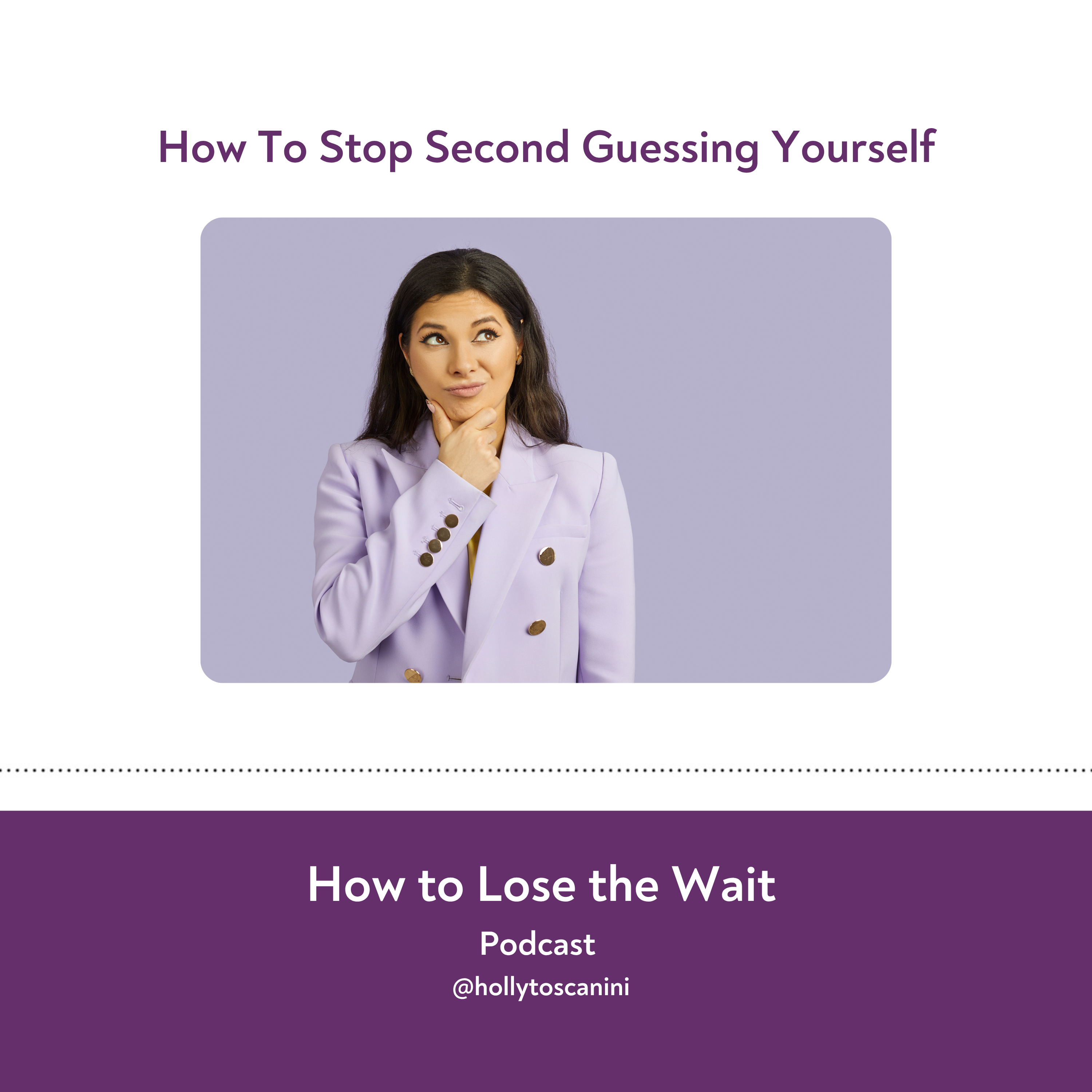
125. How To Stop Second Guessing Yourself
About this episode
You made the decision. Now doubt has you questioning it. Learn how to stop second-guessing yourself and know when a choice truly needs review.
You made the decision and felt relieved.
Then doubt arrived.
Now you’re replaying the conversation, imagining everything that could go wrong, and wondering whether your uncertainty means you made the wrong choice.
Doubt after a decision can feel convincing, especially when you’ve spent years trying to make careful, responsible choices. You may assume that a good decision should leave you feeling calm and certain. When guilt, fear, sadness, or someone else’s disappointment appears instead, the whole decision can end up back under review.
In this episode of How to Lose the ‘WAIT,’ I’ll explain why doubt doesn’t automatically mean a decision was wrong and why the path you didn’t choose can suddenly look so appealing once the path you did choose becomes real.
You’ll learn how to recognize the difference between useful new information and the ordinary discomfort that often follows a meaningful decision. I’ll also explore why second-guessing can keep you emotionally stuck between two choices, even after you’ve technically moved forward.
This episode will help you understand why reassurance rarely creates lasting self-trust, why hindsight can make your original decision look careless, and how to give a choice enough time to teach you something before reopening it.
The goal isn’t to cling stubbornly to every decision you make. It’s to stop treating every wave of doubt, guilt, or fear as proof that you need to begin the entire decision-making process again.
The question to consider this week
Complete this sentence:
I made the decision to __________, but I keep reopening it because __________.
You can send me a direct message on Instagram at @hollytoscanini or email [email protected]
One honest sentence is enough.
Next week
How to Hear Yourself When Everyone Else Is in Your Head
Sometimes the voices influencing your decision belong to people who are actively giving you advice. Sometimes they’re old expectations you’ve carried for so long that they now sound like your own.
Music from #Uppbeat (free for Creators!):
https://uppbeat.io/t/mood-maze/trendsetter
License code: VGZ66UBEGXBP8YK8
Holly Toscanini: You made the decision. For a little while, you felt relieved. You sent the email. You said no. You chose a direction. You finally stopped circling the same question and gave yourself an answer. Then doubt showed up. Maybe it showed up quietly the next morning. Maybe it waited until somebody questioned your choice. Maybe it appeared the moment the decision became real and you couldn't hide inside the safety of I'm still thinking about it. Suddenly, Your mind started rethinking everything. Did you move too quickly? Were you reacting emotionally? What if you regret it? And within a few hours, a decision you felt reasonably settled about is back under review. You're replaying the conversation, rereading the email, and asking people what they think. Although what you really want is for somebody to tell you that you didn't make a mistake. If this sounds familiar, you may have started to believe that you're Bad at making decisions. Maybe you tell yourself that you can't trust your first instinct, that you're too emotional, or that you never know what you want for very long. But doubt after a decision doesn't automatically mean the decision was wrong. Sometimes doubt means new information has showed up and it deserves your attention. Sometimes doubt is simply what uncertainty feels like after you've committed to one path and let the others go. That's what we're talking about today. Welcome back to How to Lose the Weight. I'm Holly Talcanini. Last week we talked about the difference between working on yourself and working with yourself. And we looked at how easily one decision can become a test of whether you're growing correctly, trusting yourself enough, or finally becoming the woman you think you're supposed to be. Today I want to stay with what happens after you've made the decision. Because making a choice is only the first part of self-trust. The next part is learning how to remain with yourself when that doubt shows up. And doubt usually does arrive at some point. I think we sometimes imagine that a good decision should create a clean emotional ending. We know what to do, we do it, and then we feel calm and certain. But life is rarely that cooperative. You can make a thoughtful decision and still feel unsettled afterward. You can know that something needs to change and still grieve. What the change is going to cost. You can feel relief and fear in the same afternoon. Those mixed feelings can be especially confusing when you've been waiting a long time for clarity. You thought the decision would end the uncertainty, and instead, that uncertainty just changed its form. Before the decision, you were asking, What should I do? After the decision, you're asking, Did I do the right thing? The mind is still looking for that guarantee it couldn't get before you chose. And Because you've already acted, the stakes can feel higher now. Before, all the options were still open and available. You could imagine the best version of every possible future because none of them had been tested. Once you chose, the unchosen option can start to look unusually attractive. Your mind starts editing out the difficulties and shows you the highlight reel. If you accepted the opportunity, you start imagining how peaceful your life would have been if you'd declined it. If you said no, you start wondering whether saying yes would have changed everything. The path you didn't choose remains untouched by reality, which gives it a slight advantage. It hasn't disappointed you yet. The decision you did make has deadlines and consequences and conversations and feelings attached to it. The other option gets to remain theoretical. Well, that doesn't make the other option better, it just makes it untested. Second guessing often begins when we compare the real discomfort of the path we choose with the imaginary ease of the path we didn't. That comparison will almost always make your decision look a little suspicious. There's also a loss inside every meaningful decision. When you choose one direction, you give up the freedom of remaining undecided. You close certain doors, at least for now. And you may disappoint somebody. You may have to let go of an identity or a possibility that still mattered to you. Even a good decision can create some grief. You can leave a job that was no longer right for you and still miss the people, the security, or the version of yourself who knew exactly how to succeed there. You can set a necessary boundary and still feel sad that the relationship even required one. Those feelings don't prove that you should go back. They may actually be part of moving. Forward. But if you've learned to treat every discomfort as evidence, every difficult feeling becomes a reason to reconsider. You feel guilty so you assume the boundary was too harsh. You feel nervous, so you assume the opportunity was just too big. Or you feel sad, so you assume leaving was a mistake. The emotion appears and your mind immediately tries to turn it into a verdict. This is where second guessing can become a form of waiting. You made the decision, but you don't fully allow yourself to move into it. You just keep one foot in the old question in case you need to retreat. You haven't technically stopped, but you haven't really gone forward either. You continue gathering opinions. You search for reassurance. You look for signs that confirm or contradict the choice you made. Your decision remains provisional, even if you've already announced it to everybody. And that can become exhausting because you're trying to live two lives at one time. You're carrying out the choice while continuing to debate whether you should have made it or not. And every new feeling, every new reaction or inconvenience just gets added to the evidence file. And this is especially common for women who are thoughtful, responsible, and used to considering how their decisions affect other people. You don't want to be reckless, but you also don't want to ignore important information either. You don't want to make a choice that creates unnecessary pain for somebody you care about. Those are good intentions, but carefulness can turn into constant review. You start believing that a responsible woman keeps questioning herself. If you feel certain, maybe you haven't considered enough. If somebody's unhappy, maybe you've overlooked something. The decision is difficult to carry out, so maybe it wasn't the right one. And you just keep checking. And when you check often enough, you're always going to find something to worry about. No decision can survive endless cross-examination. You could take a reasonable choice and make it look deeply questionable if you examine it from enough angles at three o'clock in the morning. Second guessing also becomes more intense when there are a lot of people talking in your head at the same time. One woman who completed my recent assessment described needing to get all the people out of her head, get them out of the way. And I understood exactly what she meant. Sometimes you aren't only listening to your own doubt. You're carrying the opinions of your partner, your family, your friends, the person who had that terrible experience once, and the woman online who seems absolutely certain about what everybody should do. Each voice offers a different version of what the right decision looks like. One person tells you to be practical. Another tells you to follow your heart. And somebody else reminds you that you're lucky and just shouldn't complain. And then there's another who says life is short and you should make the bold move immediately. And by the time everybody's had a say in the matter, your own answer can become kind of difficult to find. So you ask for more advice, hoping one more person will say the thing that settles the decision once and for all. You may feel better for a few hours when somebody agrees with you, and then another person raises a concern and the whole question reopens again. Reassurance can give some temporary belief, but it rarely creates that lasting trust you're looking for. It can make you more dependent on that next opinion. And eventually, you're no longer asking for perspective. You're asking for somebody else to carry the responsibility for that choice. That's understandable. If another person tells you what to do and it goes badly, you don't have to bear the full weight of having chosen it. But you also lose the chance to build evidence that you can make a decision and remain with yourself through whatever follows. And this is where I want to make an important distinction. Holding a decision. Doesn't mean refusing to reconsider it under any circumstances. I mean you're not proving your self-trust by stubbornly clinging to a choice that just no longer makes any sense. New information matters. Sometimes circumstances change. You may find out that something you believed when you made the decision wasn't accurate. You might learn more about the situation or about yourself. Working with yourself leaves room for that adjustment. And the question is whether you've You're responding to new information or reacting to the discomfort of having decided. And those can feel very similar in the moment. You may need to slow the process down enough to begin to tell the difference. When doubt appears, ask yourself, what's actually changed? Did you learn something new? Has that situation changed in some kind of really meaningful way? Or are you feeling the predictable discomfort that came with just making a choice and sticking to it? Suppose you turn down an obligation because you were already just stretched way too thin, and the next day you feel guilty because the other person sounded kind of disappointed. Now the new information is that the person was really disappointed, and that may matter to you, but it doesn't automatically change the original facts. You were still stretched too thin. You still didn't have the capacity or the bandwidth, and their disappointment may be making you uncomfortable without making your answer wrong. Or maybe you accepted a new opportunity and then learned that the time commitment was twice what you were originally told. That is new information. The decision may need to be revisited because the conditions have changed. Those situations feel different when you stop and name what is actually happening. Second guessing tends to blur everything together. A feeling becomes a fact. A fear becomes some kind of forecast, and somebody's reaction to what you've said becomes. Proof. Working with yourself means separating them again. You could say I'm feeling guilty because she's disappointed, but that doesn't change the reason I said no. Or you could say I'm nervous because this is new and visible. Nervousness was always going to be a part of this. Or you could also say, I've learned something important that changes what I agreed to, and I need to look at this decision again. Self-trust includes all three options. Because the goal isn't to become so committed to your original choice that you ignore reality. The goal is to stop treating every wave of discomfort as a fresh referendum. One thing that can help is deciding in advance what would justify reopening this question or decision. Before the doubt shows up, give yourself a clear standard. Maybe you'll reconsider if the cost changes significantly or if you receive information you couldn't have known earlier, or if the decision begins to affect your health or safety in a way you didn't anticipate. But feeling nervous on Tuesday because you acted on Monday may not meet that standard. And neither does imagining an outcome that hasn't happened yet. And neither does the fact that someone else would have chosen differently. When you don't have a standard, every uncomfortable moment can drag you back into that decision again. You may also need to give choice enough time to produce some information, because some decisions can be evaluated quickly, but others need a little room to become real. If you start a project and judge it after one uncertain hour, you haven't learned much about the project. You've learned at the beginning can feel uncomfortable. If you set a boundary and reverse it the first time somebody pushes back, you haven't learned whether the boundary could work or not. You've learned that pushback is kind of difficult for you. The discomfort may be useful information, but it wasn't the whole story. Sometimes the only way to know whether a decision fits is just to Live inside of it for a little while. And that's hard for someone who wants certainty before committing. The decisions often create the information we were waiting to have. You learn what the job is like by doing the job. You learn whether the boundary is necessary by holding it long enough to see what changes. And you learn how to f how you feel about the direction you took once you stop researching it and just start moving. And this is why reconsidering the decision too quickly can just keep you stuck. You never remain in one direction long enough for reality to give you the answers you need. You keep returning to the thought because the thought feels safer than the experience. Those thoughts let you keep all the possibilities alive. Experience that requires you to encounter what the choice is actually asking of you. That can be uncomfortable, but it's also where clarity becomes more grounded. I also think we need to talk about the fear underneath second guessing. For many women, the deepest fear isn't simply making the wrong decision. It's what you'll say to yourself if that decision goes badly. You know how severe that internal review can be. You're going to replay every sign you think you missed, every red flag. You'll use hindsight to convince yourself that the outcome was so obvious. You'll tell yourself you should have known better. Then the decision becomes evidence that you're just unreliable. And that fear can make you search for a level of certainty no human being has. You want to eliminate the possibility of regret because you don't trust yourself to survive your own judgment afterward. So you try to make a decision that can't possibly be criticized by anybody later. That decision doesn't exist. Every option contains a risk, and every path leaves something unknown. Every choice can look different in hindsight because hindsight gives you information you couldn't possibly have at the time you made the decision. Self-trust grows when you change the agreement you have with yourself about what's going to happen if things don't go well. You can decide that you won't use the outcome to rewrite history. You'll remember what you knew when you made the choice, and you'll be honest about what you ignored if you did ignore something without turning that into proof that you're incapable of trusting yourself. You'll learn what the decision teaches you. You'll make the next decision from there. That kind of self-trust doesn't require you to be right every single time. It requires you to remain present when you aren't. There's a great deal of freedom in knowing you don't have to predict everything perfectly. It can make you can make a thoughtful choice with the information you have now. You can tolerate the possibility that it may need to change and allow yourself to feel doubt without immediately jumping to conclusions. Doubt is a feeling and a thought process. It isn't a command. It can sit beside the decision for a while. You don't have to resolve it the moment it shows up. And that may be a new experience if you've always treated uncertainty as something urgent. When doubt arrives, your instinct may be to fix it immediately. You might call somebody or search for more information or reverse your decision or do something that makes that discomfort stop. But the discomfort often becomes louder when it believes it can crack the whip and make you act. If every wave of doubt gets rewarded with another round of analysis, your mind learns that doubt is the way back into the decision. But you can respond differently. Try saying, I hear that I'm questioning this, but I'm not changing anything tonight. You can let the feeling be present without turning it into some kind of project. Then you can return when you're calmer and see whether anything meaningful remains. Often that feeling of intensity passes. The decision might still be difficult, but it stops feeling like an emergency. And that pause can protect you from making a new decision in order to escape. That discomfort you felt from making the first one. There may also be a part of you that believes confident women don't second guess themselves. They decide and move on. They don't need reassurance. They don't wonder about the other option. They don't feel nervous after taking a risk. They don't think that I don't think that's what confidence actually looks like, though, do you? I think confident people can feel doubt. I think they've learned that doubt doesn't have to restart the entire decision-making process. Okay, so they may review a choice when there's a reason to review it, but they also allow ordinary uncertainty to pass without assuming it contains some sort of hidden meaning or message. See, the goal isn't to stop having second thoughts forever, that's not the goal, because you're learning how to stop treating every second thought as more authoritative than the first. Maybe your first thought was impulsive, but then your second thought contained a little wisdom. Sometimes the first decision came after weeks of reflection and the second thought appeared because somebody frowned at you. You have to look at the full context. Which version of you had access to more information? Which version of you was responding to your values? And which version was trying to reduce discomfort as quickly as it possibly could? See, this isn't an invitation to analyze yourself for another three hours. It's a way of restoring some proportion. To things. The loudest thought isn't always the truest thought. The newest feeling isn't always the most informed feeling. And a moment of doubt doesn't erase the thinking, reflection, and experience that led you to your decision. You're allowed to remember the woman who made the choice because she knew something. She had reasons. She may not have known everything, but she wasn't necessarily careless simply because she felt uncertain now. Sometimes self-trust looks like returning to her, to that version of you. You can ask, what did I know when I made this decision? Write it down if you need to. What was happening? What did you already tried? What mattered enough that you finally made the decision? And then when doubt shows up, memory can become strangely selective. So you remember everything that could go wrong and forget why you acted. So, restating your reasons for making that choice can help you reconnect with the full picture. You may discover that the reasons still hold. You may discover that something has genuinely changed. Either way, now you're making the next move from information instead of from panic. So think about a decision you keep revisiting. Maybe you've already said no, but you're looking for a reason to change that answer. Maybe you chose a direction, but every new opinion sends you back to the beginning. Maybe you've made the same decision several times and keep refusing to let it stand because you don't feel completely 100% certain. What happens inside you after that decision becomes real? Did guilt show up? Did somebody else's reaction become more important than your reasons for making the decision? Did you start idealizing the choice you didn't make? Did you begin imagining a future regret as though it had already happened? You don't have to solve all of that today, don't worry. I just want you to notice the moment when doubt starts turning into some kind of new investigation. Then pause. Ask whether anything has actually changed. If nothing has changed, consider giving the direction or the decision you chose just a little more time. Let it just remain in place long enough to teach you something. You can feel unsettled or uncertain and still continue. You can hear another opinion without turning it into an instruction. And I know you can acknowledge doubt without handling the handing it some kind of gavel. And if new information does appear, you can respond to it without telling yourself the first decision was a failure. You made the best choice you could with what you knew. Now you know more. And that's how decisions work. Shoot, that's how life works. Before we finish, I'd like you to hear what this looks like for you. Complete this sentence if you would. Just fill in the blank. I made the decision to fill in the blank, but I keep rethinking it because fill in the blank. Maybe you're afraid somebody's gonna be disappointed or you're waiting for doubt to go away 100% before you let the decision stand. You can send me a direct message on Instagram at Holly Toscanini or email me at hollytoscanini.com. One sentence is all I need. I'd like you to do this because I'm really paying attention to the places where women lose trust in their own decisions. Because I want these episodes to speak to what happens after the insight, after the choice, and after real life starts talking back. Next week we're talking about what happens when there are so many people in your head you can barely hear yourself think. Sometimes those voices belong to people who are actively giving you advice, and sometimes they're people whose reactions you're trying to predict. And sometimes there are old expectations you've carried for so long that they now sound like your own voice. We'll talk about how to separate what you want from what you've been taught to want and why asking for more opinions can sometimes take you further from your own answer. Until next time, bye for now.
 Apple Podcasts
 Spotify
 Castbox
 Castro
 Goodpods
 Moon FM
 Overcast
 Pocket Casts
 Podbean
 Podcast Addict
 Podcast Republic