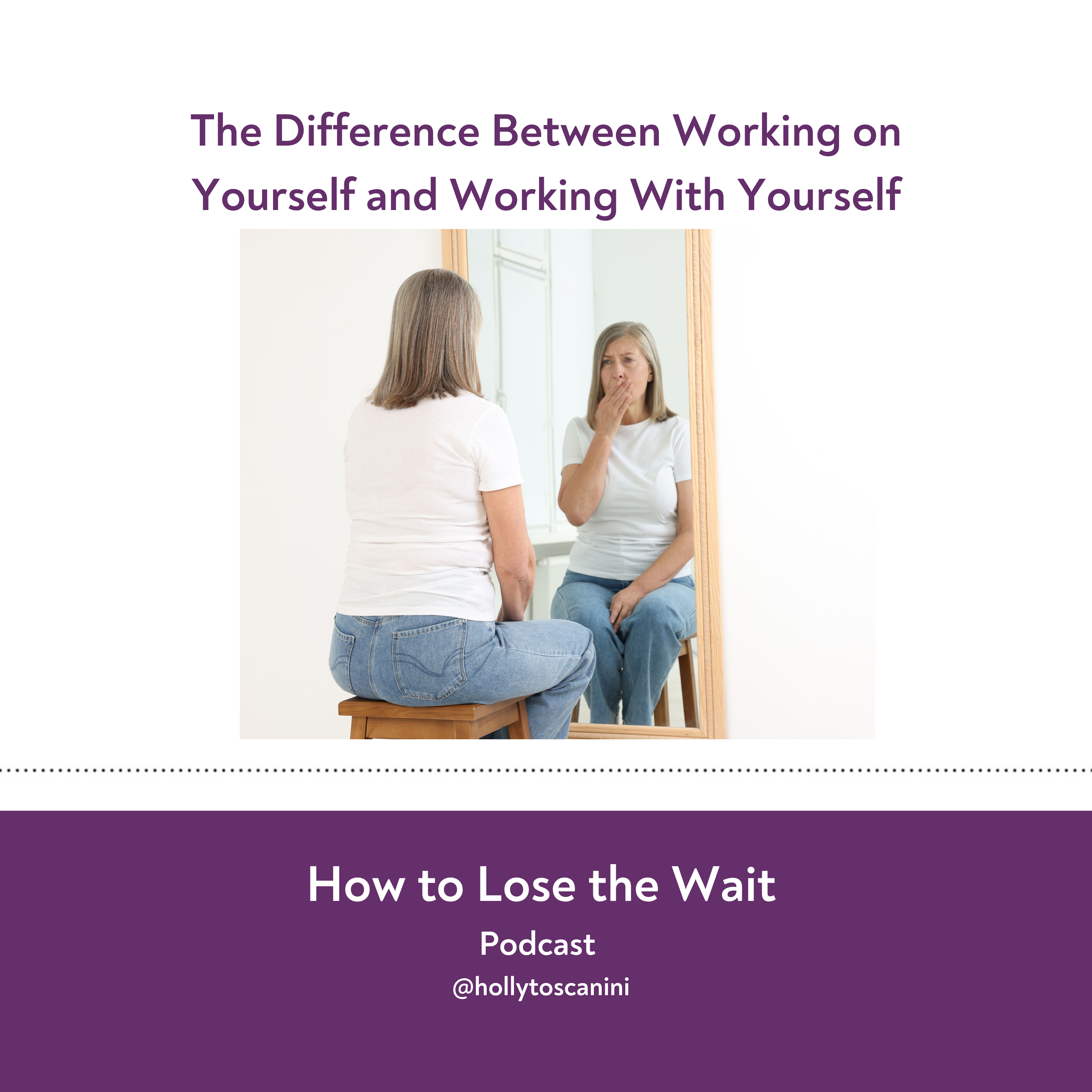
124. The Difference Between Working on Yourself and Working With Yourself
About this episode
Have you turned every decision into proof of your personal growth? Here’s what changes when you stop working on yourself and start working with yourself.
Have you ever noticed how quickly a simple decision can turn into a referendum on your personal growth?
You start out trying to decide whether to take an opportunity, apply for something, or say yes to a request. Then somewhere along the way, the decision becomes much bigger. It has to solve the situation in front of you while also proving that you’ve healed, grown, and learned the lesson.
That’s a lot to ask of one decision.
In this episode I name what happens when self-awareness turns into self-evaluation, when personal growth becomes a performance standard, and what actually shifts when you stop treating yourself as a project and start working with yourself instead.
In this episode, we’ll cover:
- How the expectation of emotional clarity and consistency becomes another form of waiting
- Why self-trust doesn’t require you to feel the same way every day — it requires you to stay in relationship with yourself while different feelings move through
- The difference between listening to a feeling and letting it make the decision for you
- How to bring a decision back to its actual size by naming what you’ve attached to it
- Why self-trust develops from staying present for what happens next, not from guaranteeing the right outcome
Journal Prompt:
Complete this sentence and share it with me on Instagram @hollytoscanini
I’ve been treating the decision about __________ as proof that I’m __________.
Send me a DM or email with your answer.
@hollytoscanini
https://www.instagram.com/hollytoscanini/
https://hollytoscanini.com/contact-holly/
working on yourself vs with yourself, self-improvement exhaustion, self-trust women, decision making anxiety, personal growth performance, treating yourself as a project, inner critic women, self-awareness women over 40, how to stop second-guessing decisions, self-compassion and accountability, W.A.I.T. framework, unwaiting method, women over 40 personal growth, self-evaluation exhaustion, working with yourself
Music from #Uppbeat (free for Creators!):
https://uppbeat.io/t/mood-maze/trendsetter
License code: VGZ66UBEGXBP8YK8
Holly Toscanini: Why does one difficult decision have the power to make you question years of personal growth? You start trying to decide whether to apply for a position, take on a project, or say yes to an opportunity. And then somewhere along the way, the decision becomes much bigger. If you go for it, does that mean you're finally becoming more courageous? If you decide against it, are you listening to yourself or letting fear win? Are you making the decision from confidence or intuition? Have you done enough work on yourself to really trust your answer? Now, before long, you're not just deciding whether you want to do something. You're trying to determine what the decision says about the person you've become. And that's exhausting. And I think it's something a lot of self-aware women experience without fully recognizing it. Look, you've spent years trying to understand yourself. You've learned about your patterns, you've become more aware of when things like fear or perfectionism, people pleasing, self-doubt, when those things are influencing you. And that awareness can be genuinely useful. But there's a point where working on yourself starts to feel like constantly supervising yourself. Every thought gets examined, every reaction gets questioned, and every choice becomes evidence that you're either making progress or backsliding. You're living your life. But you're also standing slightly outside it, watching yourself live it and just taking notes. That's what I want to talk about today. How to stop treating yourself like a project and start relating to yourself as a person. Welcome back to How to Lose the Weight. I'm Holly Toscanini. And last week we talked about the gap between insight and change. Why understanding your pattern doesn't automatically produce a different response when the pressure of the real situation shows up. Insight helps you see the pattern, but acting differently, making a different decision, that takes practice. And today we're going to add another layer to that conversation, especially for women who have spent years. Reading, reflecting, going to therapy, listening to podcasts, and trying to become more intentional. Because sometimes self-awareness turns into self-evaluation. You stop asking, what do I want to do here? And you start asking, what would be the healthiest, most confident, most self-trusting version of me do? That may sound like a useful question, and you know, sometimes it is. But it can also pull you away from the woman who's actually making that decision, the woman who's tired, the woman who has conflicting feelings about things, the woman who has grown enormously and still get scared. When you're always trying to respond as the most evolved version of yourself, your real reactions can start to feel like evidence that you haven't made enough progress. So here's what happens when personal growth Turns into some kind of performance standard. You notice that you're anxious and immediately wonder what the anxiety means. You feel guilty about saying no and then worry you haven't learned how to hold a boundary. You make a decision, experience doubt in the next morning, and start questioning whether you can trust yourself after all. The decision begins carrying far more weight than it was ever meant to hold. It has to solve the situation in front of you while also proving That you've healed and grown and learned the lesson. That's a lot to ask of one decision. Now, there's a quiet belief underneath this that I want to name. Once you've done enough inner work, you'll know exactly what you want. You'll feel clear, you'll move forward with zero hesitation, you won't need reassurance or ever second-guess yourself afterwards. Real decisions, well, they're rarely packaged up that neatly. You can want something and feel afraid of it at the same time. You can know that saying no is right for you and still feel uncomfortable when somebody else is disappointed. You can make a thoughtful decision and then keep wondering about the road you didn't take. None of those feelings automatically mean you made the wrong choice. They mean you're a person making a decision that matters. But when you've started expecting confidence and clarity from yourself as the baseline, Those ordinary mixed feelings start to look a lot like a problem that needs to be fixed before you can make the next move. So you keep working on yourself. You try to become more confident before applying for that new job. You wait for the guilt to settle down before having that difficult conversation, or maybe you look for just one more insight that will finally make the decision obvious to everybody. Meanwhile, the decision stays exactly where it is. This is one of the ways personal growth can quietly become just another form of waiting. You're waiting to become the version of yourself who makes the decision correctly. The trouble is that version keeps moving and changing. On Monday, you feel clear. On Tuesday, doubt creeps in. You write the email and feel relieved, and then you reread it and wonder if you were a little too direct. You decide to take that opportunity and feel excited. And then you imagine what could go wrong and you question the whole thing. If emotional consistency is the standard you have to meet before trusting yourself, you're going to be waiting a really long time. Because self-trust doesn't require you to feel the same way every single day. It means you can stay in relationship with yourself while different feelings sort of come and go. Working with yourself starts right there. It sounds less like, why am I feeling this? I thought I'd move past it. And sounds more like, I'm feeling anxious about this. Let me understand what the anxiety is actually trying to tell me. There's a difference between listening to a feeling and letting that feeling make the decision for you, or make you feel like there's something wrong with you. Now anxiety might be telling you the choice matters. It might be reacting to genuine uncertainty. And it it might also be pointing toward a real concern that's worthy of your attention. You can hear all of that. without assuming the anxiety means stop. The same is true of feeling guilty. If you set a boundary and feel guilty, the guilt might be connected to years of believing that being a good girl means keeping everybody else happy. It might also be telling you something about how you handled the conversation. You can be curious about that feeling without immediately reversing your decision. That's what working with yourself looks like. You listen, you ask what's happening, You stay open to real information, and you remember that every thought and feeling doesn't need to become some kind of instruction that you have to follow. When you're constantly working on yourself, the tone inside your head can become surprisingly managerial. You monitor yourself for signs of avoidance, you check whether you're acting from fear, you watch for old patterns to show up again. And at first this might feel responsible because you don't want to repeat the same mistakes. But over time, that level of Internal surveillance can make everything seem so much louder. Every hesitation seems significant and every doubt demands an explanation. Even small shifts in your mood can make you question a decision you made yesterday. You might start to believe that if you stop watching yourself so closely, everything you've worked so hard for is going to unravel. And that's a difficult way to live. It means you're never fully on your own side. You're always both the person being evaluated and the one conducting the evaluation. Now, working with yourself has a different quality. You're still paying attention, but you're not treating yourself like somebody who needs constant supervision. When you notice you're overthinking, instead of criticizing the overthinking, you might pause and ask yourself, all right, this decision feels important, and I'm trying to think my way to a guarantee. So What information would actually help me right now in this moment? And when you feel the urge to back out of a conversation, instead of shaming yourself or feeling avoidance, you might acknowledge, hey, I understand why I want to avoid this, and I also know that continuing to avoid it is costing me something. That kind of inner dialogue holds both compassion and accountability at the same time. You don't have to choose between being gentle with yourself and being honest with yourself. Because the goal was never to agree with every reason you have for waiting. It's to hear yourself clearly enough to understand what kind of support you need right now. One of the most useful things you can do when a decision has started to feel enormous is to ask what have you attached to the outcome of this decision? Okay, applying for the position has become proof that you're finally willing to be visible. Fantastic. Turning something down has become proof that you're protecting your energy. Starting the project has become proof that you can trust yourself to follow through. Suddenly, the choice has to demonstrate who you are. So what if you took that responsibility away from the choice? Applying could now simply mean you're interested enough to explore this option. And saying no could mean you don't have the capacity or even the desire this time. Starting the project could mean you're willing to spend an hour seeing if the idea still even holds your interest when you're actually in it. One decision doesn't have to represent your entire evolution. You're allowed to decide based on what you know today, learn something from what happens, and then adjust from there. That's how self-trust actually develops. Not from knowing you made the right call, but from knowing you'll stay present for whatever comes next. Now, a lot of women think trusting themselves means being certain they've made the right decision. But that sets an impossible standard. You can't guarantee every outcome or predict exactly how you're going to feel six months from now. What you can trust is that you'll pay attention, that you won't abandon yourself if things don't go the way you planned, and that you'll gather new information and then just make another decision when you need to. That kind of trust leaves room for I don't know, reality, it doesn't require you to be all knowing, just willing to stay. So if there's a decision that feels heavier than it should, one you've maybe been circling and examining from every angle, it might help to ask what you've attached to the outcome. What are you hoping it's going to prove about yourself? And then imagine what setting that part of the decision down would feel like. Because you don't have to prove you're brave or healed or finally ready. You're deciding what you want to do with the clarity and capacity you have today, even if some uncertainty is still there. You can work with that. Take a step. See what it teaches you. The goal isn't a decision that proves something. It's a decision you can stay in a relationship with. Now I want to leave you with this one prompt to sit with this week. You know, I love a good prompt for your journal. Complete this sentence, just fill in the blank. I've been treating the decision about fill in the blank as proof that I'm fill in the blank. Maybe the decision has become proof that you're brave enough to make that change. Maybe it's become proof that you've learned to trust yourself. Maybe it's become proof that you're finally someone who chooses herself first. Whatever comes up when you finish that sentence, that's where the weight of the decision is coming from. And once you can see it. You can choose whether you want to keep carrying it or set it down. Now, if you want to share what came up for you, I'd love to hear it. You can send me a message on Instagram at Holly Toscanini or send me an email for my website, hollytoscanini.com. Next week, we're talking about why you keep rethinking the decisions you've already made. You know it, you make the choice, you feel relieved, and then doubt shows up and suddenly everything's back on the table. We'll talk about why doubt after a decision doesn't automatically mean the decision was wrong, and how to let a choice stand long enough to actually learn something from it. Until next time, thanks for joining me. Bye for now.
 Apple Podcasts
 Spotify
 Castbox
 Castro
 Goodpods
 Moon FM
 Overcast
 Pocket Casts
 Podbean
 Podcast Addict
 Podcast Republic