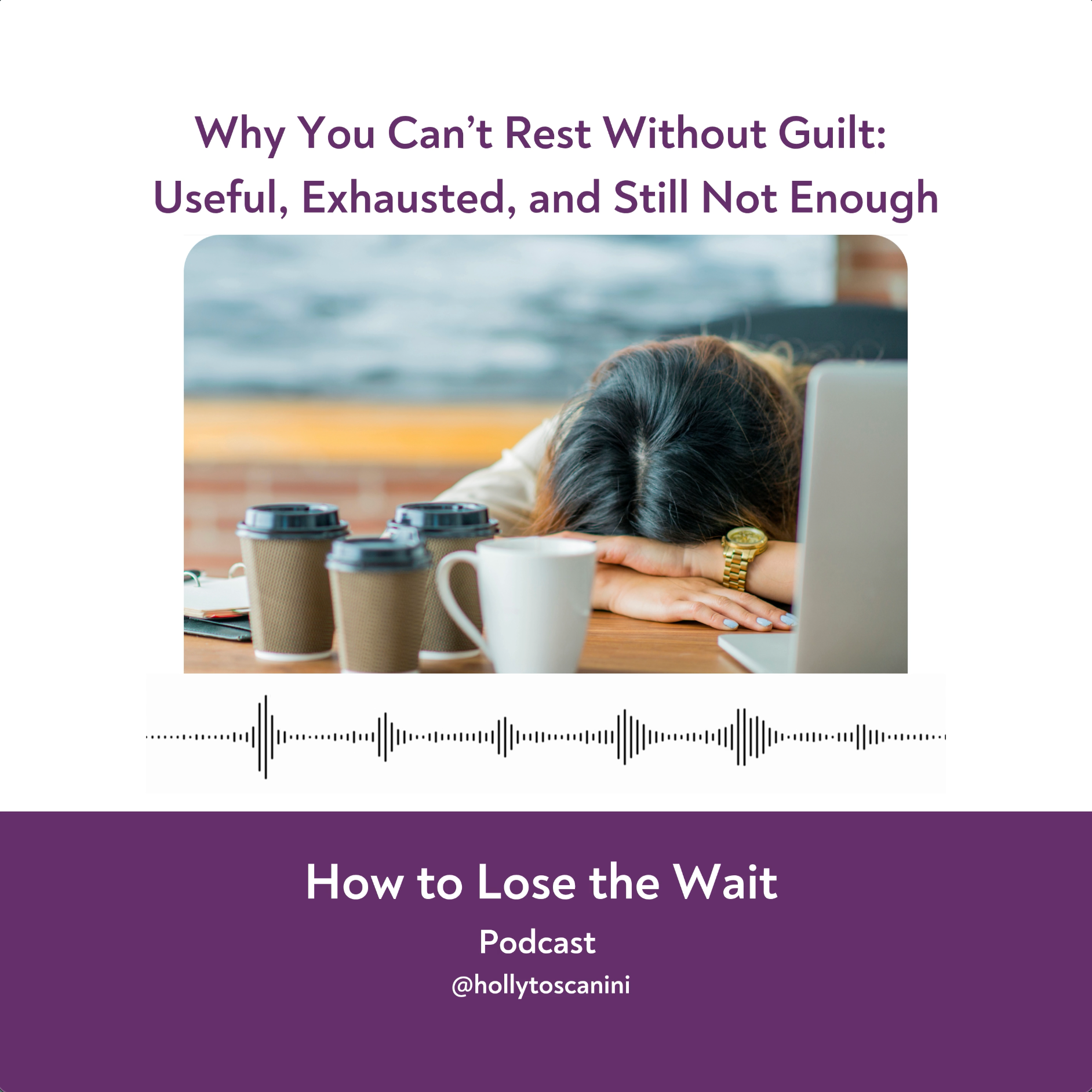
117. Why You Can’t Rest Without Guilt: Useful, Exhausted, and Still Not Enough
About this episode
You weren’t born believing you had to earn rest. You were trained to measure your worth by how useful you could be. Here’s how to name that condition.
Download your copy of Activate Your Intuition eBook
You were not born believing you had to earn rest.
That belief was taught.
It arrived through thousands of small, consistent signals: praise for the child who helped without being asked, warmth for the girl who stayed busy and never complained, approval for the woman who kept going long after anyone else would have stopped.
By the time most women reach midlife, this belief no longer feels like conditioning. It feels like personality. It feels like just who they are.
But here’s what it actually sounds like when it’s running:
“I’ll rest when everything is done.” “I’ll slow down when things calm down.” “I’ll choose myself when everyone else is okay.” “I’ll matter when I’ve handled enough.”
Every one of those sentences is a condition placed on your own life. A condition that sounds responsible. A condition that, by design, can never fully be met.
In this episode — week two of the Attune phase of the W.A.I.T. Framework series — Holly Toscanini names how the guilt-around-rest pattern develops, how it becomes a waiting cycle, and what it looks like to begin removing the condition underneath it.
This episode is not about doing less. It’s about something more specific: the belief that your worth is contingent on your usefulness, and the particular brand of waiting that belief creates.
In this episode, Holly covers:
- How the belief that usefulness equals worth gets established — and why it’s so hard to recognize as conditioning rather than character
- The five W.A.I.T. sentences that reveal how this pattern becomes a waiting cycle
- The real fear underneath the productivity trap: if I’m not doing, who am I?
- Why high-achieving women hit a wall when the output no longer delivers the feeling of being enough
- How to name the condition out loud and make it examinable
- How to use Three Micro Desires as a daily practice in receiving without earning
Download the Activate Your Intuition eBook — a practical resource for hearing your own signal beneath the noise of constant productivity.
Next week: Episode 118 — Why You Keep Getting Ready But Never Start: The Perfectionism Trap
https://holly-toscanini-f50a.mykajabi.com/opt-in
can’t rest without guilt, guilt when resting, worth tied to productivity, measuring worth by usefulness, exhausted and still not enough, high-achieving women burnout, rest feels like failure, women over 40 self-worth, productivity and identity, conditional self-worth, W.A.I.T. framework, unwaiting method, I’ll rest when everything is done, earning rest, self-trust women
Music from #Uppbeat (free for Creators!):
https://uppbeat.io/t/mood-maze/trendsetter
License code: VGZ66UBEGXBP8YK8
Holly Toscanini: Think back to when you were a little girl. Before school, before schedules, before the concept of a to-do list entered your life. You rested without permission. You sat the sun, you daydreamed, you stopped when you were tired, you ate when you were hungry, and you played until you were done. You didn't calculate if you'd earned it or not. You weren't born believing you had to earn rest. That belief came later. It was taught. And it was taught so consistently through so many different channels that by the time women reach adulthood, they can't sit still without a low level of guilt sort of humming underneath it. They can't stop moving without the nagging sense that they're falling behind. They can't choose themselves first without making sure everybody else has been handled. Today, we're gonna name exactly how that happens and more specifically, how it becomes a waiting pattern. Because I'll rest when everything is done. It's not a time management problem. It's a condition you've placed on your own life. And conditions, once you name them, can be removed. Welcome back to How to Lose the WAIT I'm Holly Toscanini, and this is week two of the Attune phase of the WAIT Framework series. ⁓ Now, if you remember, last week we talked about signals versus spirals, learning tell your inner wisdom. from your anxiety. And this week we're looking at one of the most reliable ways that signal gets drowned out, the constant self-renewing pressure to be useful. Now I wanna be clear about what this episode is and isn't. This is not an episode about doing less. That's too generic and honestly not really the point. The women I work with are not doing too much because they're poorly organized. They're doing too much because they were trained to measure their worth by how much they could be needed. Those are very different problems. The condition this episode names is one of the most embedded in the entire waiting cycle. I'll be worthy when I've done enough. I'll rest when everything is done. It's okay to choose myself, but only after everybody else is taken care of. Now that's not a productivity problem. That's a worth problem. And today we're gonna learn more about this and connect it back to the weight pattern so you can start to see it clearly in your own life. Let's start with the origin because women often carry this belief as though it's some sort of character trait. Like they're simply a certain kind of person, driven, high achieving, someone who doesn't know how to turn it off, right? And some of that framing is even flattering, which is part of what makes this so sticky because you weren't born this way, you were trained to be this way. And that training started early and it was rarely explicit. mean, nobody sat you down and said you're worth this contingent on your usefulness, but we got the message anyway through thousands of small, very consistent signals. The child who helped without being asked got praise. The one who finished early, worked hard, stayed busy, and never complained about being tired, she got warmth. She got seen. She got the particular safety of being valued. And the connection got established at a very fundamental level too, because being useful is now somehow how I matter. Doing is how I belong. For girls especially, this conditioning runs through multiple channels simultaneously. There's the academic channel, grades reward output directly and consistently. There's the domestic channel, girls are disproportionately socialized to help, to pitch in, to be the ones who notice what needs to be done and do it without asking or being asked, right? There's a relational channel, being agreeable, available and low maintenance always gets rewarded with approval and belonging. And there's the cultural channel that runs underneath all of it. That particular message sent to women that their bodies, their time, and their energy are fundamentally in service of others. That to be a good woman is to be a useful one. That needing things, wanting rest, claiming space for yourself, these are inconveniences at best and selfishness at worst. So by the time most women reach their 30s and 40s, they have been running this program for so long that it no longer feels like conditioning. It just feels like a personality. Feels like who you are. And here is the particularly cruel piece. The women who are most thoroughly trained in the belief are often the most capable, competent, impressive, by external measures at least. They got rewarded precisely because they internalized this lesson so well. The productivity became evidence of their worth. So they kept producing and the bar kept moving and the rest kept being deferred. I mean, you weren't born believing you had to earn rest. That belief has a history and histories, unlike character traits, can be examined and changed. So here's where I want to connect this to the larger work we've been doing in this series, because the guilt around rest, that pattern is not just a productivity issue. Listen to what it actually sounds like. You've probably said these things to yourself. I'll rest when everything is done. I'll slow down when things calm down. I'll choose myself and my needs when I know everybody else is okay. I'll stop when I've earned the rest. Every single one of those sentences is a condition placed on your own life, a condition that might sound responsible, a condition that sounds like maturity and care and good priorities, and a condition that by design can never be fully met. Everything is never done. Things never fully calm down. There's always someone who could use more from you. Earned is a moving target and it's handled through friction, so the rest gets put off indefinitely. Not because you're lazy or undisciplined, you are clearly neither of those things. But because you have attached your permission to rest to a condition that your life is structurally designed to never deliver. This is the waiting cycle wearing the face of responsibility. And it's hard to catch because It looks so responsible from the outside and feels so virtuous from the inside. Now there's another layer here that I want to name because it shows up consistently with the women I work with. It's not just that rest gets deferred. It's that rest starts to feel dangerous. Maybe not physically dangerous, but emotionally dangerous. Because for a woman whose worth is tied to her usefulness, stopping creates a question she's not sure she wants answered. If I'm not constantly doing, Who am I? If the doing is how you matter, then the not doing threatens that whole structure so you don't stop. Not because there's always something urgent, but because stopping would require sitting with the possibility that your worth exists independently of your output. And that is a genuinely terrifying thing to test if you've never had evidence that it's true. Now, this is also not coincidentally why so many high achieving women hit a wall in midlife. Not because they've run out of things to do, but because the doing no longer delivers what it used to. The accomplishments come, the productivity continues, and the feeling of being enough still never shows up because it was never gonna get there through your output. It was only ever gonna come from somewhere else, from deciding, from choosing, from the kind of honest self-reconing that requires you to stop long enough to actually feel what's there. And I wanna be honest with you about something before we get to this practical piece. Removing the belief that you have to earn your worth through usefulness is not a weekend project. This is not a mindset shift you make once and then you're done. It's a practice. It's something you have to keep coming back to again and again. It's a thing you choose and then you have to keep choosing, especially in the beginning when that old conditioning is so loud. So what we're doing today is not fixing the whole pattern. We are creating a sliver of daylight between you and the belief, just enough space that you can begin to question it rather than just live inside of it. So here's the first thing I want you to try. The next time you feel the guilt of resting, that hum underneath the stillness, the pull back towards doing, I want you to name the condition out loud, even if it's just to yourself. I'll rest when everything is done. I'll matter when I've handled enough. I'll choose myself when I know everybody else is okay. Whatever version is running for you, say it out loud, write it down if that helps. Because there is something that happens when you separate that belief from the automatic background noise and bring it into your conscious awareness. It now becomes something you can examine. And once you can examine it, you can ask the questions that change everything. You can ask, is this actually true? And is everything ever done? Does everyone ever reach a state of being fully okay? Will this condition I put on myself in my life ever actually be met? For most women, the honest answer is no. And that no is really the beginning of something special. Now, the second thing I want you to try is what I call receiving without earning. Now, this is a direct application of the three micro desires practice, but with a specific focus. Once a day, give yourself something with no productive justification attached to it. Not, I'll rest because it will make me more productive. Not, I'll take a walk because exercise is good for me. Something purely because you want it, because you are a person who was allowed to have things she wants. It's possibly gonna feel a little uncomfortable, but that discomfort is not evidence that you're doing something wrong. It's simply evidence of exactly how deep that conditioning runs. The discomfort is the belief defending itself. Stay with the feeling anyway. 10 minutes, that's all. Receive something without earning it and let the guilt be there without acting on it. Notice it and name it. This is the training, not the truth. And stay into your rest. Every time you do this, you're gonna build a small piece of evidence that your worth existed before your output, that you were allowed to be here before you ever did anything to earn it. and that rest was never something you needed to earn, that evidence starts to build and accumulate. That doesn't happen in one session, but it does build over time. And eventually, the signal that says you're enough right now as you are without doing one more thing starts to get louder than the training. And that's what we're building toward. Not doing less, knowing more, knowing that you were enough before the doing ever began. Here's the lesson for today. You were not born believing you had to earn rest. You were not born measuring your worth by how useful you are or how useful you could be. Those beliefs were installed carefully, consistently, and with a great deal of positive reinforcement because they served a system that benefited from your endless availability. You get to question that now, not by doing less, but by asking what conditions have I placed on my own worth? What am I waiting to finish? before I'm allowed to stop. And who told me that was the deal? Your practice this week is two things. First, name the condition. The next time you feel guilty for resting, stopping, or choosing yourself, find the specific sentence that's running in your brain underneath it and say it out loud. Write it down if you have to, make it visible. Then ask yourself if it's actually true. Second, receive something without earning it. Once today, once tomorrow, When's the day after that? Something small, something that needs no justification beyond the fact that you want it. You're going to feel that wobble come. That's okay. Just name it and resist the urge to judge what you're feeling because you, my friend, are not a to-do list. You are not your output and your worth was never contingent on your usefulness from the beginning, even if it took this long to say it out loud. Now, if you want support in rebuilding the habit of hearing your inner wisdom, your intuition beneath the noise of constant productivity, the Activate Your Intuition ebook is the resource you need today. The link is in the show notes and in the description below the video. Next week, we move into the I phase of the WAIT weight framework, initiate the micro pivot. We've just spent two weeks of attuning to our intuition and learning to hear ourselves. Now we're going to start moving. Episode 118 is called, Why You Keep Getting Ready, But Never Start, The Perfectionism Trap. And it's about the specific way that smart women use the pursuit of perfection as a reason never to begin. Not because they have high standards, because beginning requires being seen. And being seen before you're certain is one of the most vulnerable things a person can do. So if you've ever kept something in permanent preparation mode because it wasn't ready yet or perfect yet, this one is for you. I'll see you then. Until next time, bye for now.
 Apple Podcasts
 Spotify
 Castbox
 Castro
 Goodpods
 Moon FM
 Overcast
 Pocket Casts
 Podbean
 Podcast Addict
 Podcast Republic